

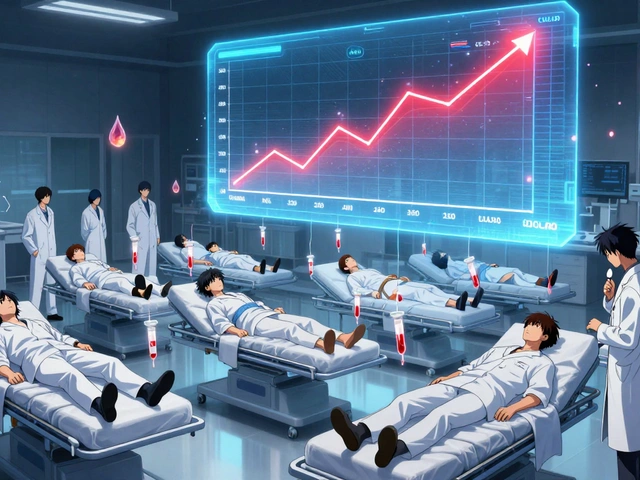
When a brand-name drug loses its patent, everything changes. The price doesn’t just drop-it collapses. Within months, the same pill that cost $200 a month suddenly sells for $10. And suddenly, the company that spent billions developing it sees its revenue shrink by 80% or more. This isn’t speculation. It’s what happened to AbbVie when Humira lost patent protection in 2023. That single drug brought in over $20 billion a year. After generics hit the market, sales plunged. That’s the patent cliff-and it’s the biggest financial threat brand manufacturers face.
Why Generics Cost So Much Less
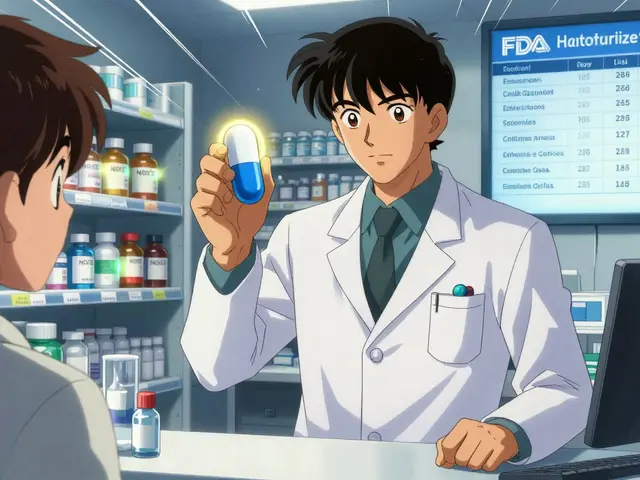
Generic drugs aren’t cheaper because they’re lower quality. They’re cheaper because they don’t need to repeat the billion-dollar clinical trials that brand manufacturers ran to get FDA approval. The Hatch-Waxman Act of 1984 made this possible. It allowed generic companies to prove their drugs are the same as the brand version by showing bioequivalence-meaning they work the same way in the body. No need to prove safety again. No need to retest dosing. Just show the active ingredient matches, and the FDA approves it. That’s why generics cost 80-85% less. The FDA estimates that generic drugs save Americans $8-10 billion every year just in out-of-pocket costs. The Congressional Budget Office says generic drugs saved the U.S. healthcare system $253 billion in 2014 alone. By 2023, those savings had grown to an estimated $330 billion annually. That’s not a small number. That’s the equivalent of covering health insurance for millions of people for a year.90% of Prescriptions, 20% of Spending
Here’s the shocking part: generics make up about 90% of all prescriptions filled in the U.S. But they account for only about 20% of total drug spending. That means the other 80% of spending is going to brand-name drugs-even though they’re prescribed far less often. Why? Because brand manufacturers still control the most expensive drugs: new cancer treatments, GLP-1 weight-loss drugs like Ozempic, and cutting-edge biologics. These aren’t easy to copy. They’re complex molecules that take years and billions to develop. So while a simple pill like metformin has hundreds of generic makers competing on price, a new injectable biologic might have no competition for a decade. This creates a strange imbalance. Patients are getting most of their meds from generics, but the big profits still come from brands. That’s why brand manufacturers fight so hard to protect their patents. They know if they lose exclusivity, their revenue can vanish overnight.The Tactics Brand Manufacturers Use to Hold On
Brand companies don’t just wait for their patents to expire. They use every trick in the book to delay generics. One common tactic is called “pay for delay.” A brand manufacturer pays a generic company to hold off on launching its version. These deals are legal-but controversial. A 2023 study by the Blue Cross Blue Shield Association found these agreements cost patients $3 billion a year in higher out-of-pocket costs. The Congressional Budget Office estimates ending them would save $45 billion over 10 years. Another tactic is “product hopping.” A brand company makes a tiny change to its drug-maybe a new pill shape, a new delivery system, or a slightly different dose-and then markets it as “improved.” Then they file a new patent. This pushes back generic entry by years. For example, some companies switched from a daily pill to a once-monthly version just before the original patent expired. The FDA calls this “evergreening,” and it’s a major reason why some drugs stay expensive long after they should be generic. Then there’s “patent thickets.” Instead of one patent, brand companies pile on dozens-covering everything from the chemical structure to the manufacturing process to how the pill dissolves. Each one adds another hurdle for generic makers to clear. The CBO estimates that cracking down on patent thickets could save $1.8 billion over 10 years.
Generics Aren’t Always Cheap for Patients
Here’s the twist: even though generics are cheap to make, patients don’t always get the savings. That’s because of pharmacy benefit managers, or PBMs. These middlemen negotiate prices between drug makers and insurers. But their pricing system is opaque. They often set reimbursement rates so low that pharmacies lose money selling generics. Some pharmacists on Reddit say they’ve been forced to pay out of pocket just to fill a prescription because the PBM reimbursement didn’t cover their cost. The Schaeffer Center at USC found that patients often pay 13-20% more for generics than they should because of these hidden markups. A $5 generic might end up costing $6.50 because the PBM takes a cut, the insurer adds a copay, and the pharmacy gets squeezed. Meanwhile, the generic manufacturer is making pennies per pill.How Brand Manufacturers Are Adapting
Some brand companies are learning to live with generics. Instead of fighting them, they’re joining them. One strategy is the “authorized generic.” That’s when the brand company itself launches a generic version of its own drug. For example, when Pfizer’s Lipitor went generic, Pfizer started selling its own generic version. That way, they still capture some of the market instead of losing everything to competitors. Others are shifting focus. Novartis spun off its generics division, Sandoz, into a separate company in 2022. That let Novartis concentrate on innovative drugs while Sandoz handled the low-margin, high-volume generic business. It’s like splitting a business into two: one that bets on breakthroughs, and one that bets on volume. Some companies are moving into complex generics-things like inhalers, injectables, and topical creams. These are harder to copy, so they face less competition. But they also cost more to develop. That’s why their prices don’t drop as fast.
The Supply Chain Is Under Pressure
There’s another hidden cost: drug shortages. As generic prices keep falling, manufacturers are under pressure to cut costs. Some stop making low-margin drugs altogether. Others move production overseas to save money. That’s led to supply chain fragility. The FDA warns that when too many generic makers exit a market, even a small disruption-like a factory inspection failure or a raw material shortage-can cause a nationwide shortage. That’s happened with antibiotics, blood pressure meds, and even basic painkillers. The cheaper the drug, the more likely it is to disappear when profits dip.What’s Next? The $400 Billion Problem
By 2028, an estimated $400 billion in brand drug revenue will be at risk from patent expirations. That’s more than the entire annual budget of the U.S. Department of Education. Companies like Roche, Merck, and Johnson & Johnson are already preparing. Some are investing in gene therapies and personalized medicine-drugs so complex that generics can’t easily copy them. Meanwhile, Congress is pushing for change. Bipartisan bills are being introduced to ban pay-for-delay deals and limit product hopping. The FDA’s Generic Drug User Fee Amendments (GDUFA), reauthorized in 2022 with $1.1 billion in fees through 2027, are speeding up approvals. More generics are coming faster than ever.The Real Winner? Patients-If the System Works
Generics are the most effective cost-saving tool in modern medicine. They’ve made life-saving drugs accessible to millions who couldn’t afford them before. But the system is broken in places. Patients still pay too much. Pharmacists are squeezed. Manufacturers are playing games to protect profits. The solution isn’t to stop generics. It’s to fix the middlemen, crack down on shady patent tactics, and make sure savings actually reach patients. Because right now, the system is designed to save money-but not always for the people who need it most.
Kyle Oksten
December 9, 2025 at 10:28It’s wild how we’ve normalized paying $200 for a pill that costs 50 cents to make. The real crime isn’t the generics-it’s the system that lets middlemen and patent lawyers profit off human suffering. We treat medicine like a luxury good, not a right. And yet, when someone says ‘socialized medicine,’ people lose their minds. Funny how that works.
Sam Mathew Cheriyan
December 11, 2025 at 04:00bro did u know the FDA is controlled by big pharma? they let the same people who made the drug approve the generic?? like wtf?? i heard the CEO of abbvie used to work at the fda and he just ‘retired’ right before humira went generic… conspiracy? or just capitalism?? 🤔
Ernie Blevins
December 13, 2025 at 03:29generics are garbage. i took one for my blood pressure and felt like i was dying. the brand worked fine. they’re not the same. the FDA is just letting cheap junk into the system. people die because they take these knockoffs. it’s not a savings-it’s a gamble.
Nancy Carlsen
December 14, 2025 at 19:42thank you for writing this!! 🙏 it’s so important to see the full picture-not just ‘generics = good’ or ‘brands = evil.’ the real villain is the PBM mess. pharmacies are losing money just trying to help people. we need to fix that. also, if you’ve ever been stuck paying $6.50 for a $5 generic… you’re not alone. 💙
Ted Rosenwasser
December 15, 2025 at 00:48Let’s be clear: the Hatch-Waxman Act was a catastrophic policy failure disguised as consumer protection. Bioequivalence is a statistical fiction. Pharmacokinetic curves don’t account for excipient interactions, patient metabolism variance, or chronic disease comorbidities. You think a generic metformin is identical to Glucophage? Please. The FDA’s approval standards are a joke. And now we’re exporting this broken model globally. Shameful.
Helen Maples
December 15, 2025 at 03:35If you think patent thickets and pay-for-delay are just ‘business tactics,’ you’re not paying attention. These are predatory practices that cost lives. Every delay in generic entry means someone can’t afford insulin. Every product hop means a diabetic skips doses because they can’t afford the ‘new’ version. This isn’t capitalism-it’s extortion. And Congress is asleep at the wheel.
Ashley Farmer
December 15, 2025 at 20:44I work in a community pharmacy and see this every day. An elderly woman comes in for her cholesterol med-$6.50 out of pocket for a generic. She tells me she used to pay $200, but now she’s still struggling. I know the manufacturer makes pennies. I know the PBM takes half. I just wish someone would fix it so the person who needs it gets it. No one wins here.
Kurt Russell
December 16, 2025 at 03:14THIS. THIS IS THE STORY NO ONE TELLS. 🚨 Generics aren’t just cheaper-they’re revolutionary. They turned HIV meds from a death sentence into a daily pill. They let a single mom in Ohio afford her asthma inhaler. They’re why your kid can take ADHD meds without you maxing out your credit card. The system is broken? Fix it. But don’t you DARE take away generics. They’re the last line of defense for millions.
Stacy here
December 17, 2025 at 06:14Here’s the uncomfortable truth: the real threat isn’t generics-it’s the end of innovation. If every drug becomes a commodity overnight, who will spend $2 billion developing a new cancer therapy? The system is rigged, yes-but if we break it too hard, we kill the goose that lays the golden egg. The answer isn’t to destroy patents-it’s to reform them. Create tiered exclusivity: 5 years for simple pills, 12 for biologics, 20 for gene therapies. Let innovation survive while still crushing the low-hanging fruit of generic abuse.