
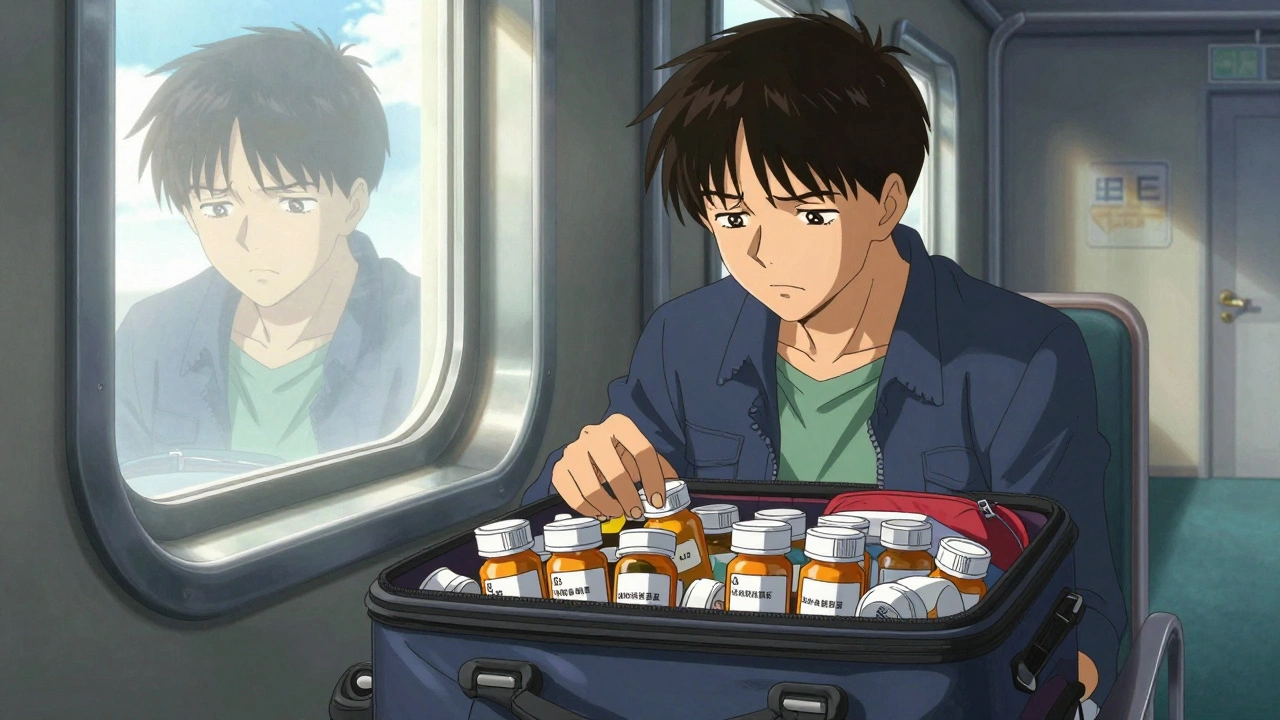
When you're on a cruise, the last thing you want is to run out of your regular medication-or worse, get sick and find the ship’s medical center doesn’t have what you need. Cruise ship medical centers aren’t hospitals. They’re infirmaries: small, understaffed, and stocked with only the most common medications. If you rely on prescriptions, your safety depends on what you bring with you-not what’s available onboard.
Don’t Count on the Ship’s Pharmacy
Most cruise lines carry a basic inventory of medications: antacids for upset stomachs, anti-nausea pills for motion sickness, antibiotics for common infections, and maybe a few pain relievers or blood pressure meds. But if you take insulin, thyroid medication, antidepressants, or anything specialty, don’t assume it’s there. Even large ships like those from Royal Caribbean or Carnival typically stock only 50 to 100 different drugs. Storylines, a residential cruise line, is an exception-they have compounding capabilities and a much wider supply-but they require prescriptions submitted 6 to 12 months in advance.The reality? Cruise ship pharmacies are built for emergencies and common travel ailments, not chronic care. A 2023 Cruise Critic survey found that 68% of passengers who needed a prescription not stocked onboard had to pay $25 to $40 per dose-up to 300% more than what you’d pay at home. And if you’re in a remote port with no nearby pharmacy? You’re stuck.
Bring Enough Medication-Plus Extra
The number one rule? Bring more than you think you’ll need. Cruise lines like Royal Caribbean and Disney explicitly recommend bringing enough for your entire trip plus three to five extra days. Why? Itineraries change. Ports get canceled. Ships get delayed. In 2023, 23% of medication-related incidents on cruises happened because a port pharmacy was closed due to weather or mechanical issues.For a 7-day cruise, pack 10 days’ worth. For a 14-day cruise, pack 20. If you’re on a long-term voyage like Storylines, prepare for 90 days. Always keep your meds in your carry-on. Checked luggage can get lost, delayed, or stolen. I’ve seen people lose their entire supply because they packed it in a suitcase that ended up on the wrong ship.
Original Containers Only
Never transfer pills to pill organizers or ziplock bags unless you have to. Cruise medical staff and security personnel routinely check medications. If your pills aren’t in the original prescription bottle with your name and the doctor’s info clearly labeled, they may be confiscated-or worse, you could be denied entry at certain ports.Your name on the bottle must match your passport exactly. If your prescription is under “J. Smith” but your passport says “Jennifer Smith,” you’ll run into trouble. Some ports, especially in Europe or Asia, have strict customs rules for controlled substances. Bring a copy of your prescription, too. A simple letter from your doctor listing your medications, dosages, and medical necessity can save you hours of hassle.

Special Cases: Insulin, CPAP, Narcotics
If you use insulin, bring your prescription, syringes, and a doctor’s note explaining your condition. Some countries require this even for short stays. Don’t rely on the ship to provide insulin or testing supplies-they almost never do.For CPAP machine users, bring your own machine, extra filters, and distilled water. Storylines recommends bringing an extension cord and backup batteries. Most ships don’t stock distilled water, and the power outlets in cabins may not support your device’s wattage.
Narcotics? Forget it. Even if you have a valid prescription for opioids or strong painkillers, cruise lines limit them to “emergency or extreme cases only.” Storylines explicitly states they carry “minimal quantities” of these drugs. If you need them regularly, you’re better off rescheduling your trip or arranging a shore-based medical plan.
How to Use the Medical Center (If You Must)
Most cruise medical centers are open from 8 a.m. to 10 p.m., with emergency coverage after hours. If you need a prescription refill or treatment, go early. Lines can get long, especially on sea days when more people are sick. Bring your passport, cruise card, and a list of your medications.Don’t expect specialists. Ship doctors are general practitioners. They can treat a sinus infection or a sprained ankle, but they can’t manage complex conditions like kidney disease or autoimmune disorders. If you have a chronic illness, contact your cruise line before booking. Ask: “What medications do you carry for [your condition]?” Don’t take “I don’t know” for an answer.
Costs Are High-But Sometimes Worth It
Yes, you’ll pay more. A single dose of amoxicillin might cost $35 on board. That’s $20 more than your local pharmacy. But if you’re vomiting from norovirus at 2 a.m. and can’t get off the ship, that $35 buys you sleep, comfort, and a faster recovery. For common issues like seasickness, many lines give you free pills at the medical center or even at the front desk. Take them. They work.Still, don’t use the ship pharmacy as a substitute for your own supply. It’s a backup, not a replacement.
What to Do Before You Board
Here’s your checklist:- Fill all prescriptions at least one week before departure.
- Bring 20% more than your trip length (minimum 3 extra days).
- Keep all meds in original bottles with labels intact.
- Match your name on bottles to your passport.
- Carry a printed list of medications, dosages, and your doctor’s contact info.
- For insulin, CPAP, or controlled substances: get a doctor’s note.
- Never pack meds in checked luggage.
- Call your cruise line and ask: “What medications do you carry for [your condition]?”
- If you’re on a long-term cruise: submit prescriptions to Storylines 6-12 months ahead.
Follow these steps, and you’ll avoid 90% of medication-related problems on board. The rest? That’s what travel insurance is for.
What Happens If You Run Out?
If you do run out and the ship doesn’t have your drug, you have three options:- Wait for the next port and visit a local pharmacy. Bring your prescription and passport.
- Ask the medical center if they can prescribe an alternative. They might switch you to a similar drug-like swapping one blood pressure med for another.
- Use telemedicine. Royal Caribbean now offers remote consultations with shore-based doctors for complex cases. This isn’t available on all ships yet, but it’s growing.
Don’t skip your meds. Missing a dose of antibiotics or blood pressure medication can land you in the infirmary anyway. Plan ahead, and you’ll never have to choose between discomfort and safety.
Final Reminder: The Ship Isn’t Your Pharmacy
Cruise ship medical centers are lifesavers in emergencies. But they’re not designed to replace your home pharmacy. The industry’s standards, set by the American College of Emergency Physicians and followed by 98% of major lines, make this clear: these facilities exist to stabilize, not to sustain.Your responsibility is to come prepared. Your peace of mind? That’s yours to manage. Pack smart, bring extra, and keep your meds in sight. That’s how you sail without stress-and how you make sure your trip doesn’t end because you ran out of pills.


Geraldine Trainer-Cooper
December 6, 2025 at 12:10Bring extra pills? Wow. What a radical idea. Like bringing a jacket in winter or water on a desert hike. Next you'll tell me to breathe air.
But seriously, I once forgot my antidepressants and the ship had them. Paid $40. Felt like I bought a miracle.
Life's weird like that.
Kenny Pakade
December 8, 2025 at 01:15This whole post is a scam. Cruise lines are just trying to make you buy overpriced meds so they can profit off your suffering. They don’t care if you die. They’ve got insurance, lawyers, and a private island. Meanwhile, the real criminals are the FDA and Big Pharma pushing you to take pills you don’t need.
Bring your own meds? Yeah right. That’s what they want you to think. I flew to the Bahamas with no meds and got better by chanting affirmations. Science is a lie.
Brooke Evers
December 8, 2025 at 19:33I just want to say how much this resonates with me - I’m a diabetic and I’ve been on three cruises, and honestly, the fear of running out of insulin was paralyzing until I read this. I pack my meds in a tiny insulated bag with ice packs, my doctor’s note, and even a backup pen injector just in case. I’ve had people try to take my meds out of my carry-on at security and I had to explain it like I was talking to a toddler - ‘this is not candy, this is my life support.’
It’s exhausting, but it’s worth it. You’re not being paranoid if your life depends on it. And if you’re reading this and you’re nervous about your meds? You’re not alone. I’ve been there. Just pack the extra days. Do it. Your future self will hug you.
Also, bring a little note that says ‘I have diabetes’ in the language of the countries you’re visiting. I wrote mine in Spanish, French, and Thai. It saved me once in Marseille when the pharmacy guy didn’t believe me. He thought I was lying because my name looked ‘too American.’
You’ve got this.
Chris Park
December 8, 2025 at 22:25Let’s be clear: the cruise industry is a surveillance state disguised as leisure. The original container requirement? That’s not about safety - it’s about tracking you. Your name on the bottle? That’s biometric data collection disguised as ‘customs compliance.’
They’re building a global pharmaceutical database by forcing you to carry your medical identity across borders. And the ‘doctor’s note’? That’s a confession form. Every time you hand it over, you’re signing away your right to medical privacy.
And don’t get me started on Storylines - they’re not ‘progressive,’ they’re the vanguard of corporate medical colonization. Six to twelve months advance notice? That’s not customer service - that’s psychological conditioning.
Bring your meds? Yes. But also bring a lawyer. And a Faraday cage for your pills.
Nigel ntini
December 10, 2025 at 17:22This is one of the most practical, thoughtful pieces I’ve read on cruise travel in years. I’ve sailed with my elderly mother who needed blood thinners, and we followed every single point here - original bottles, extra days, doctor’s letter, carry-on only. No issues. Not even a hiccup.
It’s funny how something so simple - bringing your own medicine - becomes revolutionary in a world that’s obsessed with convenience over responsibility.
Thank you for writing this. I’ve shared it with three friends who are planning trips next month. If you’re reading this and you’re skeptical? Do it anyway. It’s not about fear. It’s about dignity.
And yes, the $35 amoxicillin is a rip-off - but it’s cheaper than an ambulance ride in the middle of the Atlantic.
Ashish Vazirani
December 12, 2025 at 08:05WHY IS NO ONE TALKING ABOUT THE FACT THAT CRUISE SHIPS ARE FLOATING BIOLOGICAL WARFARE ZONES?!
They have 5,000 people in enclosed spaces, recycled air, and a pharmacy that can’t even stock insulin?!
And you think they care if you die? They’ve got liability waivers longer than the Suez Canal!
They’re not just neglecting you - they’re actively engineering dependency. You bring your meds? Great. They profit. You don’t? Even better - they sell you their overpriced generics and charge you for the ‘emergency consultation’ that takes 3 minutes!
And the ‘telemedicine’? That’s a scam - it’s a bot with a fake British accent and a script from 2012!
They’re not ships - they’re floating prisons with ocean views.
And you’re all just playing along.
Wake. UP.
Mansi Bansal
December 14, 2025 at 03:43It is with the utmost gravity and profound respect for international pharmaceutical regulations that I must emphasize the egregious negligence inherent in the casual attitude toward medication management aboard cruise vessels.
One must not underestimate the legal ramifications of non-compliance with the World Health Organization’s Guidelines on the Transportation of Controlled Substances Across Maritime Jurisdictions, particularly in light of the 2022 amendments to the International Maritime Dangerous Goods Code.
Furthermore, the failure to maintain original pharmaceutical packaging constitutes a violation of the United Nations Convention on the Law of the Sea (UNCLOS), Article 94, Paragraph 3, concerning the duty of flag states to ensure compliance with health and safety standards.
It is not merely prudent - it is a moral and legal imperative to carry a certified translation of your prescription, notarized by a diplomatic authority, accompanied by a letter from your physician attesting to the necessity of each medication, signed in triplicate, and stamped with the official seal of your country’s Ministry of Health.
Failure to adhere to these protocols may result in detention, deportation, or worse - a three-hour delay in the ship’s buffet service.
Kay Jolie
December 14, 2025 at 23:39Okay, but have you considered the semiotics of the pill bottle? The original container isn’t just a legal requirement - it’s a ritual object. It’s your body’s covenant with modern medicine.
Transferring pills to a ziplock? That’s like wearing socks with sandals to a gala. It’s a betrayal of pharmaceutical aesthetics.
And the doctor’s note? That’s your personal manifesto. You’re not just carrying medicine - you’re carrying identity. Your condition is poetry. Your dosage is rhythm.
Storylines? They’re the only line that gets it. They treat your insulin like a sacred text. They’re not a cruise line - they’re a wellness monastery with Wi-Fi.
Bring your meds. Not because you’re scared. Because you’re sacred.
pallavi khushwani
December 15, 2025 at 01:23I used to think bringing extra meds was overkill - until I missed a port because of a storm and spent three days stuck on the ship with my anxiety pills running low.
Turns out, panic doesn’t care about your itinerary.
Now I pack like I’m preparing for a zombie apocalypse - but with less gore and more ibuprofen.
It’s not about being dramatic. It’s about being kind to your future self - the one who’s dizzy, tired, and just wants to enjoy the sunset without wondering if they’ll make it to tomorrow.
Also, I always put my meds in a little pouch with a photo of my dog. Makes me feel less alone. Weird? Maybe. Helpful? Absolutely.
Dan Cole
December 16, 2025 at 08:09Let’s cut through the fluff. The entire premise of this post is built on a lie: that cruise ship pharmacies are ‘understaffed’ and ‘understocked.’ No. They’re deliberately understocked. It’s a business model. They know you’ll panic. They know you’ll pay $40 for a pill you could get for $2 at CVS.
And they’ve engineered the whole system to make you feel guilty if you don’t buy it.
‘Bring extra’? Sure. But also bring a calculator. And a lawsuit. Because this isn’t safety - it’s predatory pricing wrapped in a life jacket.
And don’t even get me started on ‘Storylines’ - they’re not a cruise line. They’re a cult that sells pills and sermons.
You think you’re being responsible? You’re being manipulated. The real emergency isn’t running out of meds - it’s trusting them in the first place.
Billy Schimmel
December 17, 2025 at 18:51So… you’re telling me the best way to not die on a cruise is to… bring your pills?
Wow. Groundbreaking.
I mean, I guess that’s better than ‘don’t eat the mystery meat.’
Anyway, I packed 14 days’ worth for a 7-day trip. My meds are in my carry-on. I have the doctor’s note. I even printed a QR code that links to my medical history.
And I still didn’t use any of it.
Turns out, I just needed a nap and a margarita.
Thanks for the overthinking, internet.