
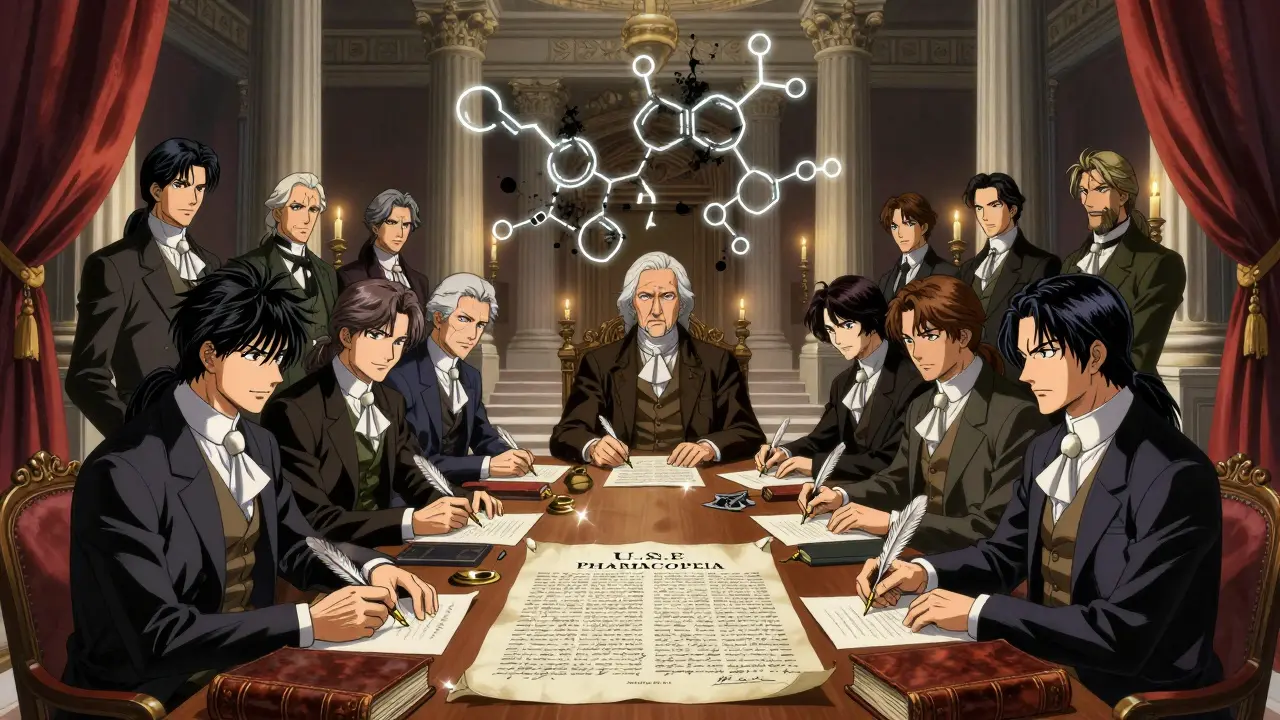
By 2022, generic drugs filled 90.5% of all prescriptions in the United States. Yet most people don’t know how they got here. It wasn’t luck. It wasn’t just cheaper prices. It was a 200-year battle over safety, patents, profit, and public health - and it changed how every American buys medicine.
The First Steps: Standardizing Medicine in the 1800s
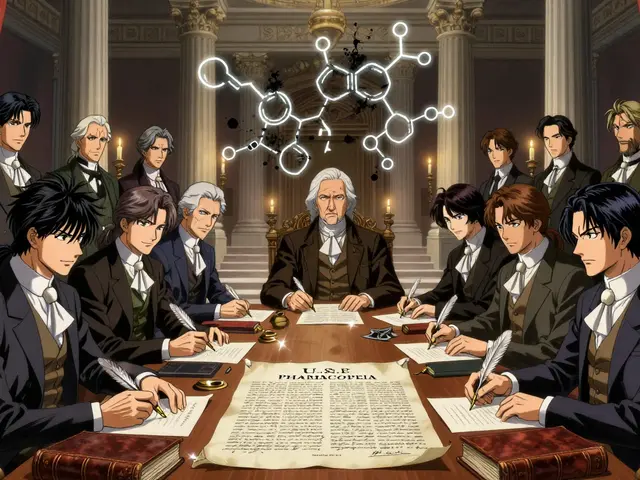
Before there were generic drugs, there weren’t even real standards for drugs at all. In 1820, eleven doctors met in Washington, D.C., and created the first U.S. Pharmacopeia. They listed ingredients, strengths, and how to make common medicines. This was the first time the U.S. tried to stop pharmacies from selling fake or weak drugs. Back then, a bottle labeled "quinine" might contain chalk, sawdust, or worse. The Pharmacopeia didn’t make drugs safe overnight, but it gave pharmacists a reference. By 1888, the American Pharmaceutical Association added the National Formulary - another list of approved formulas - to fight counterfeit medicines flooding the market.Deadly Mistakes and the Birth of the FDA
In 1906, President Theodore Roosevelt signed the Federal Food and Drugs Act. It didn’t ban dangerous drugs. It just made companies label what was inside. No more hiding poison in "tonics" or selling snake oil as a cure. But it still didn’t require proof that drugs worked. That changed after 1937. That year, a drug company mixed a deadly industrial solvent - diethylene glycol - into a liquid antibiotic called Elixir Sulfanilamide. It killed 107 people, mostly children. Public outrage forced Congress to act. In 1938, they passed the Federal Food, Drug, and Cosmetic Act. For the first time, drug makers had to prove their products were safe before selling them. The FDA got real power. This was the foundation of modern drug safety.Prescription Rules and the Efficacy Gap
In 1951, the Durham-Humphrey Amendment split drugs into two categories: prescription and over-the-counter. That made sense - some drugs were too risky to buy without a doctor’s oversight. But here’s the problem: drugs already on the market between 1938 and 1962 didn’t have to prove they worked. They only had to be safe. So thousands of drugs were still being sold with no proof they actually helped patients. That changed in 1962, after the thalidomide tragedy in Europe. Though thalidomide wasn’t approved in the U.S., the scare pushed Congress to pass the Kefauver-Harris Drug Amendments. Now, every drug - new or old - had to prove both safety and effectiveness. The FDA started reviewing all drugs approved before 1962. Many were pulled off the market. But here’s what no one talked about: the law didn’t say anything about generics. Brand-name companies still held all the data. Generic makers couldn’t copy those drugs without doing expensive clinical trials. So they didn’t try.
The Turning Point: The Hatch-Waxman Act of 1984
By the early 1980s, generic drugs made up just 19% of prescriptions. Why? Because it was too hard and too expensive to get them approved. Then came the Hatch-Waxman Act. Officially called the Drug Price Competition and Patent Term Restoration Act, it was a deal: brand-name companies got extended patents to make up for time lost during FDA review. In return, generic companies got a shortcut. The shortcut? The Abbreviated New Drug Application (ANDA). Instead of running new clinical trials, generic makers only had to prove their drug was bioequivalent - meaning it released the same amount of active ingredient into the bloodstream at the same rate as the brand-name version. No need to prove safety again. No need to prove effectiveness again. Just prove it worked the same way. This was revolutionary. Generic manufacturers could now enter the market fast and cheap. And they did. By 1990, generics were in 35% of prescriptions. By 2000, it was 50%. Today? Over 90%.How Generics Saved Billions - and Why Prices Still Spike
In 2021, generic drugs saved the U.S. healthcare system $373 billion. Over the last decade, total savings exceeded $3.7 trillion. The Congressional Budget Office found generics cut drug costs by 80-85% compared to brand names. A bottle of generic lisinopril costs $4. A brand-name version? $80. That’s not a coincidence. It’s competition. But here’s the catch: not all generics are cheap. Between 2013 and 2017, prices for 15% of generic drugs jumped more than 100%. Why? Because when only one or two companies make a drug, there’s no competition. Take the antibiotic doxycycline. In 2013, it cost $20 for a 30-day supply. By 2014, it jumped to $1,850. Why? Because the other manufacturers had left the market. Only one company was left. They raised the price - and the FDA couldn’t stop them. These spikes happen in drugs with low profit margins - old, off-patent pills that don’t make much money. Companies stop making them. Then, when demand spikes, the few remaining makers raise prices. It’s not fraud. It’s market failure.The Quality Crisis and Supply Chain Risks
Between 2018 and 2022, the FDA recorded 1,234 drug shortages. Sixty-five percent of them involved generic drugs. Why? Because most of the active ingredients - the actual medicine - come from factories in China and India. Eighty percent of API (active pharmaceutical ingredient) facilities are overseas. The U.S. doesn’t make much of its own medicine anymore. When a factory in India gets shut down for safety violations - and they’ve been shut down many times - it can cause nationwide shortages. In 2018, a single plant in Puerto Rico failed inspection, causing a shortage of injectable epinephrine - the drug used in emergency allergic reactions. Hospitals scrambled. Patients waited. The FDA inspects foreign facilities, but they can’t be everywhere. And when a plant fails, it doesn’t mean the drugs are dangerous. It means they don’t meet U.S. standards for cleanliness or quality control. Still, the public hears "FDA recall" and thinks the medicine is toxic. Most of the time, it’s not. It’s just not made to the right standard.
Modern Battles: Blocking Generics and Closing Loopholes
The Hatch-Waxman Act had a flaw: brand-name companies could sue generic makers to delay their entry. Every lawsuit triggered a 30-month automatic stay. Some companies filed dozens of lawsuits - not because they had a real patent claim, but just to stall. This became known as "pay-for-delay" or "evergreening." In 2019, Congress passed the CREATES Act. It made it illegal for brand-name companies to block generic makers from getting samples of their drug - a tactic used to delay approval. As of 2022, the FDA had taken 27 enforcement actions under this law. The Generic Drug User Fee Amendments (GDUFA), launched in 2012, also helped. Before GDUFA, it took 30 months to approve a generic application. Now? It takes 10 months. Approval rates jumped from 45% to 95%. More generics. Faster. Cheaper.What’s Next? Biosimilars and the Future of Generics
The next frontier isn’t pills anymore. It’s biologics - complex drugs made from living cells. Think Humira, Enbrel, or insulin. These drugs cost tens of thousands of dollars a year. They’re not easy to copy. But they can be mimicked. Biosimilars are the generic version of biologics. The FDA approved its first biosimilar in 2015. Since then, more have come. But adoption is slow. Doctors are cautious. Patients are wary. Prices haven’t dropped like they did with pills. Still, the trend is clear: competition drives down cost. The same model that made aspirin and metformin affordable will eventually work for cancer drugs and autoimmune treatments. The question isn’t if - it’s when.Why This Matters to You
You might think generics are just cheaper versions of the same thing. They are. But that simplicity hides a massive system - built on science, law, and political compromise - that keeps millions of Americans alive at a price they can afford. Without generics, insulin would cost $1,000 a month. Blood pressure pills would be unaffordable. Cancer drugs? Out of reach. The next time you pick up a generic prescription, remember: you’re not just saving money. You’re using a tool that was fought for over 200 years - and still needs defending.Are generic drugs as safe as brand-name drugs?
Yes. The FDA requires generic drugs to have the same active ingredient, strength, dosage form, and route of administration as the brand-name version. They must also meet the same strict standards for purity, potency, and quality. Generic drugs are tested for bioequivalence - meaning they work the same way in the body. The FDA inspects manufacturing facilities for both brand and generic drugs using the same standards.
Why are some generic drugs more expensive than others?
When only one or two companies make a generic drug, there’s little competition. That can lead to price spikes. For example, if a drug has low profit margins, manufacturers may stop making it. When demand rises and supply drops, the few remaining makers can raise prices. This often happens with older, low-cost drugs like doxycycline or nitrofurantoin. It’s not about quality - it’s about market dynamics.
Do generic drugs take longer to work than brand-name drugs?
No. Generic drugs are required to be bioequivalent, meaning they enter the bloodstream at the same rate and to the same extent as the brand-name version. There’s no delay in how quickly they start working. Any difference in how you feel is likely due to inactive ingredients - like fillers or dyes - which don’t affect the medicine’s performance.
Why do generic drugs look different from brand-name drugs?
By law, generic drugs can’t look identical to brand-name drugs because of trademark rules. That means color, shape, or size may differ. But the active ingredient - the part that treats your condition - is exactly the same. The differences are only in inactive ingredients like coatings or dyes, which don’t affect how the drug works.
Are most generic drugs made in the U.S.?
No. About 80% of the active pharmaceutical ingredients (APIs) used in U.S. generic drugs come from facilities outside the country, mostly in China and India. The finished pills may be packaged in the U.S., but the key medicine inside is often imported. The FDA inspects these foreign factories, but supply chain issues abroad can still lead to drug shortages.
Can I trust generic drugs from big pharmacy chains?
Yes. Whether you get your generic drug from CVS, Walgreens, or a small pharmacy, it’s the same product. Pharmacy chains buy from the same wholesalers and manufacturers. The FDA ensures all approved generics meet the same standards, no matter who sells them. The only difference might be the label or packaging - not the medicine inside.
Michael Burgess
January 4, 2026 at 03:05Just picked up my generic lisinopril for $3 at CVS today. Seriously, who knew we were living in a miracle? My grandpa used to pay $80 for that same pill in the 90s. This whole system? Hard-fought. Hard-won. And we take it for granted. Thanks to the people who pushed Hatch-Waxman. 🙌
Tiffany Channell
January 4, 2026 at 10:37Let’s be real-generic drugs are a scam. The FDA doesn’t test them like they test brand names. They just assume bioequivalence. But what if the inactive ingredients cause inflammation? What if your body reacts differently? We’re guinea pigs for corporate cost-cutting.
Joy F
January 5, 2026 at 04:02There’s a philosophical irony here: we’ve democratized medicine by commodifying it. Generics aren’t just cheaper-they’re a societal contract. The moment we stop valuing access over purity, we regress to the 1820s. The Pharmacopeia was a moral document. Today’s ANDA is a bureaucratic one. But it works. And that’s the tragedy and triumph wrapped in one pill.
And don’t even get me started on the supply chain. We outsource the soul of medicine to factories in Guangdong and Hyderabad. We treat life-saving molecules like widgets. This isn’t capitalism-it’s biopolitical nihilism.
Meanwhile, people are dying because a single plant in Puerto Rico failed an inspection. And we blame the FDA? No. We blame the system that outsourced its conscience.
Every time you swallow a generic, you’re participating in a 200-year experiment in public health equity. Most don’t even know they’re holding history in their hands.
And yet, the same people who scream about ‘big pharma’ are the first to bitch when their $4 generic suddenly costs $40 because the only manufacturer left decided to ‘optimize margins.’
It’s not greed. It’s structural collapse disguised as capitalism. And we built it.
Haley Parizo
January 6, 2026 at 05:04You think this is about medicine? No. It’s about power. The FDA, Congress, Big Pharma-they all play the same game. They let generics in only when it suits them. The real enemy isn’t the price hike-it’s the monopoly that gets to decide who lives and who dies based on quarterly earnings.
And don’t tell me about ‘bioequivalence.’ My cousin had a seizure after switching to a generic anticonvulsant. The label said ‘same active ingredient.’ But the fillers? Different. The release profile? Off by 12%. No one tracks that. No one cares.
We’re not saving money. We’re gambling with lives. And the people who profit? They’re not in India or China. They’re in boardrooms in New Jersey.
Angela Fisher
January 6, 2026 at 09:06EVERY SINGLE GENERIC DRUG IS A BACKDOOR FOR CHINA TO CONTROL OUR HEALTHCARE. 🇨🇳💊 I’ve read the reports. The FDA inspectors are underfunded. They can’t even visit half the factories. And the pills? They’re laced with heavy metals. I know someone who switched to generic metformin and got liver damage. The docs said ‘coincidence.’ COINCIDENCE?! They don’t want you to know this.
And the ‘bioequivalence’ test? It’s a joke. They test on 20 healthy college kids. Not old people with diabetes. Not pregnant women. Just kids on protein shakes.
Why do you think the government pushed Hatch-Waxman? To make us dependent. To make us docile. To make us take pills instead of asking questions. Wake up.
And now they want biosimilars? That’s next-level control. Biologics are the future. And China owns the patents. They’re already making them cheaper. We’re being slowly poisoned by convenience.
Buy brand names. Even if it costs $100. At least you know it’s made in a country that doesn’t dump waste in the Yangtze.
Also-why is the FDA always approving generics from the same 3 companies? Coincidence? Or collusion? 🤔
Tru Vista
January 7, 2026 at 20:30Generic drugs aren’t cheaper because of competition. They’re cheaper because the FDA lets them skip testing. Bioequivalence is a myth. The real savings? From cutting corners on QA.
Vincent Sunio
January 9, 2026 at 00:02It is regrettably evident that the commodification of pharmaceuticals has led to a systemic erosion of therapeutic integrity. The Hatch-Waxman Act, while ostensibly promoting competition, has institutionalized a regulatory arbitrage wherein bioequivalence-defined by statistically insignificant plasma concentration curves-is deemed sufficient for clinical equivalence. This is not science; it is administrative convenience masquerading as public policy.
Moreover, the reliance upon foreign-sourced active pharmaceutical ingredients constitutes a national security vulnerability of the highest order. One cannot credibly assert the sovereignty of a healthcare system predicated upon the goodwill of geopolitical adversaries.
One might ask: why, then, do we not mandate domestic production? The answer lies in the inertia of neoliberal orthodoxy and the captured regulatory state.
Let us not mistake affordability for safety. Let us not confuse accessibility with efficacy. The data are clear: adverse event reporting for generics is significantly undercounted, and the FDA’s inspection regime is woefully inadequate.
It is not hyperbole to suggest that we have traded pharmacological certainty for fiscal illusion.
JUNE OHM
January 10, 2026 at 00:06China owns our pills. 🇨🇳💥 And you’re all just swallowing it. Literally. The FDA? A puppet. The brand names? In on it. They let generics in so they can charge $1000 for the next ‘breakthrough’ drug later. This isn’t capitalism-it’s a trap. We’re being slowly poisoned so they can sell us the ‘real’ medicine later. Wake up. 🚨
Shanahan Crowell
January 10, 2026 at 07:16My dad’s on a generic blood thinner. He used to pay $200 a month. Now it’s $7. He doesn’t know the history behind it-but I do. And I’m so damn proud. People act like generics are ‘cheap medicine.’ Nah. They’re justice. They’re the result of people fighting for decades so my dad could live. Don’t you dare call it ‘inferior.’
And yeah, sometimes prices spike. That’s not the system’s fault-that’s greedy monopolies breaking it. But don’t throw the baby out with the bathwater. We fixed this once. We can fix it again.
Also, I’ve been on 5 different generics for my asthma. Never had an issue. The pill looks different? Cool. It still works. 😊
Philip Leth
January 10, 2026 at 07:57My cousin’s a pharmacist in Ohio. He says 90% of the time, the generic is the exact same pill, just in a different bottle. The only difference? The label. The rest? Same factory. Same machine. Same batch. Sometimes the brand name is just the generic with a fancy coat of paint.
Stop overthinking it. Your body doesn’t care if it says ‘Lisinopril’ or ‘Zestril.’ It just cares if it lowers your blood pressure.