
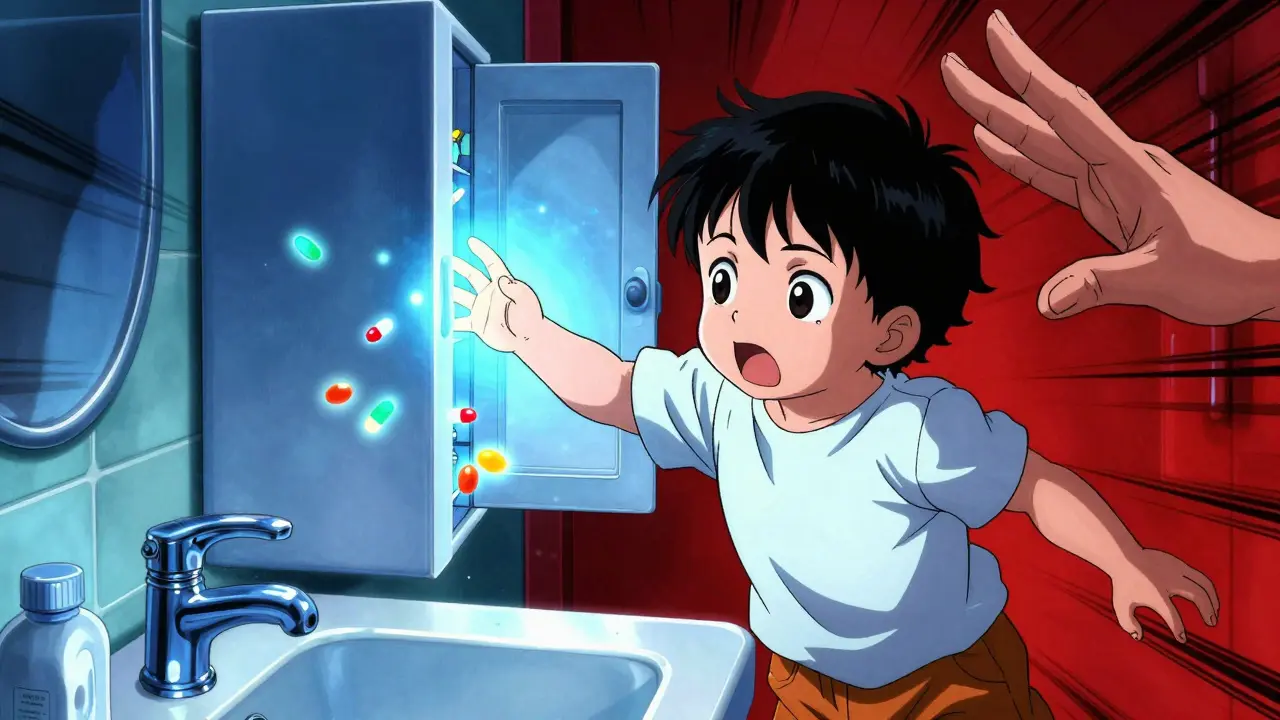
Every year, 60,000 children under five end up in emergency rooms because they got into medicine they weren’t supposed to. That’s about 165 kids a day. It’s not because parents are careless-it’s because storing medicine safely is harder than it looks. You think you’re being careful when you put pills on the bathroom counter while you’re brushing your teeth. But in less than 90 seconds, a curious toddler can open a cabinet, climb up, and swallow something deadly. And it doesn’t take much: a single pill of high-blood-pressure medicine or a few opioid tablets can be fatal to a small child.
Why Child-Resistant Caps Aren’t Enough
Most medicine bottles have child-resistant caps. They’re designed to be hard for little hands to twist open. But here’s the truth: 50% of children under five can open them in under a minute when no one is watching. A 2023 study by Express Scripts found that even toddlers as young as 24 months can figure out how to twist, push, and pull those caps open. And if the bottle’s been sitting out for a while, they’ll find it. Kids aren’t being naughty-they’re just exploring. They see a bright pill that looks like candy, and they want to taste it.
That’s why relying on child-resistant packaging alone is like locking your front door but leaving the window wide open. The American Academy of Pediatrics says you need physical barriers, not just caps. The CDC’s Up and Away campaign calls it the “lock it up” rule: if it’s not locked, it’s not safe.
Where to Store Medicine: The Right Height and Location
Forget the bathroom cabinet. That’s the most common mistake. Bathrooms are humid, warm, and full of hooks and counters that toddlers can use to climb. A 2023 Safe Kids Worldwide survey found that 41% of parents still store medicine there, even though 89% know kids can reach it.
Here’s what works:
- Store all medicine in a high cabinet or drawer, at least 36 inches off the ground-that’s counter height or higher.
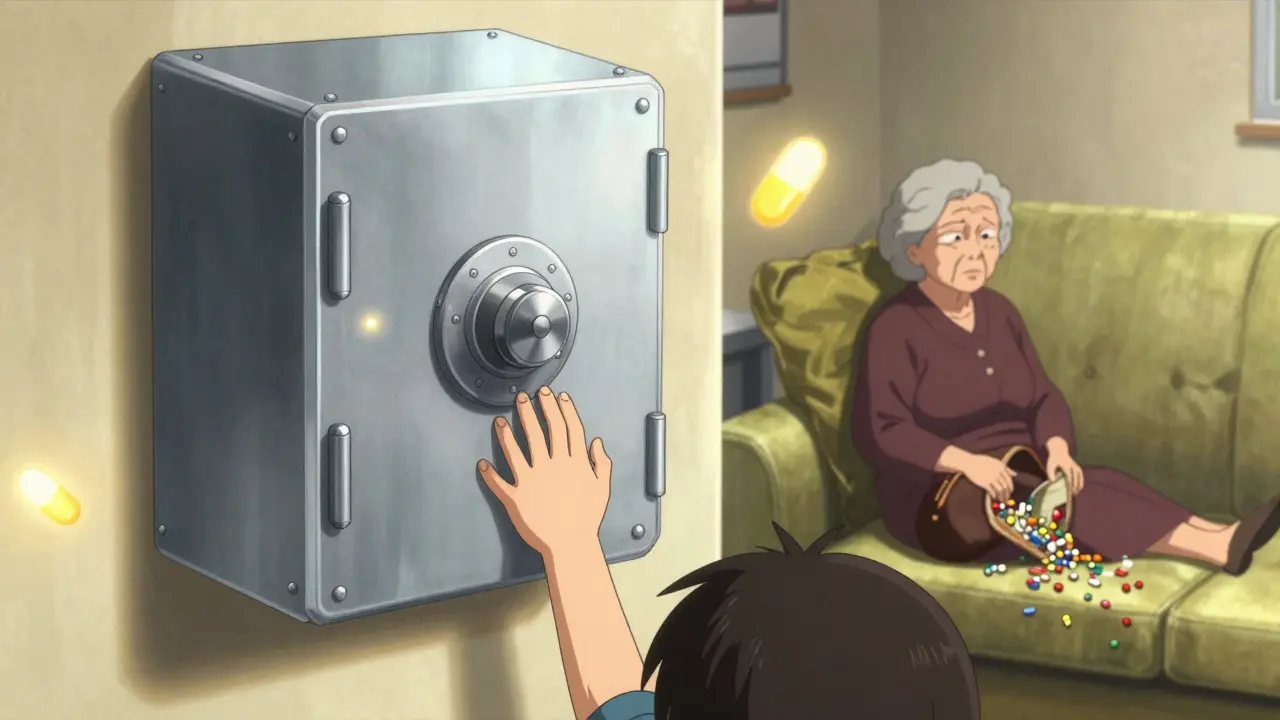
- Use a locked container. A simple lockbox with a key or combination works better than any child-resistant cap.
- Keep it out of sight. Kids remember where things are. If they’ve seen you take medicine from the top shelf, they’ll go back there.
- Never store medicine in purses, coat pockets, or nightstands. A 2024 Reddit Parenting thread had over 1,200 stories-87% of parents had a near-miss where kids got into meds during travel or when things were out of place.
For refrigerated meds like insulin, use a locked container inside the fridge. Don’t leave them on the top shelf-kids can pull down a bottle if it’s not secured. A 2022 study in the Journal of Pediatric Health Care found that locked cabinets prevent access 98% of the time. High shelves alone? Only 72% effective.
Special Cases: Travel, Grandparents, and Emergency Meds
Most poisonings happen when routines break. Holidays, visits to grandma’s house, or last-minute trips are high-risk times.
Grandparents: A 2024 Express Scripts survey found that 76% of grandparents don’t lock up medicine when grandchildren visit. They think, “My grandchild knows not to touch medicine.” But kids don’t understand the difference between candy and pills. Chewable Tums look like SweeTarts. Aspirin looks like Skittles. One study showed a 17% spike in ingestions of these types of pills in children aged 2-4.
Travel: The CDC’s 2024 data shows a 31% increase in poisonings during holidays. Pack a portable lockbox. Many are small enough to fit in a suitcase or hotel safe. The Up and Away campaign now offers free Travel Safety Kits with these lockboxes at pharmacies.
Emergency meds: If your child uses an inhaler or epinephrine auto-injector, you need it fast. But you still need to keep it safe. Seattle Children’s Hospital recommends a “medication triage system”: keep emergency meds in a clearly labeled, locked box that opens quickly-like a key-lock box on the fridge. Make sure every adult who cares for your child knows where it is and how to use it.
What Kind of Lockbox Should You Buy?
You don’t need a high-tech safe. But you do need something solid.
- Basic lockbox: Plastic or steel, at least 6” x 4” x 2”, with a key or combination. Costs $15-$30. Works 92% of the time, according to Amazon reviews for Med-Tek lockboxes.
- Smart lockbox: Bluetooth-enabled, sends alerts when opened. Costs $45-$120. But here’s the catch: a 2024 Consumer Technology Association test found only 43% reliability. Don’t rely on it for emergencies.
- Biometric lock: Fingerprint access. Great for security, but takes 5-8 seconds to open. Too slow for asthma attacks or allergic reactions.
Stick with a simple key or combo lock. Test it. Make sure you can open it in under 3 seconds-because in an emergency, every second counts.
Medicine Disposal: Don’t Just Toss It
Old or expired meds are just as dangerous as new ones. Flushing them harms the environment. Throwing them in the trash? Kids and pets can dig them out.
Here’s the right way:
- Remove pills from the bottle.
- Mix them with something unappetizing-used coffee grounds, cat litter, or dirt.
- Seal them in a plastic bag or container.
- Throw it in the trash.
Or, use a permanent disposal kiosk. 78% of U.S. pharmacies now offer free drop-off bins for old meds. Check with your local pharmacy. The FDA’s 2023 survey confirms they’re safe, easy, and widely available.
Behavior Matters More Than You Think
Most poisonings don’t happen because medicine was left out. They happen during administration.
Dr. Stephen Gersch of the American Academy of Family Physicians says: “78% of accidental ingestions happen while adults are giving medicine to a child.” You’re distracted-your phone rings, the baby cries, you turn around for a second. That’s all it takes.
Follow the Two-Minute Rule from the Up and Away campaign: never leave medicine unattended for more than 120 seconds. Put the cap on immediately. Lock it back up. Don’t pause. Don’t multitask. Even if you’re just walking to the kitchen.
Also, never call medicine “candy.” Don’t say, “This will taste like a gummy.” That creates a dangerous association. Kids learn fast. They’ll start looking for “candy” in your purse or medicine cabinet.

What About Teenagers?
Teenagers don’t accidentally ingest medicine-they take it on purpose. Prescription misuse is rising. The National Association of Pediatric Nurse Practitioners recommends a monitored medication system for teens who take daily meds: they log each dose, and a parent verifies it. This reduces misuse by 67%, according to data from 12,000 families.
Keep all prescription meds locked-even if your teen is responsible. A study in 2024 showed that 40% of teens who misused opioids got them from their own home medicine cabinet.
The Big Picture: Why This Isn’t Just Common Sense
Every year, pediatric medication poisonings cost the U.S. over $67 billion in medical bills and lost work time. Each ER visit averages $3,217. That’s not just money-it’s trauma. A child who swallows too much medicine can suffer brain damage, organ failure, or death.
But here’s the good news: locked storage works. Families who practice daily lock-up routines reduce accidental access by 83%. The National Safety Council predicts that if every household locked their meds, we could prevent 53,700 emergency visits a year within a decade.
This isn’t about being paranoid. It’s about being smart. You install smoke detectors. You use car seats. You put gates on stairs. Medicine is just another hazard. And it’s one you can control.
Quick Checklist: Your Daily Medicine Safety Routine
- Store all meds in a locked cabinet or box, at least 36 inches high.
- Never leave meds out during use-even for 30 seconds.
- Lock up meds after every use, even if you’re just putting them back.
- Keep meds out of purses, pockets, nightstands, and bathroom counters.
- Use a travel lockbox when visiting family or on trips.
- Dispose of expired meds using a pharmacy drop-off bin or by mixing with coffee grounds.
- Teach kids: “Medicine is not candy.”
- For teens: Use a monitored system with dose logging and adult verification.
It’s not about perfection. It’s about consistency. One locked box, one routine, one less chance for disaster.


Janette Martens
December 30, 2025 at 10:49i cant believe ppl still leave meds on the counter like its a damn snack bowl. my cousin's kid almost died from grandma's blood pressure pills. she thought "child proof" meant "kid proof". lol. no it dont. lock it up or get ready for the ER.
Marie-Pierre Gonzalez
January 1, 2026 at 05:35Thank you for this vital reminder. As a parent and a healthcare advocate, I cannot stress enough the importance of secure storage. Even a moment's distraction can lead to irreversible consequences. Let us all commit to the Lock It Up campaign-because safety is not optional, it is sacred. 🙏
Louis Paré
January 2, 2026 at 21:51So let me get this straight-you’re saying we should treat our own medicine like it’s nuclear launch codes? Meanwhile, the real problem is lazy parenting and over-medicated households. If your kid’s eating pills, maybe they’re not getting enough attention. Or maybe your house is just a pharmacy with a couch.
Nicole Beasley
January 2, 2026 at 23:30I just bought one of those little lockboxes from Target!! 🎉 My 2yo keeps climbing on the counter to get my ibuprofen. Now it’s locked in the kitchen cabinet. No more panic attacks at 3am. 🙌
sonam gupta
January 3, 2026 at 22:20In India we dont have lockboxes but we hang medicine from ceiling hooks. Kids cant reach. Simple. Effective. No money needed. Why make it complicated
Vu L
January 5, 2026 at 10:39Child resistant caps? Bro, my 18 month old opened a bottle of melatonin like it was a gumball machine. The real enemy is not the cap-it’s the fact that we think our kids are dumb. They’re not. They’re just hungry for novelty.
Teresa Marzo Lostalé
January 5, 2026 at 13:42I used to think this was overkill… until my nephew swallowed half a bottle of children’s Tylenol because he saw me take one for my headache. He’s fine now. But I’ll never forget the sound of the ambulance siren. I lock everything now. Even my vitamins. Even the hemp gummies. Even the ones I don’t think are dangerous. It’s not paranoia. It’s love.
ANA MARIE VALENZUELA
January 6, 2026 at 17:12This post is a 10/10. But let’s be real-90% of the people reading this will still leave pills in the bathroom. You want to save lives? Stop being a hypocrite. Put the meds away. Right now. Before your kid turns your medicine cabinet into a candy store.
Gran Badshah
January 8, 2026 at 07:02My dad used to keep his heart meds in his pants pocket. He’d sit on the couch and the baby would crawl up and grab them. One time she swallowed two. We had to rush her to hospital. Now I lock everything. Even my dad’s meds. He hates it. But he’s alive.
Ellen-Cathryn Nash
January 8, 2026 at 11:14I used to think calling medicine 'candy' was harmless. Until I caught my 3-year-old trying to give her stuffed bear a 'gummy' from my nightstand. I cried. I threw out the whole bottle. I now say 'medicine is for doctors' and I mean it. No more sugar-coating the truth. Literally.
Samantha Hobbs
January 9, 2026 at 13:20I just locked my meds in the fridge. But now my toddler opens the fridge door every 2 minutes. I’m thinking of installing a baby gate around the kitchen. Or maybe just move to a cabin in the woods.
James Hilton
January 10, 2026 at 01:06Lock it up? Nah. Just teach your kid not to be a dumbass. Kids eat dirt. They lick doorknobs. They’ll eat anything. The real issue? Overprotective parents who think their kid’s a walking poison risk. Chill. Let them learn. Or don’t. Your call.
Hakim Bachiri
January 10, 2026 at 09:37I mean, sure, lock boxes are nice. But let’s not ignore the cultural context. In the U.S., we over-medicate everything. We treat every headache like a crisis. We give kids pills for breathing too loud. The real solution? Stop prescribing so damn much. Then we won’t need lockboxes-we’ll need fewer pills. And fewer parents panicking over candy-shaped capsules. Just a thought. 🤷♂️