

When your doctor prescribes a medication and the pharmacy says it’s out of stock-again-you’re not alone. In 2025, over 350 drug shortages hit U.S. pharmacies, leaving patients without critical treatments for conditions like heart failure, epilepsy, and even antibiotics. For many, the answer isn’t waiting or switching drugs-it’s compounding pharmacies. These aren’t your neighborhood drugstore. They’re specialized labs where pharmacists build medications from scratch, tailored to your exact needs when nothing off the shelf will work.
What Exactly Is a Compounding Pharmacy?
A compounding pharmacy doesn’t just fill prescriptions. It creates them. Think of it like a custom kitchen where a chef doesn’t serve pre-made meals but builds each dish to match a diner’s allergies, tastes, and dietary limits. These pharmacies take raw pharmaceutical ingredients and mix them into forms that manufacturers don’t produce: sugar-free liquids for diabetics, dye-free capsules for people with allergies, or transdermal gels for those who can’t swallow pills.
Unlike regular pharmacies that stock mass-produced drugs, compounding pharmacies work under strict guidelines-USP <795> for non-sterile mixes and <797> for sterile ones like injections or IV solutions. They use calibrated scales, clean rooms, and precise tools to measure doses down to the microgram. A standard pill might be 50 mg. A compounded version could be 12.5 mg, 7.3 mg, or even 0.8 mg-something no factory can make efficiently.
Why Do People Need These Custom Medications?
There are three big reasons why a patient ends up at a compounding pharmacy:
- Drug shortages: The FDA tracks over 300 shortages each year. Some last weeks. Others drag on for months. When the only available treatment for thyroid disease or chemotherapy support vanishes, compounding fills the gap.
- Allergies or sensitivities: About 1 in 5 people react to dyes, preservatives, or lactose in pills. A compounded version removes those triggers. One patient with severe eczema couldn’t tolerate the dye in her blood pressure pill-switching to a dye-free compounded version cleared her skin in two weeks.
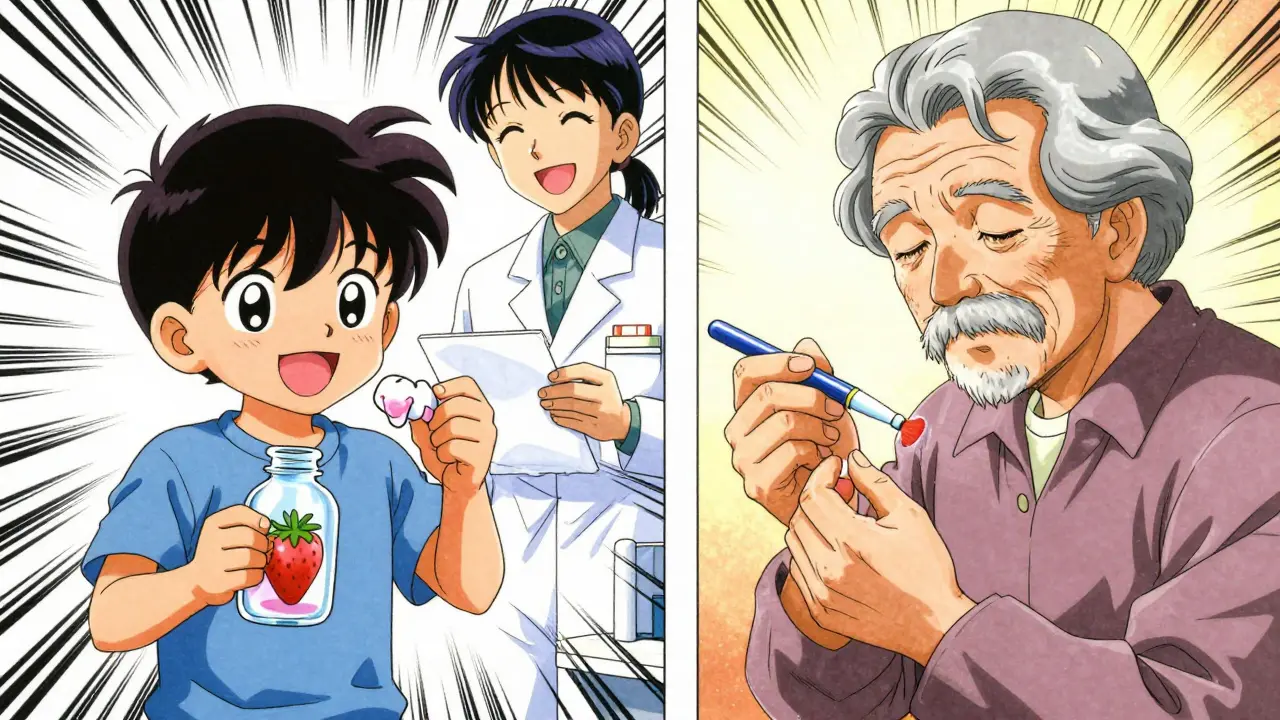
- Difficulty taking medication: Kids who gag on pills, seniors with swallowing problems, or people with GERD can’t use standard tablets. Compounding turns pills into flavored liquids, nasal sprays, or even lollipops (called troches) that dissolve under the tongue.
One study found that 85% of patients with allergies to commercial drug ingredients stuck to their treatment plan after switching to compounded versions. That’s not just convenience-it’s survival.
Common Uses You Might Not Know About
Compounding isn’t just for rare cases. It’s quietly helping millions:
- For kids: 40% of children can’t swallow pills. Compounding pharmacies make amoxicillin taste like bubblegum or strawberry. One parent told us her 3-year-old went from vomiting every dose to asking for "the pink medicine" after switching to a compounded liquid.
- For seniors: About 30% of adults over 65 struggle with swallowing. Creams for thyroid meds or gels for pain relief avoid the need to swallow entirely.
- For hormone therapy: Bioidentical hormone creams for menopause or testosterone gels for low T are almost always compounded. They’re not mass-produced because each dose is personalized.
- For chronic pain: A topical pain gel combining three different medications (like gabapentin, ketamine, and lidocaine) can be mixed to target nerve pain without the side effects of oral pills.
- For fertility and IVF: Custom dosing of medications like clomiphene or progesterone is common, especially when standard doses don’t match a patient’s body weight or response.
How It Works: From Doctor to Dose
It’s not as simple as walking in and asking for a custom pill. Here’s the real process:
- Your doctor identifies a problem: "This patient can’t take the standard version because of X allergy, or the dose isn’t available."
- The doctor writes a specific prescription with the exact strength, form, and ingredients needed. "Compounded topical finasteride 0.5% in a vanishing cream base, no alcohol, no parabens."
- The pharmacy receives the script and reviews it for safety and feasibility. Some formulas require special sourcing or testing.
- The pharmacist prepares the medication in a clean room-often taking 24 to 72 hours, depending on complexity.
- You pick it up. Some pharmacies ship, but most require in-person pickup for sterility and safety checks.
That’s why you can’t get a compounded drug the same day. It’s not a product-it’s a custom-made treatment.
Pros and Cons: What You Should Know
Compounding isn’t magic. It’s a tool-and like any tool, it has limits.
Advantages
- Personalized dosing: No more guessing if 50 mg is too much or 25 mg is too little.
- No allergens: Gluten, lactose, dyes, preservatives-all removed.
- Alternative delivery: Creams, sprays, lollipops, suppositories-options for people who can’t swallow.
- Availability during shortages: When the FDA-approved version vanishes, compounding keeps treatment going.
- Higher adherence: Patients stick with meds they can actually take.
Limitations
- Not FDA-approved: Compounded drugs don’t go through the same safety and efficacy testing as mass-produced ones. They’re made under quality standards, but not pre-market trials.
- Insurance coverage is spotty: About 45% of patients pay out of pocket. Some plans cover it if the doctor proves no alternative exists.
- Longer wait times: 24-72 hours vs. same-day pickup at CVS.
- Can’t replace everything: No compounding pharmacy can make biologics like insulin, monoclonal antibodies, or complex IV drugs. Those require factory-grade manufacturing.

How to Find a Reputable Compounding Pharmacy
Not all compounding pharmacies are equal. Here’s how to pick one:
- Look for PCAB accreditation: The Pharmacy Compounding Accreditation Board (PCAB) certifies about 1,200 pharmacies nationwide. It’s the gold standard. You can search their directory online.
- Ask about their processes: Do they use laminar airflow hoods? Do they test for potency and stability? Do they document every batch?
- Check if they work with your doctor: Good compounding pharmacies collaborate with prescribers. If the pharmacist refuses to talk to your doctor, walk away.
- Read patient reviews: Look for mentions of consistency, communication, and how well the medication worked.
One patient in Florida switched from a local pharmacy to a PCAB-accredited one after her compounded thyroid cream kept changing in texture. The new pharmacy started using stability testing-and her symptoms stabilized within weeks.
What’s Changing in 2026?
Compounding is evolving fast:
- More tech: Digital formulation tools have cut compounding errors by 37%. Automated weighing and mixing systems improve accuracy.
- Longer shelf life: New testing methods now extend the stability of compounded creams and liquids by 25-40%.
- Genetic matching: 68% of compounding pharmacists report growing demand for medications based on genetic test results-like tailoring antidepressants to how a patient metabolizes them.
- Regulatory clarity: The FDA has tightened rules since 2013, but recent guidance in 2022 made it clearer when compounding is acceptable during shortages. That’s helping doctors prescribe with confidence.
One thing won’t change: compounding pharmacies will always be the backup plan. Not the first choice. But when everything else fails, they’re the only thing standing between a patient and no treatment at all.
Final Thought: It’s Not a Substitute-It’s a Solution
Some doctors worry patients use compounding as a shortcut. But the data tells a different story. When a patient can’t swallow a pill, is allergic to a dye, or can’t get their medicine because of a shortage, compounding isn’t a luxury. It’s necessary.
It’s not about avoiding FDA-approved drugs. It’s about making sure no one gets left behind because a factory didn’t make the right dose, the right form, or the right version. For thousands of patients, that’s the difference between managing their condition-and not being able to live with it at all.
Are compounded medications safe?
Yes, when made by accredited pharmacies following USP <795> and <797> standards. These pharmacies use sterile environments, calibrated equipment, and batch testing to ensure safety. However, they don’t undergo the same pre-market testing as FDA-approved drugs, so they’re only used when no other option exists. Always choose a PCAB-accredited pharmacy.
Can my insurance cover compounded prescriptions?
Sometimes, but not always. About 55% of plans cover compounded medications if your doctor provides documentation proving no FDA-approved alternative exists. Many require prior authorization. Out-of-pocket costs are common-around 45% of patients pay full price. Ask your pharmacy to submit a claim and check your plan’s policy.
How long does it take to get a compounded medication?
Most take 24 to 72 hours. Simple non-sterile formulas (like flavored liquids or topical creams) can be ready in a day. Sterile compounds (injections or IVs) take longer-up to 5 days-because they require extra testing and validation. Always plan ahead.
Can compounding pharmacies make any drug I need?
No. They can’t replicate complex biologics like insulin, monoclonal antibodies, or vaccines. These require factory-level manufacturing. Compounding works best for simpler chemical compounds-hormones, pain creams, antibiotics, or altered dosage forms. If your drug is made from living cells or requires ultra-pure conditions, compounding won’t work.
Why not just switch to a different FDA-approved drug?
Sometimes you can. But not always. Some patients have allergies to inactive ingredients in all available versions. Others need a specific dose that doesn’t exist. For example, a child might need 7.5 mg of a medication, but the only available tablet is 10 mg or 25 mg. Crushing pills isn’t safe or accurate. Compounding provides the exact dose needed-without guesswork.

Chris Bird
March 12, 2026 at 08:08My cousin in Nigeria got his epilepsy meds from a compounding shop after the imported stuff ran out. Took 3 weeks but he’s alive. No fancy lab, just a guy with a scale and a dream. Sometimes that’s all you need.
Tom Bolt
March 14, 2026 at 06:00The article is meticulously researched, yet it omits a critical legal nuance: under the Federal Food, Drug, and Cosmetic Act, Section 503A, compounding pharmacies are permitted only when acting in response to a valid prescription for an identified individual. Mass production or bulk compounding is illegal-and yet, many so-called ‘compounding pharmacies’ operate as de facto manufacturers. This regulatory gray zone is a public health time bomb.
Gene Forte
March 16, 2026 at 05:42Let me tell you something real: medicine isn’t one-size-fits-all. And if you’re telling someone they have to take a pill they can’t swallow, or a drug that gives them a rash, you’re not helping-you’re giving up on them. Compounding pharmacies? They’re the quiet heroes no one talks about. They don’t show up on TV. They don’t get stock options. But they show up at 6 a.m. to mix a dose for a kid who hasn’t slept in three nights because the medicine made them sick. That’s not magic. That’s humanity.
And yes, insurance is a mess. And yes, it takes time. But when your child’s life depends on a strawberry-flavored liquid instead of a crushed tablet, you don’t care how long it takes. You just care that it works.
We need more of these places. Not fewer. Not lawsuits. More.
David L. Thomas
March 17, 2026 at 01:22From a pharmacokinetic standpoint, the variability in bioavailability of compounded formulations is non-trivial. Without batch-specific HPLC validation, you’re essentially gambling with therapeutic efficacy. And while PCAB accreditation helps, the lack of centralized pharmacovigilance means adverse events go unreported. We’re trading regulatory rigor for accessibility-and that’s a Faustian bargain.
That said, for patients with rare allergies or extreme dosing needs, it’s the only viable pathway. The system’s broken, but the workarounds? Brilliant.
Bridgette Pulliam
March 18, 2026 at 02:06I’ve worked in hospice care for 18 years. I’ve seen people who couldn’t swallow, couldn’t digest, couldn’t tolerate anything standard. Compounded meds? They didn’t just help-they restored dignity. One woman, 92, had her morphine turned into a lavender-scented topical gel. She said it felt like a massage. She smiled for the first time in months. That’s not science. That’s love, wrapped in a prescription.
Mike Winter
March 19, 2026 at 03:32Interesting piece, though I wonder-how many of these compounded medications are actually tested for stability beyond the manufacturer’s claim? I’ve read horror stories of creams separating after two weeks, or liquids turning cloudy. And yet, patients are told to use them for 30 days. Is that really safe? Or are we just hoping for the best?
Also, why isn’t there a national registry for compounded drug outcomes? We track adverse events for FDA-approved drugs. Why not here?
Randall Walker
March 19, 2026 at 21:00So… let me get this straight. We have a system where people can’t get life-saving meds because corporations won’t make tiny doses… so we turn to pharmacists with beakers and hope?
And you call this progress?
Meanwhile, the same companies that stopped making 12.5mg tablets are charging $12,000 for a 50mg version. And we’re supposed to be grateful for a guy in Ohio mixing it by hand?
Yeah. I’m crying too. With laughter.
Miranda Varn-Harper
March 20, 2026 at 19:59Compounding pharmacies are a symptom of a broken system, not a solution. If you need a custom dose, the problem isn’t the pharmacy-it’s the pharmaceutical industry’s refusal to serve niche markets. Instead of patching the leak, why not fix the pipe? And why are we letting pharmacists play chemist without FDA oversight? This is how people die.
Donnie DeMarco
March 22, 2026 at 09:37My grandma’s thyroid cream? Used to be a greasy mess that smelled like old socks. Switched to a PCAB shop and now it’s like applying vanilla lotion. She says she feels like a queen again. And yeah, it cost $80. But I’d pay $800 if it meant she stopped crying every morning.
Also, the lollipop version of her seizure med? She calls it her "magic candy." Kids, seniors, pets-it’s all the same. You just want the medicine to work. And sometimes, that means it has to taste like cotton candy.
Shourya Tanay
March 23, 2026 at 05:03In India, compounding is common due to supply chain fragility. But here’s the twist: many Indian compounding labs are more rigorous than U.S. ones. They use ISO-certified cleanrooms, perform stability testing, and maintain batch records. The difference? They’re not trying to profit off insurance loopholes-they’re trying to keep people alive. We need to stop seeing this as a U.S.-only problem. It’s global.
LiV Beau
March 24, 2026 at 07:57OMG this is so important!! 🙌 I didn’t know compounding could make meds into lollipops-my nephew’s ADHD med was a nightmare until they turned it into a cherry-flavored troche. He asks for it like it’s candy. And guess what? He’s taking it. Every. Single. Day. 🍒✨
Also, can we make a TikTok trend out of this? #CompoundedAndCute #MedicineThatDoesntSuck
Adam Kleinberg
March 25, 2026 at 20:31Compounding pharmacies are just the tip of the Big Pharma conspiracy. They’re letting unregulated labs make drugs because the FDA is in bed with corporations. The real solution? Let people import from Canada. Or better yet-make their own. I’ve seen DIY hormone kits online. No pharmacy needed. No middlemen. Just freedom.
And don’t even get me started on PCAB. It’s just another corporate stamp. Real healers don’t need accreditation. They have guts.
Denise Jordan
March 27, 2026 at 05:21So… you’re telling me we need a whole other system because the first one is too broken to fix? Cool. I’ll just keep waiting. Or not. Whatever.
Kenneth Zieden-Weber
March 28, 2026 at 02:58You know what’s wild? The fact that we need a whole other branch of pharmacy just to make a pill that’s not 50mg. Imagine if we designed drugs for humans instead of profit margins. Imagine if we made 12.5mg tablets because someone needed them-not because it’s "too niche."
This isn’t innovation. It’s damage control.
But hey-at least someone’s trying. So props to the pharmacists. They’re the unsung heroes of the medical world.
Alexander Erb
March 28, 2026 at 23:14My cousin’s dog had lymphoma. The vet prescribed a compounded chemo gel. Applied it once a week. No vomiting. No hair loss. Just… chill. Dog’s still alive 2 years later. We didn’t even know this was a thing until we Googled "pet chemo alternatives."
Turns out, compounding isn’t just for humans. It’s for cats. Dogs. Even rabbits. If you’ve got a living thing that needs medicine? There’s probably a way to make it work.
And yeah, it costs more. But it’s cheaper than burying your pet.