
When a brand-name drug hits the market, it’s protected by patents that can last 20 years or more. But those patents aren’t bulletproof. In the U.S., generic drug makers have a legal tool built into the Paragraph IV certification - a mechanism that lets them challenge those patents before even making a single pill. This isn’t just a technical loophole. It’s the main reason 90% of prescriptions today are filled with generic drugs, saving consumers nearly $200 billion every year.
What Exactly Is a Paragraph IV Certification?
A Paragraph IV certification is a formal statement filed with the FDA as part of an Abbreviated New Drug Application (ANDA). It’s not a request for approval. It’s a legal challenge. The generic company says: “One or more of your patents are invalid, unenforceable, or won’t be infringed by our product.” That’s it. No product made yet. No sales. Just a paper challenge.
This process exists because of the Hatch-Waxman Act of 1984. Before that, generic companies couldn’t start testing their versions until the brand’s patent expired - even if they knew the patent was weak. The law changed that. It created a legal fiction: submitting an ANDA with a Paragraph IV certification is treated as an act of patent infringement. That means the brand company can sue before the generic drug ever hits shelves.
Why does this matter? Because it flips the script. Normally, patent holders wait for infringement to happen, then sue. Here, the generic company forces the issue upfront. It’s the only industry where the challenger has to declare war before firing a shot.
The 20-Day Notice and the 45-Day Clock
Once a generic company files its ANDA with a Paragraph IV certification, it has exactly 20 days to send a notice letter to the brand-name drugmaker and the patent holder. This isn’t a courtesy. It’s a legal requirement. The letter must lay out the factual and legal basis for why the patent doesn’t apply - whether it’s obvious, too broad, or doesn’t cover the generic’s formulation.
Then the clock starts. The brand company has 45 days to file a patent infringement lawsuit. If they do? The FDA immediately puts a 30-month stay on approving the generic. That means even if the FDA says the generic is safe and effective, it can’t be sold for up to 30 months - unless the court rules sooner.
But here’s the twist: the 30-month clock isn’t fixed. Courts can shorten it if the case is resolved early. Or, if the brand company delays filing or the generic company files amendments, the stay can stretch to 36 months or longer. In 2023, nearly 63% of generic companies reported delays beyond 30 months - costing them an extra $8.7 million per product in holding costs.
The 180-Day Exclusivity Prize
Why do generic companies risk millions in legal fees and years of delay? Because the first one to successfully challenge a patent gets a golden ticket: 180 days of exclusive market access.
During those six months, no other generic can enter. That means the first filer gets to charge a fraction of the brand’s price - but still capture nearly the entire market. In 2023 alone, first-filers earned $4.7 billion from this exclusivity window. For a blockbuster drug like Humira, which sold over $20 billion a year, that’s up to $500 million in pure profit.
But it’s not that simple. Many of these first-filers end up settling with the brand company. In 2024, 78% of Paragraph IV cases ended in settlement - and 68% of those included “pay-for-delay” deals. That means the brand pays the generic to hold off on launching. These deals, which the FTC has challenged in 17 cases since 2023, can delay generic entry by over two years.
How Brands Fight Back: Patent Thickets and Product Hopping
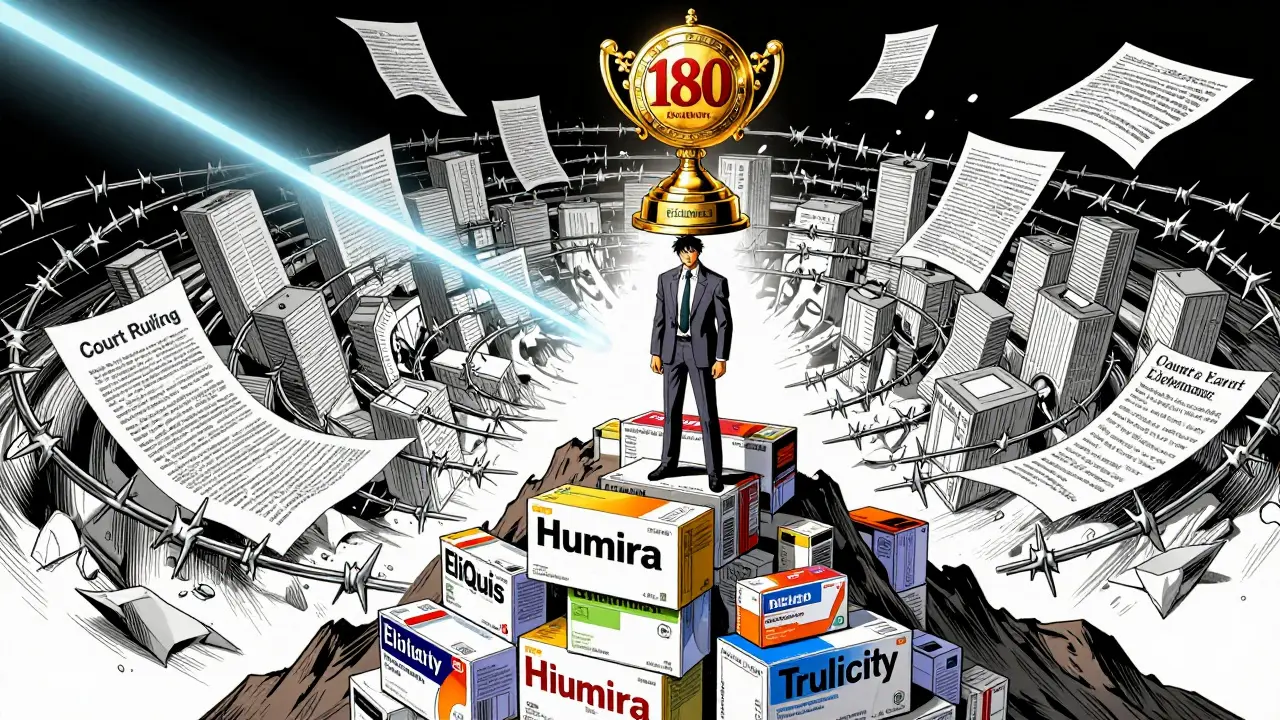
Brands didn’t sit still. They responded by listing more patents on each drug. In 2005, the average drug had 7.2 patents in the FDA’s Orange Book. By 2024, that number jumped to 17.3. These aren’t all strong patents. Many are for minor changes - a new coating, a different dosage form, or a method of use that’s already known.
This is called “patent thickets.” The goal? To make it so expensive and time-consuming for generics to challenge every patent that they give up. One generic company told industry analysts they spent $12.3 million and 28.7 months on average just to challenge a single drug’s patents.
Another tactic? “Product hopping.” When a generic is about to file a Paragraph IV challenge, some brands release a slightly reformulated version of the drug - say, a new tablet instead of a capsule - and get a new patent. The generic can’t copy it without starting over. In 2024, 31% of Paragraph IV challenges targeted drugs that had been reformulated within the previous year.
Carve-Outs and Skinny Labels: The Smart Workaround
Not every patent covers the whole use of a drug. Take a painkiller approved for arthritis, back pain, and migraines. If only the arthritis patent is still active, a generic company doesn’t need to challenge it. Instead, they can file a “Section viii carve-out.” That means they ask for approval only for back pain and migraines - leaving out the patented use.
This is called a “skinny label.” It lets the generic launch immediately without triggering a Paragraph IV challenge. About 37% of all Paragraph IV filings in 2023 included a carve-out strategy. It’s lower risk, faster, and cheaper. For companies with limited legal budgets, it’s often the smarter move.
Who’s Winning? Who’s Losing?
Some companies are built for this game. Teva filed 147 Paragraph IV certifications in 2024 - more than any other generic maker. Mylan, Sandoz, and Hikma aren’t far behind. These firms have teams of 5 to 15 specialists: patent lawyers, regulatory experts, pharmacologists. They use specialized software that costs up to $500,000 a year just to track which patents are listed in the Orange Book.
On the brand side, AbbVie’s Humira faced 28 challenges. Eli Lilly’s Trulicity had 24. Pfizer’s Eliquis had 21. These aren’t random. They’re blockbuster drugs with massive profits. The more money at stake, the more patents get filed - and the more generics come knocking.
But the real winners? Patients. Since 1984, Paragraph IV challenges have saved U.S. consumers $2.2 trillion in drug costs. In 2024, generic drugs accounted for $55.3 billion of the $128.7 billion generic market - almost half - thanks to these challenges.
The Future: Tighter Rules and More Challenges
The FDA’s 2022 rule update cracked down on loopholes. Now, if a generic company changes its formulation after filing - say, switches from a tablet to a liquid - it can’t just amend its Paragraph IV certification. It has to prove the new version still doesn’t infringe the patent. This was meant to stop “litigation shopping,” where companies tweak their applications to reset the clock.
In 2025, the FDA proposed a new rule that would force brand companies to justify every patent they list in the Orange Book. Analysts predict this could cut patent thickets by 30-40%. That’s huge.
Meanwhile, generic success rates are rising. From 2003 to 2019, generics won about 41% of their challenges. From 2020 to 2025, that jumped to 58%. Why? Supreme Court rulings have narrowed what counts as a patentable invention. Obvious combinations, minor tweaks - those are getting thrown out.
Even with all the hurdles, Paragraph IV certifications aren’t going away. They’re the backbone of generic competition in the U.S. And as long as brand drugs keep charging high prices, generics will keep challenging - one certification at a time.

Nancy Kou
December 20, 2025 at 05:03This is the quiet revolution that keeps insulin affordable. No one talks about it, but without Paragraph IV, millions would be choosing between meds and rent. Generic companies aren't villains-they're the only thing standing between pharmaceutical greed and real people.
Hussien SLeiman
December 21, 2025 at 12:58Let’s be honest-this whole system is a legal circus. The Hatch-Waxman Act was supposed to balance innovation and access, but now it’s just a weaponized paperwork war. Generic companies file Paragraph IV certs like they’re playing poker, bluffing with weak patents, while brands stack 20 patents on a single pill just to scare them off. And don’t get me started on pay-for-delay deals-those aren’t settlements, they’re collusion with a lawsuit-shaped veneer. The FDA’s new rules are a start, but they’re like putting a bandage on a hemorrhage.
Ashley Bliss
December 22, 2025 at 23:44Some of us call this capitalism. Others call it moral bankruptcy. The fact that a company can pay another company millions to NOT bring a life-saving drug to market-while patients die waiting-isn’t just unethical. It’s a crime against humanity. And yet, we treat it like a business negotiation. Where’s the outrage? Where’s the protest? Or are we too numb from paying $800 for a 30-day supply of a drug that costs $2 to make?
Dev Sawner
December 24, 2025 at 17:55It is imperative to note that the statistical increase in generic litigation success rates-from 41% to 58%-is directly attributable to the Supreme Court's jurisprudential narrowing of patent eligibility under 35 U.S.C. § 101, particularly post-Alice and Mayo. The proliferation of patent thickets is a rational market response to the economic incentives embedded in the current regulatory architecture. Moreover, the 180-day exclusivity period, while ostensibly pro-competitive, induces strategic behavior that distorts market entry dynamics. One must also consider the opportunity cost of R&D diversion toward litigation rather than innovation.
Moses Odumbe
December 25, 2025 at 11:25Bro, did you know some generic companies use AI to predict which patents are most likely to be invalidated? 🤯 They feed the Orange Book data into models trained on past court rulings. One startup even built a tool that tells you the probability a patent is a "junk patent" based on wording alone. It’s wild. Also, pay-for-delay? That’s just corporate bribery with a law degree. 😤
bhushan telavane
December 26, 2025 at 18:21In India, we don’t have this system. Our generics are cheap because we don’t allow product hopping or thickets. But we also don’t have the same level of innovation. There’s a trade-off. Still, I’m glad someone’s fighting for affordability. My cousin in Chicago pays $400 for a pill that costs 70 rupees here. It’s not right.
Kelly Mulder
December 27, 2025 at 19:51It’s disgusting how these so-called "generic" companies are just corporate vultures waiting to pick the bones of real innovators. They don’t create anything-they just wait for someone else to take the risk, then swoop in with a legal loophole. And now we’re supposed to cheer them on? The FDA’s "reforms" are just enabling more of this predatory behavior. Shame on you, Teva.
Mark Able
December 29, 2025 at 06:45Wait, so if a generic company files a Paragraph IV and the brand sues, the FDA can’t approve it for 30 months? But what if the generic is already making the drug in another country? Can’t they just import it? Or is that illegal too? I’m confused. Someone explain this like I’m 10.
Chris Clark
December 29, 2025 at 08:15Actually, you can’t import it-that’s why the 30-month stay exists. But here’s the thing: if the generic wins the case early, they can launch right away. And that’s why some companies file multiple ANDAs with different formulations-trying to find the one that slips through. The "skinny label" trick is genius. Skip the patented use, get approved faster, and sell the rest. It’s like selling a hammer without the nail. No one’s suing you for that.
Dorine Anthony
December 29, 2025 at 17:14Just… thank you. This is the kind of stuff no one talks about, but it’s why my dad can afford his meds. Keep fighting.