

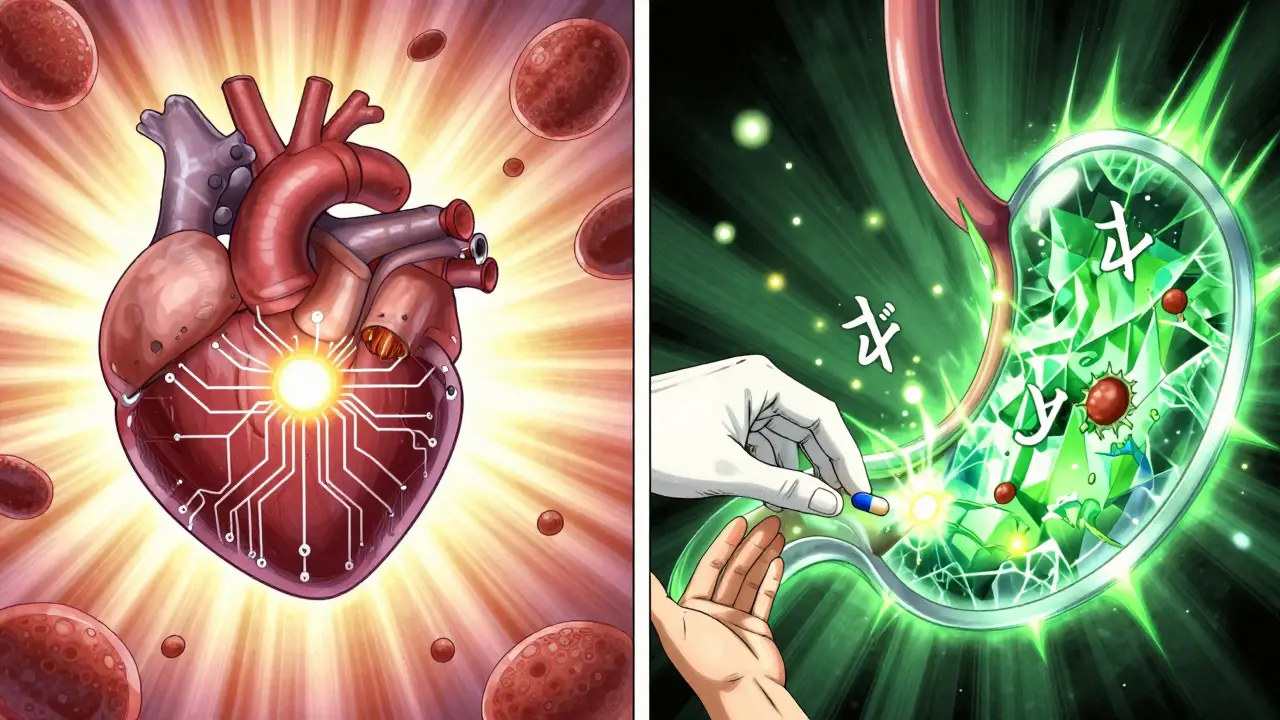
Every year, millions of people take antiplatelet medications to prevent heart attacks and strokes. These drugs-like aspirin, clopidogrel, prasugrel, and ticagrelor-stop blood clots from forming by calming down platelets, the tiny cells in your blood that stick together to seal cuts. But here’s the catch: the same mechanism that saves your heart can also cause dangerous bleeding, especially in your stomach. If you’re on one of these meds, you’re not just taking a pill-you’re managing a delicate balance between protecting your heart and keeping your gut safe.
Why Antiplatelet Drugs Can Hurt Your Stomach
Aspirin was the first antiplatelet drug discovered, back in the 1970s. It works by permanently blocking an enzyme called cyclooxygenase-1 (COX-1), which your stomach lining needs to make protective mucus. Without that mucus, stomach acid starts eating away at the tissue. Even enteric-coated aspirin, designed to dissolve in the intestine instead of the stomach, doesn’t fix this. The drug still gets into your bloodstream and affects platelets everywhere-including the ones trying to heal tiny tears in your stomach lining. Newer drugs like clopidogrel, prasugrel, and ticagrelor work differently. They block a receptor called P2Y12 on platelets, stopping them from clumping. But here’s what many don’t realize: these drugs also slow down ulcer healing. Platelets don’t just form clots-they release growth factors that help repair damaged tissue. When you block them, your stomach can’t recover from everyday irritation caused by food, stress, or even H. pylori bacteria. The numbers are real. About 1% of people on these drugs will have a major gastrointestinal bleed within the first month. That number jumps to 40% for aspirin users and 50% for those on clopidogrel or dual therapy after 6 to 12 months. And if you’re on two antiplatelet drugs at once-common after a stent placement-your bleeding risk goes up by 30% to 50% compared to just one.Which Antiplatelet Drug Is Safest for Your Stomach?
Not all antiplatelet drugs are created equal when it comes to gut safety. - Aspirin: Highest risk of causing ulcers, but lowest risk of triggering a major bleed if you already have one. If you’ve had a prior GI bleed, staying on low-dose aspirin (75-100 mg) is often safer than stopping it entirely. - Clopidogrel: Less damaging to the stomach lining than aspirin, but still causes bleeding in about half of long-term users. It’s also the most commonly prescribed because it’s cheap-generic versions cost around $25 a month. - Prasugrel: Stronger than clopidogrel at preventing clots, but also increases GI bleeding risk by 20-30%. Not usually first-line unless you’ve had a stent and are at high risk for clotting. - Ticagrelor: The most potent of the group, with a 30% higher bleeding risk than clopidogrel in clinical trials. It also causes shortness of breath in about 15% of users, which can be scary if you don’t expect it. The trade-off is clear: stronger drugs prevent more heart attacks and stent clots-but they also cause more bleeding. For someone who’s had a heart attack and got a stent, the benefits usually outweigh the risks. But for someone with a history of ulcers or older adults on multiple medications, the choice needs more care.How to Protect Your Gut: PPIs Are the Gold Standard
The single most effective way to reduce GI bleeding risk while staying on antiplatelet therapy is taking a proton pump inhibitor (PPI). These drugs-like esomeprazole (Nexium), omeprazole (Prilosec), and pantoprazole (Protonix)-shut down stomach acid production. That gives your stomach lining time to heal. Studies show that when you add a PPI to clopidogrel or aspirin, you cut the risk of ulcers and bleeding by up to 70%. In one trial, 92% of patients with prior ulcers saw complete healing within 8 weeks when taking esomeprazole 40 mg daily. The American College of Gastroenterology and Canadian Association of Gastroenterology both recommend PPIs for:- Anyone with a history of peptic ulcer or GI bleed
- Patients over 65
- Those taking NSAIDs (like ibuprofen) or corticosteroids at the same time
- People with H. pylori infection
The Clopidogrel and PPI Interaction: What You Need to Know
There’s been a lot of noise about whether PPIs reduce clopidogrel’s heart protection. The concern started in 2009, when some studies suggested PPIs might interfere with how clopidogrel is activated in the liver. The FDA looked into it. Dr. Norman Stockbridge from the FDA said back in 2010: “The clinical relevance remains uncertain.” Since then, bigger studies have shown mixed results. Some observational data suggested a 20-30% higher chance of heart attacks in people taking both. But randomized trials-the gold standard-found no significant increase in heart events. The 2023 guidelines from the ACG and Canadian Association of Gastroenterology say this interaction is likely not clinically meaningful for most people. Still, if you’re worried, here’s what you can do:- Choose pantoprazole or dexlansoprazole-they have the least interaction with clopidogrel
- Avoid omeprazole and esomeprazole if you’re on clopidogrel and have a high risk of clotting
- Take your PPI at night and clopidogrel in the morning-this separates absorption times
What If You Start Bleeding? Don’t Stop Your Medication
This is one of the most dangerous myths: if you’re bleeding, stop your antiplatelet drug. That’s the opposite of what you should do. A 2017 Lancet study found that patients who stopped aspirin during a GI bleed had a 25% higher chance of dying from a heart attack or stroke. Platelets need to be active to stop bleeding, but in this case, the real danger isn’t the bleeding-it’s the clot that forms after you stop the drug. Here’s what experts recommend during active GI bleeding:- Keep taking aspirin
- Hold clopidogrel, prasugrel, or ticagrelor for 5-7 days if bleeding is severe
- Restart the P2Y12 inhibitor as soon as the bleeding is controlled-usually within 24-72 hours after endoscopic treatment
- Do NOT give platelet transfusions. A 2023 study showed transfused patients had 27% mortality vs. 12% in those who didn’t get them
Who Should Avoid These Drugs Altogether?
Not everyone needs antiplatelet therapy. If you’ve never had a heart attack, stroke, or stent, you likely don’t need it. Even for people with risk factors like high cholesterol or diabetes, the bleeding risk may outweigh the benefit. The AIMS65 score helps doctors decide who’s at highest risk for dying from a GI bleed:- Albumin under 3.0 g/dL
- INR over 1.5
- Confusion or mental status change
- Systolic blood pressure under 90
- Age 65 or older
What Happens When PPIs Don’t Work?
About 15-20% of people on long-term PPIs develop side effects: headaches, diarrhea, nutrient deficiencies (like magnesium or B12), or even an increased risk of bone fractures. Some patients can’t tolerate them at all. For those people, alternatives include:- H2 blockers like famotidine (Pepcid)-less effective than PPIs but better than nothing
- Switching to aspirin-only therapy if you’re on dual therapy
- Testing for H. pylori and treating it if present-this alone can reduce ulcer risk by 50%
- Using misoprostol (Cytotec)-a prostaglandin analog that protects the stomach lining, but it’s not used often because of side effects like cramping and diarrhea

What to Do Next: A Simple Action Plan
If you’re on an antiplatelet drug, here’s your checklist:- Ask your doctor: “Am I at risk for GI bleeding?” Use your age, history of ulcers, NSAID use, and other meds to decide.
- If you’re on clopidogrel, prasugrel, or ticagrelor-ask if you should be on a PPI. Don’t wait until you’re bleeding.
- If you’re on aspirin and have stomach pain, bloating, or black stools-get checked. Don’t assume it’s just indigestion.
- If you’ve had a GI bleed, never stop aspirin without talking to your cardiologist. The risk of a heart attack is higher than the risk of rebleeding.
- Get tested for H. pylori if you’ve ever had an ulcer. Eradicate it if it’s there.
- Avoid NSAIDs like ibuprofen or naproxen. Use acetaminophen (Tylenol) for pain instead.
Frequently Asked Questions
Can I take ibuprofen while on aspirin or clopidogrel?
No. Ibuprofen and other NSAIDs increase your risk of stomach bleeding by 3-5 times when combined with antiplatelet drugs. Even occasional use can trigger a serious bleed. Use acetaminophen (Tylenol) instead for pain or fever.
How long should I take a PPI with clopidogrel?
If you’ve had a stomach ulcer or GI bleed, take a PPI for at least 8 weeks after healing. If you’ve had a complicated ulcer (bleeding, perforation, or obstruction), you may need to stay on it indefinitely. For people without prior bleeding but on dual therapy, guidelines recommend at least 6-12 months of PPI use.
Does enteric-coated aspirin protect my stomach?
No. Enteric coating only delays when aspirin dissolves-it doesn’t stop it from affecting platelets throughout your body. Your stomach lining still loses its natural protection. If you’re at risk for bleeding, you still need a PPI.
Can I stop my antiplatelet drug before a dental procedure?
No. Stopping aspirin or clopidogrel for dental work increases your risk of a heart attack or stroke more than the risk of bleeding from a tooth extraction. Most dentists now know to manage bleeding locally with sutures or gauze. Always consult your cardiologist before stopping any antiplatelet medication.
Are there natural alternatives to antiplatelet drugs?
No. While some supplements like fish oil, garlic, or turmeric have mild blood-thinning effects, they’re not strong enough to prevent clots after a heart attack or stent. Relying on them instead of prescribed medication can be deadly. Always talk to your doctor before adding or removing any supplement.
Final Thought: It’s Not About Avoiding Risk-It’s About Managing It
Antiplatelet drugs aren’t perfect. They save lives, but they come with real, measurable risks. The goal isn’t to avoid them-it’s to use them smartly. If you’re on one, make sure you’re also on a PPI if you need it. Don’t stop your meds without talking to your doctor. And if you’re feeling off-black stools, dizziness, stomach pain-get checked. Your heart needs protection. So does your stomach. You don’t have to choose one over the other anymore. With the right strategy, you can protect both.
steve rumsford
January 7, 2026 at 13:14i swear half these people dont even know what a ppi is and are just scared of taking pills. my grandpa’s been on aspirin + pantoprazole for 12 years and still rides his bike to the store. stop overcomplicating it.
Anastasia Novak
January 8, 2026 at 10:15oh sweet jesus another medical article that reads like a pharmaceutical sales pitch wrapped in a 10-page manifesto. let me guess-someone at ACG got a free trip to Boca Raton for endorsing PPIs. the real scandal? how many patients are being overmedicated because doctors don’t have time to explain the difference between ‘risk’ and ‘certainty’.
Vince Nairn
January 10, 2026 at 09:10so let me get this straight-we’re giving people life-saving drugs that shred their stomachs… then giving them another drug to fix the damage… then telling them not to worry about the side effects of the fix? brilliant. capitalism’s finest masterpiece. i’m just here waiting for the pill that prevents the side effects of the pill that prevents the side effects of the pill.
Poppy Newman
January 11, 2026 at 12:52this is why i love medical deep dives 🧠❤️🔥 the nuance here is *chef’s kiss*-especially the bit about platelets helping tissue repair. never thought of them as tiny healers. also, H. pylori testing? why isn’t this routine??
Aparna karwande
January 13, 2026 at 02:29You people are so obsessed with pills you forget the body heals itself if you stop poisoning it. Aspirin? A 19th-century weed extract. Why not try turmeric, ginger, and fasting? Western medicine treats symptoms like enemies. We don’t need more chemistry-we need wisdom. Your stomach isn’t broken-it’s begging you to listen.
LALITA KUDIYA
January 14, 2026 at 20:14i took clopidogrel for 6 months after my stent and skipped the ppi because i thought it was unnecessary now i have gastritis and i regret everything
Ayodeji Williams
January 16, 2026 at 15:54so you saying if i bleed from my stomach i should keep taking my heart pill?? bro that’s like saying if your car is on fire you should still keep driving it 😭😂
Jonathan Larson
January 17, 2026 at 12:30The ethical imperative in modern cardiology is not merely to extend life, but to preserve its integrity. The confluence of antiplatelet pharmacology and gastrointestinal mucosal defense represents a paradigm wherein therapeutic efficacy must be balanced against physiological autonomy. To prescribe without concurrent gastroprotection is not clinical practice-it is negligence masked as protocol. The data are unequivocal; the guidelines, robust. The question is not whether PPIs should be administered, but why any deviation persists in the face of evidence.
Anthony Capunong
January 19, 2026 at 01:47this is why america is dying. we’re so scared of a little bleeding we give people 7 pills a day. back in my day, we took aspirin and drank milk. if you got an ulcer, you toughed it out. now we’ve got people on PPIs before they even know what a platelet is. this isn’t medicine-it’s fear marketing.