
Chronic pain doesn’t just hurt-it steals your sleep, your mood, and your ability to move without fear. If you’ve tried pills, injections, or physical therapy and still feel stuck, you’re not alone. Millions of people are turning to something quieter, slower, and surprisingly powerful: yoga and tai chi. These aren’t just trendy wellness practices. They’re backed by science, used in VA hospitals, and recommended by doctors for conditions like arthritis, fibromyalgia, and lower back pain. And the best part? You don’t need to be flexible or fit to start.
What Makes Yoga and Tai Chi Different From Other Exercises?
Most exercise for pain focuses on strength or stretching. Yoga and tai chi do that-but they also retrain your brain. They teach you to move with awareness, not force. In yoga, you hold poses like mountain or child’s pose while breathing deeply. In tai chi, you shift your weight slowly from one foot to the other, like flowing water. Neither practice raises your heart rate dramatically. That’s the point. A 2021 review from the National Center for Complementary and Integrative Health (NCCIH) looked at over 2,700 people with chronic pain. Those who practiced yoga or tai chi regularly reported less pain, better sleep, and lower stress levels than those who didn’t. Why? Because these practices don’t just work on muscles. They calm the nervous system. When you’re in pain, your body stays in fight-or-flight mode. Yoga and tai chi flip that switch. They tell your brain: you’re safe now.Yoga for Pain: More Than Just Stretching
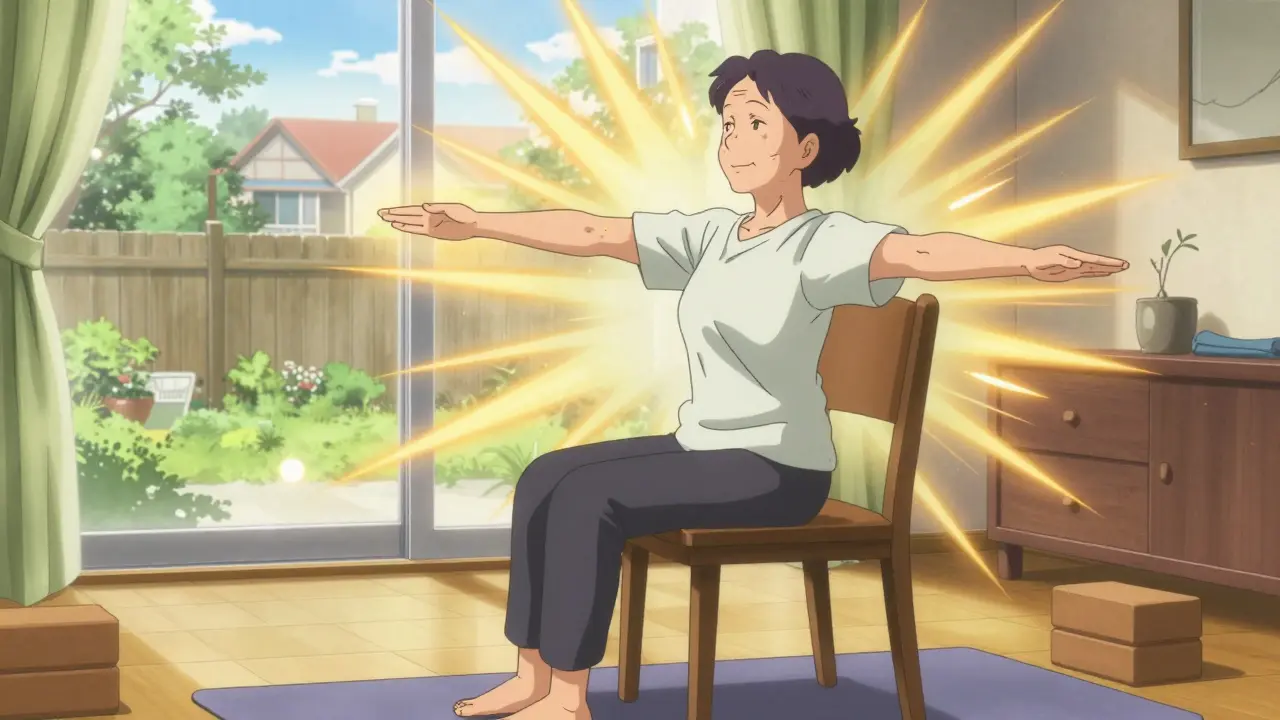
Yoga isn’t one thing. There are dozens of styles, but not all are right for pain. If you’re dealing with joint pain, back pain, or fibromyalgia, stick to gentle styles: Hatha and Restorative yoga. These use props-blocks, straps, bolsters-to support your body. You don’t have to touch your toes. You don’t even have to stand. Seated or lying-down poses work just as well. A 2024 NCCIH review of 18 studies on neck pain found that yoga combined with hot sand fomentation reduced pain by 37% and improved neck movement more than standard physical therapy. For lower back pain, a 2021 study of 3,484 people showed yoga was more effective than standard care after 12 weeks. The key? Consistency. You don’t need to do an hour every day. Even 15 minutes, three times a week, can make a difference. One woman in Melbourne, 58, with osteoarthritis in both knees, started with chair yoga. She did poses while sitting, using the chair for balance. After eight weeks, she could walk to the mailbox without painkillers. "I didn’t know my body could move like that again," she said.Tai Chi: The Martial Art That Heals
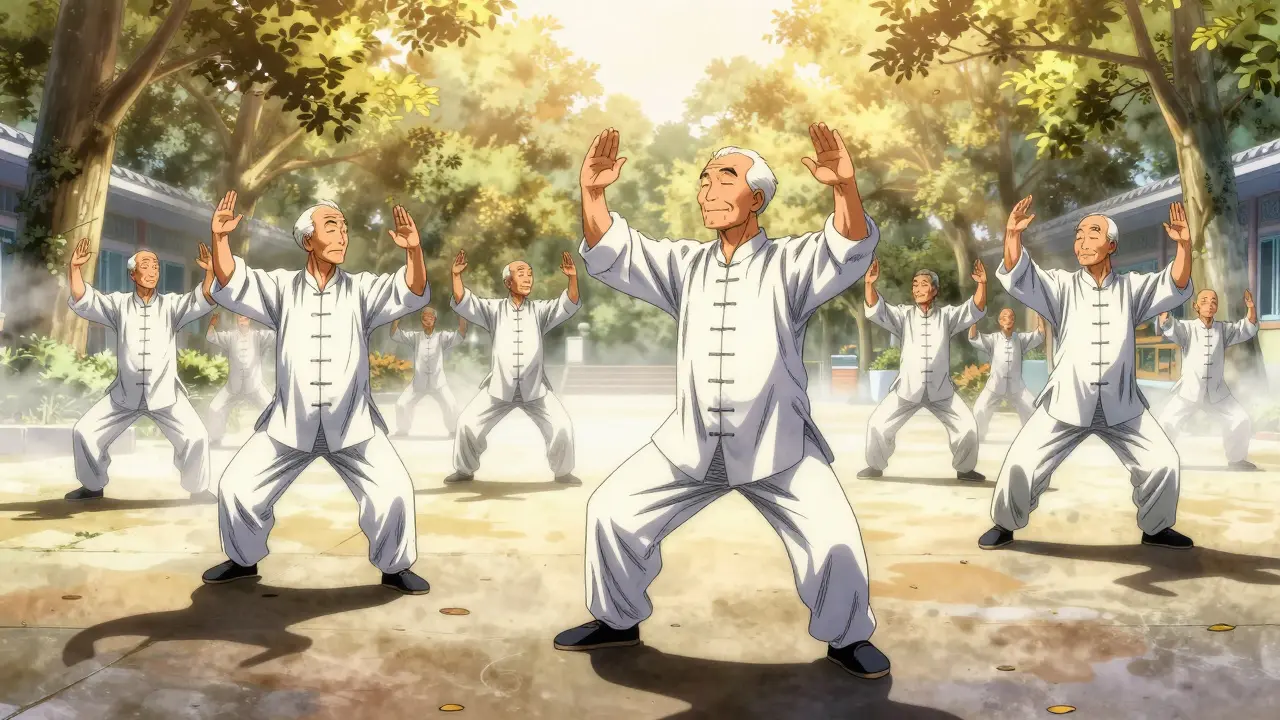
Tai chi looks like slow dancing. But it’s rooted in ancient Chinese martial arts. The movements are continuous, flowing, and coordinated with breath. This isn’t just exercise-it’s moving meditation. And for pain, that matters. A landmark 2018 study in the New England Journal of Medicine followed 66 people with fibromyalgia. Half did tai chi twice a week for 12 weeks. The other half did stretching and wellness education. The tai chi group had 27% more pain reduction, 31% fewer symptoms of depression, and 22% better sleep. They also moved better. Their balance improved by 18-25% compared to the control group. Why does tai chi work so well for older adults? Because it’s safe. It builds strength without impact. It improves balance so you’re less likely to fall. And because it’s done in groups, many people stick with it longer. Veterans using VA programs reported 68% reduced opioid use after six months of regular tai chi.Yoga vs. Tai Chi: Which One Is Right for You?
There’s no single winner. It depends on what you need.| Feature | Yoga | Tai Chi |
|---|---|---|
| Structure | Static poses + movement flows | Continuous, flowing sequences |
| Best for | Back pain, neck pain, stiffness | Balance issues, fibromyalgia, knee osteoarthritis |
| Typical session length | 45-90 minutes | 30-60 minutes |
| Frequency | 2-7 times per week | 2-4 times per week |
| Best beginner style | Hatha, Restorative | Yang or Sun style |
| Equipment needed | Mat, blocks, straps | Comfortable clothes, flat shoes |
| Best for men | 67% satisfaction | 82% satisfaction |
If you’re dealing with stiffness or tight muscles, yoga gives you more control over stretching. If you struggle with balance, feel shaky, or worry about falling, tai chi is your best bet. If you’ve tried yoga and felt it was too spiritual or too intense, tai chi might feel more natural. It’s martial, not mystical.
What the Research Really Says
Let’s cut through the noise. The evidence isn’t perfect-but it’s strong enough for major medical groups to take notice. The American College of Physicians recommends both yoga and tai chi for chronic low back pain. The Veterans Health Administration lists tai chi as a core therapy for pain management. Harvard Medical School calls tai chi a "first-line" treatment for fibromyalgia. And the National Institutes of Health just awarded $4.2 million to study exactly how these practices reduce pain. But here’s the catch: not all studies are created equal. Many have small groups. Some don’t compare tai chi or yoga to other active treatments. Still, the pattern is clear: when people stick with it, they feel better. And that’s not placebo. Brain scans show reduced activity in pain-processing areas after just 8 weeks of practice.How to Start Without Getting Hurt
Starting is easy. Getting hurt? That’s the risk. The biggest mistake? Pushing too hard too fast. A 2022 study found that 39% of new users felt more pain in the first few weeks-not because the practice was bad, but because they did too much too soon. Here’s how to start right:- Begin with 10-15 minutes a day. Not an hour. Just 10.
- Use a chair. If standing hurts, sit. You can do tai chi and yoga seated. Many online classes offer chair modifications.
- Find an instructor who knows pain. Look for teachers certified in therapeutic yoga or tai chi for arthritis. Avoid instructors who say "just push through the pain."
- Start slow. Aim for 6-8 weeks before expecting results. Pain relief doesn’t happen overnight.
- Use free apps. The Arthritis Foundation’s "Tai Chi for Arthritis" and Yoga Medicine’s "Yoga for Chronic Pain" are both evidence-based and free to try.
One man in his 70s with spinal stenosis started with a 10-minute YouTube video. He did it every morning before coffee. After three months, he could walk his dog without stopping. "I didn’t think I’d ever move like that again," he said.
Cost, Access, and Insurance
You don’t need expensive gear or a pricey membership. Community centers often charge $10-15 per class. Online subscriptions like Glo or Alo Moves run $18-29 a month. But you don’t need to pay. Free YouTube channels like "Yoga with Adriene" and "Tai Chi for Health Institute" offer high-quality, pain-friendly classes. Insurance coverage is still limited-but growing. Blue Cross Blue Shield now covers tai chi and yoga programs in 12 states. The VA covers both for veterans. Starting in January 2025, doctors in the U.S. will be able to bill insurance for referring patients to these therapies. That’s a big deal. It means they’re being treated like real medicine, not just "nice to have."
Real People, Real Results
On Reddit’s r/ChronicPain community, 78% of people who tried tai chi reported "moderate to significant" pain reduction. One user wrote: "I can do seated tai chi on high-pain days when yoga isn’t possible." Another said: "I stopped taking painkillers after six months. I didn’t realize I was in that much pain until it was gone." On Healthline, 34% of negative reviews mentioned difficulty with standing poses. That’s why modifications matter. Chair yoga. Seated tai chi. Wall support. These aren’t "watered-down" versions-they’re the most effective for people with pain.What to Avoid
Don’t do these:- Don’t try advanced poses like headstands or deep backbends if you have back or neck pain.
- Don’t push into pain. Discomfort is normal. Sharp pain is not.
- Don’t skip the breath. If you’re holding your breath, you’re not doing it right.
- Don’t rely on YouTube alone if you have severe pain. Find a qualified instructor-even if it’s just one session to learn how to modify.
One woman in Melbourne tried a tai chi class where the instructor didn’t know how to adapt for knee osteoarthritis. Her pain got worse for two weeks. "I almost gave up," she said. "Then I found a physio who taught tai chi. Everything changed."
Can You Do Both?
Yes. And you should. The American Chronic Pain Association found that combining yoga or tai chi with conventional treatments-like physical therapy or medication-leads to 30-40% better outcomes than either alone. Yoga helps you stretch and release tension. Tai chi helps you move with control and confidence. Together, they build a stronger, calmer body.Try yoga on Monday and Wednesday. Tai chi on Friday. Or do 15 minutes of each every day. There’s no rule. Just move. Breathe. Show up.
What’s Next?
The future of pain management isn’t more pills. It’s more movement. More mindfulness. More personalization. Researchers are now testing virtual reality tai chi programs that give real-time feedback on your form. The VA is rolling them out. Early results show 28% better adherence than traditional classes. What’s clear is this: if you’re tired of pain controlling your life, yoga and tai chi offer a path forward-gentle, sustainable, and deeply human. You don’t need to be strong. You don’t need to be young. You just need to begin.Can yoga or tai chi really reduce chronic pain, or is it just placebo?
Yes, they can. Multiple high-quality studies, including those published in the New England Journal of Medicine and reviewed by the National Institutes of Health, show measurable pain reduction in conditions like fibromyalgia, osteoarthritis, and chronic low back pain. Brain imaging studies confirm reduced activity in pain-processing areas after consistent practice. This isn’t just feeling better-it’s actual physiological change.
I have severe arthritis. Can I still do tai chi or yoga?
Absolutely. Both practices can be adapted for limited mobility. Chair yoga and seated tai chi are widely used in clinical settings for people with arthritis, spinal stenosis, or joint replacements. The key is working with an instructor trained in therapeutic movement. Many classes specifically designed for arthritis focus on gentle joint movement, balance, and breathing-without stressing damaged areas.
How long until I feel results from yoga or tai chi?
Most people notice small improvements-like better sleep or less stiffness-after 4-6 weeks. Significant pain reduction typically takes 8-12 weeks of consistent practice. Studies show the best results happen after 12 weeks of doing it 2-4 times per week. Don’t quit if you don’t feel it right away. The benefits build slowly, like muscle strength.
Is tai chi better than yoga for pain?
It depends on your needs. Tai chi is especially strong for balance, fall prevention, and fibromyalgia. Yoga tends to be more effective for stiffness, tight muscles, and neck or back pain. Both reduce stress and improve body awareness. Many people use both: yoga for stretching and release, tai chi for fluid movement and calm. Neither is "better." They’re different tools for the same goal.
Do I need special equipment or clothing?
No. For yoga, a nonslip mat helps, but you can use a towel on carpet. Blocks and straps are useful but not required-you can use books or belts instead. For tai chi, wear loose, comfortable clothes and flat, flexible shoes (or go barefoot). You don’t need to buy anything expensive. Many people start with what they already have.
Can I do yoga or tai chi if I’m on pain medication?
Yes. In fact, many people use these practices to reduce their reliance on medication. The American Chronic Pain Association recommends combining them with conventional treatments, not replacing them. Talk to your doctor about timing-some find it helps to practice after taking medication when pain is lower. Others prefer doing it before, to build body awareness without numbing.
Where can I find a qualified instructor?
Look for instructors certified in therapeutic yoga (Yoga Therapy) or tai chi for arthritis (through the Arthritis Foundation). Hospitals, rehab centers, and community health clinics often offer classes led by trained professionals. Avoid instructors who push you into painful poses or don’t ask about your health conditions. A good teacher will modify movements for your body-not the other way around.

Jody Patrick
December 18, 2025 at 11:09This is just woke nonsense. Yoga and tai chi? For pain? My grandpa fixed his back with whiskey and hard work. Stop coddling people with feel-good fluff.
Radhika M
December 18, 2025 at 17:33My aunt had arthritis. She did chair yoga every morning. After 2 months, she could walk to market without cane. No magic. Just slow movement and breath. Try it. No need to be fit.
Philippa Skiadopoulou
December 20, 2025 at 14:24While the anecdotal evidence is compelling, the methodological limitations of many cited studies warrant caution. The lack of standardized protocols across yoga and tai chi interventions introduces significant variability. Furthermore, the absence of long-term follow-up data limits conclusions regarding sustained efficacy.
Pawan Chaudhary
December 21, 2025 at 19:37You got this! Even 10 minutes a day is a win. I started with YouTube videos and now I feel like a new person. No painkillers, better sleep, and I actually smile in the morning. You don’t need to be perfect-just show up.
Jonathan Morris
December 22, 2025 at 00:08Let’s be clear: this is a government-funded distraction. The NIH spent $4.2 million proving what chiropractors knew in 1987. The VA promotes tai chi because it’s cheaper than opioids-and the pharmaceutical lobby is furious. Don’t be fooled. This isn’t medicine. It’s cost-cutting wrapped in mindfulness.
Linda Caldwell
December 22, 2025 at 06:04Just started sitting tai chi last week. My knees still ache but I slept through the night for the first time in years. No hype. No fancy gear. Just me, a chair, and 12 minutes of slow moves. You don’t need to be flexible. You just need to try.
Anna Giakoumakatou
December 23, 2025 at 15:02Oh look, another sanctimonious article about ‘gentle movement’ as if the rest of us are just too dumb to understand that pain is a spiritual lesson. I’ve had three hip replacements. Do you think I need to ‘flow like water’ or do I need a damn MRI and a surgeon who doesn’t charge $300/hour to say ‘maybe try not to run marathons’?
CAROL MUTISO
December 24, 2025 at 08:51It’s funny how we’ve turned ancient wisdom into a checklist: ‘Do yoga 3x a week, use blocks, track sleep, avoid headstands.’ Meanwhile, the real magic was never in the pose-it was in the quiet. The breath. The permission to stop fighting your body. We’ve commodified stillness until it costs $29/month on Glo. But hey, at least we’re now billing insurance for mindfulness. Progress?
Steven Lavoie
December 25, 2025 at 03:53I’m from Vietnam. My grandmother practiced tai chi every sunrise by the river. She never had pain. Not because she was strong-but because she moved with patience. This isn’t exercise. It’s respect. For your body. For time. For breath. You don’t need to understand it. Just let it find you.
Patrick A. Ck. Trip
December 26, 2025 at 06:33im not sure if this is real or not but i heard from my cousin who works at a clinic that tai chi really helps with balance. i think its worth trying even if its just for 5 mins. dont push too hard. just be gentle. i believe in you.
Sam Clark
December 26, 2025 at 12:07For individuals with chronic pain, the integration of low-impact, mind-body practices into clinical care represents a paradigm shift toward patient-centered, non-pharmacological intervention. The longitudinal data supporting reduced opioid utilization and improved functional mobility is statistically significant and clinically meaningful. I encourage all providers to consider referral pathways.
Jessica Salgado
December 27, 2025 at 21:14I tried yoga after my accident. First week? I cried. Second week? I cried harder. Third week? I didn’t cry-I just breathed. And then, one morning, I stood up without grabbing the counter. I didn’t think I’d ever feel that again. I’m not healed. But I’m not broken anymore either.
Chris Van Horn
December 29, 2025 at 04:37Let’s be honest-this entire article is a corporate PR stunt disguised as science. Yoga studios pay researchers. The VA promotes tai chi because it’s cheaper than surgery. And now they’re billing insurance? This isn’t medicine. It’s a marketing funnel. The real solution? Stop sitting all day. Stop eating processed food. Stop pretending movement is a ‘therapy’ and not a basic human need. This is all just distraction.