
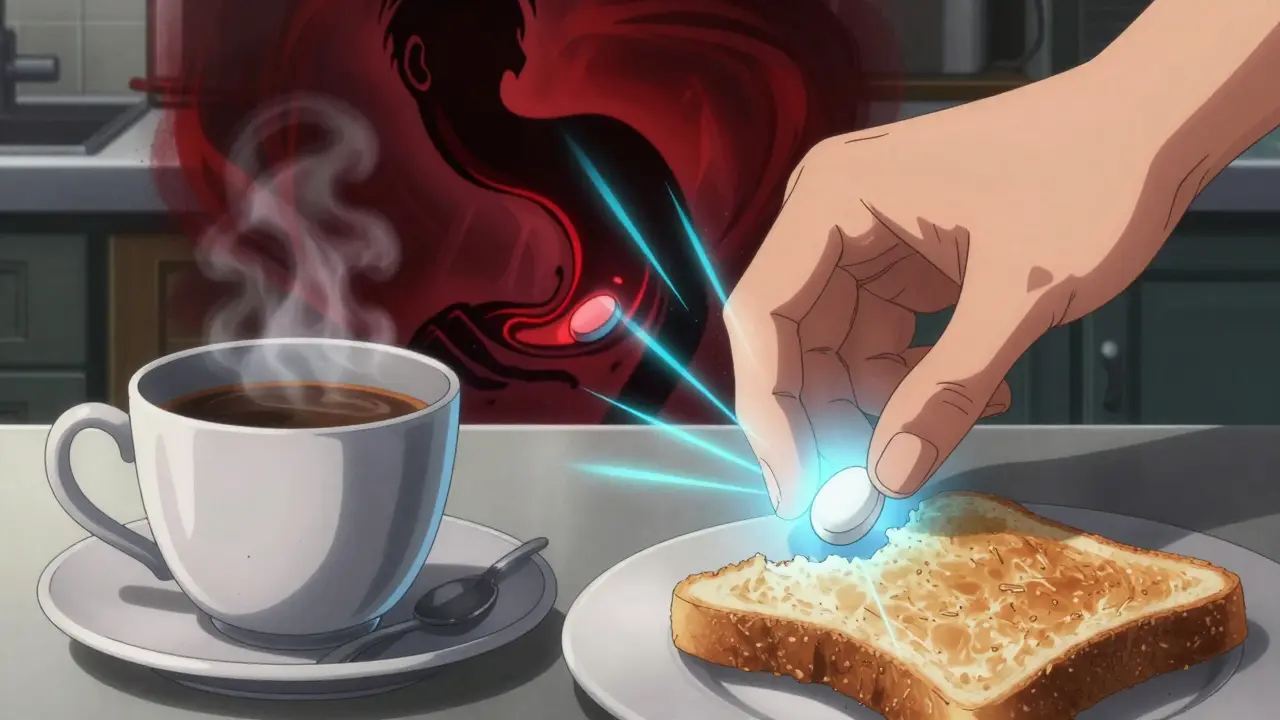
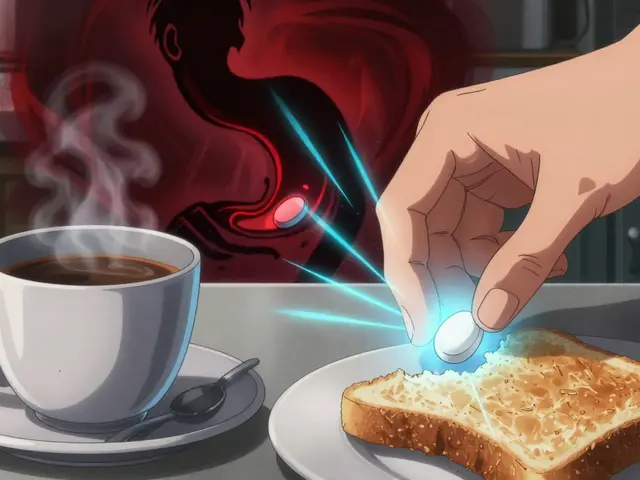
Ever taken a pill with your morning coffee and wondered why it didn’t seem to work? You’re not alone. Many people don’t realize that when they take their meds-before, with, or after food-can make the difference between healing and harm. It’s not just about swallowing a pill. It’s about timing it right.
Why Food Changes How Your Meds Work
Food doesn’t just fill your stomach. It changes your whole digestive environment. When you eat, your stomach pH rises from super acidic (1-2) to much milder (3-5). That might sound harmless, but for some drugs, it’s a dealbreaker. Acid-sensitive meds like penicillin V break down faster in less acidic conditions, cutting their effectiveness by up to 40%. Meanwhile, high-fat meals slow down how fast your stomach empties-sometimes by over two hours. That delay can wreck the timing of drugs that need to hit your bloodstream fast, like levothyroxine.Medications That Must Be Taken on an Empty Stomach
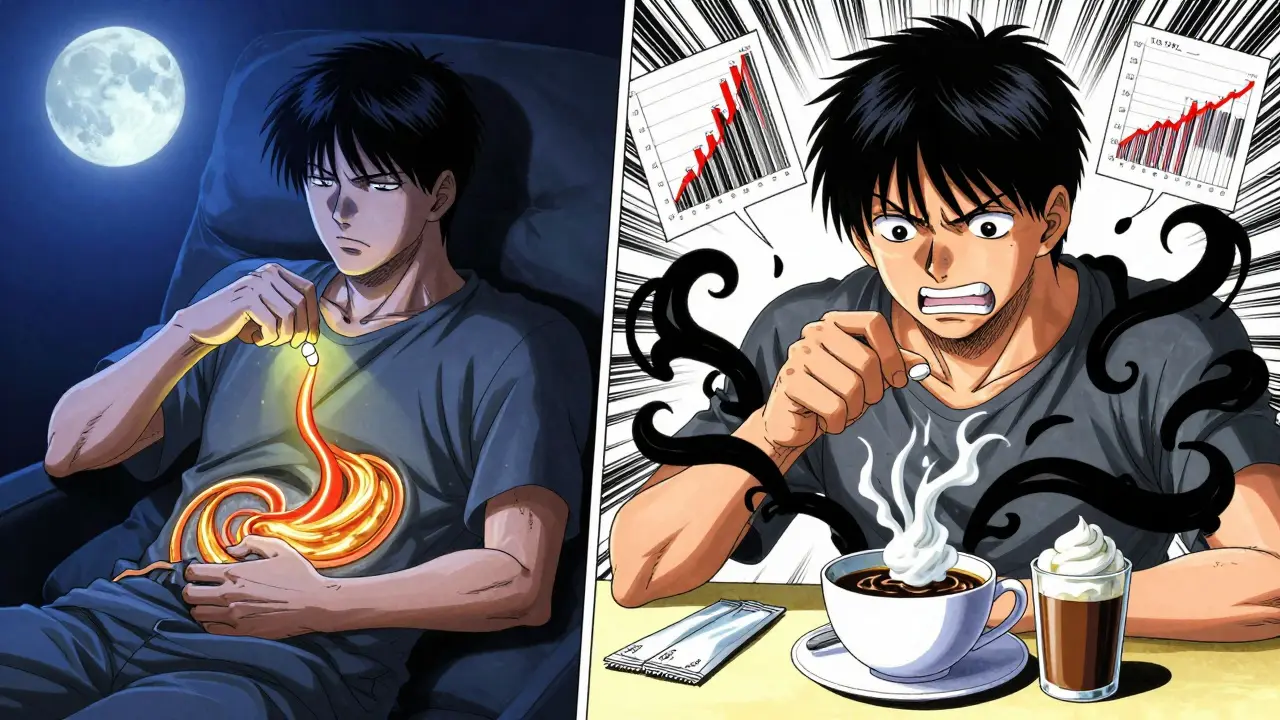
Some drugs simply don’t work well with food. Take levothyroxine (Synthroid), the most common thyroid medication. Studies show food can reduce its absorption by 20% to 50%. That’s not a small drop-it’s enough to throw your TSH levels out of whack. One patient on Reddit spent two years chasing weird symptoms until they realized their coffee with cream was blocking absorption. Now they take it at 4 a.m. and wait 90 minutes before eating. That’s not extreme-it’s necessary.Alendronate (Fosamax), used for osteoporosis, is another critical case. If you take it with breakfast, you get only 40% of the drug you paid for. That’s because food binds to it in the gut, preventing absorption. The same goes for sucralfate (Carafate), which needs an empty stomach to form a protective coating over ulcers. Take it after eating, and it’s useless.
Ampicillin and zafirlukast (Accolate) also suffer major drops in absorption when taken with food. Ampicillin’s peak concentration falls by 35%, and zafirlukast’s by 40%. Both are labeled for use 1 hour before or 2 hours after meals. And don’t forget proton pump inhibitors like omeprazole and esomeprazole. They work by blocking acid production triggered by food. If you take them after breakfast, you’re late to the party. They need to be taken 30 to 60 minutes before eating. Nexium specifically requires at least an hour before food. Pantoprazole is the exception-it works fine either way.
Medications That Need Food to Work Right
Not all meds hate food. Some actually need it.NSAIDs like ibuprofen and naproxen are a big one. Without food, they irritate your stomach lining. Studies show taking them with food cuts your risk of ulcers and bleeding by 50% to 70%. The American College of Gastroenterology says over 10,000 people are hospitalized each year from NSAID-related GI damage-most of which could’ve been avoided by just eating first.
Aspirin, especially at higher doses for pain, follows the same rule. One Bayer study showed stomach irritation dropped from 25% to just 8% when taken with food. That’s a huge win for anyone taking it regularly.
Duloxetine (Cymbalta), an antidepressant, causes nausea in many users. But take it with a meal, and nausea drops by 30%. Same goes for mesalamine, used for IBD. One patient on HealthUnlocked said taking it with food turned daily nausea into a once-a-month nuisance-life-changing.
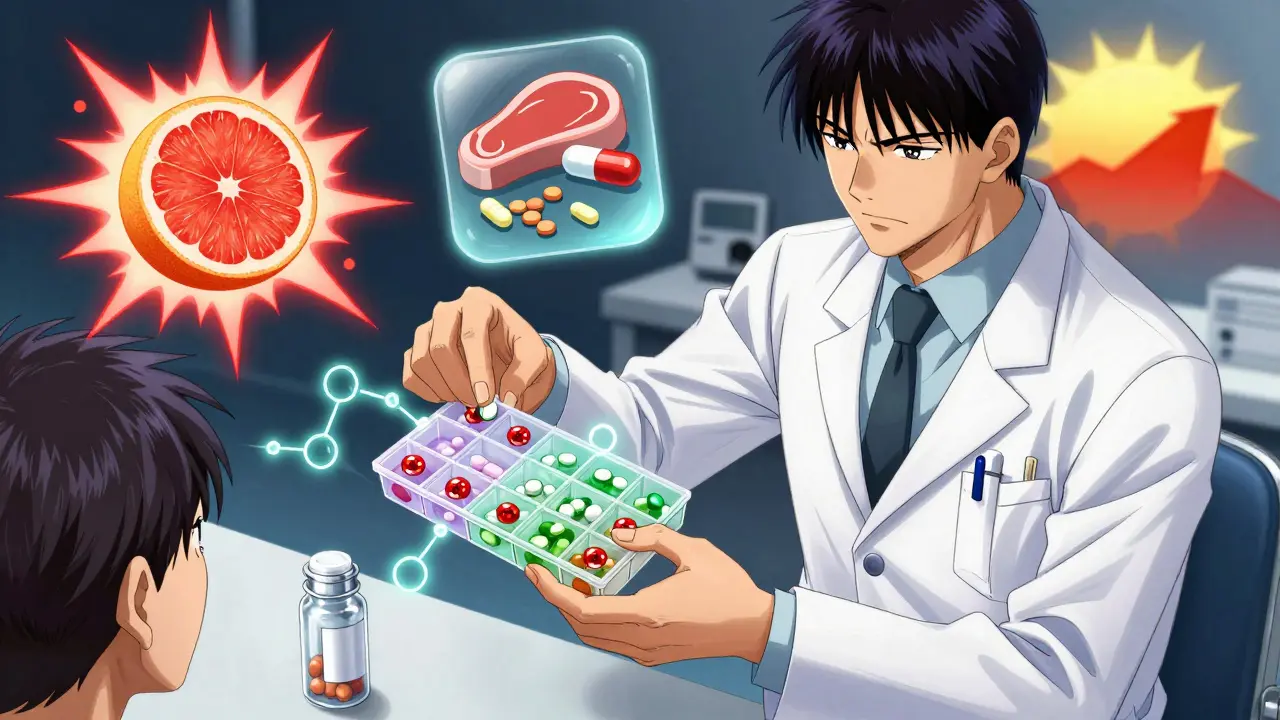
Statins like atorvastatin and simvastatin absorb better with food. But here’s the catch: grapefruit juice is a no-go. It can spike statin levels by 300% to 500%, raising your risk of muscle damage (rhabdomyolysis) by 15 times. Even a single glass can do it. So if you’re on a statin, skip the grapefruit. Ever.
The Science Behind the Rules
It’s not magic. It’s chemistry and biology.Calcium and iron in dairy or supplements can bind to antibiotics like tetracycline, blocking absorption by up to 75%. That’s why you’re told to wait two hours after dairy before taking it. Bile, released when you eat fat, helps dissolve fat-soluble drugs like griseofulvin. Without food, you get barely half the benefit.
Even the size of your meal matters. The FDA requires drug makers to test their meds with both high-fat (800-1,000 calories) and low-fat (250-300 calories) meals. Why? Because a big steak will delay absorption longer than a banana. That’s why the standard advice is: “empty stomach” means 1 hour before or 2 hours after eating. “With food” means during or up to 30 minutes after a meal with at least 500-800 calories.
What Happens When You Ignore the Rules
It’s not just about feeling worse. It’s about real, measurable harm.When people take levothyroxine with breakfast, their TSH levels rise-meaning their thyroid isn’t getting enough hormone. One study found this mistake made them functionally equivalent to missing 25% of their doses. To compensate, doctors had to raise their dose by 30%. That’s dangerous over time.
For PPIs like Nexium, taking them after food slashes healing rates for esophagitis from 93% down to 67% in eight weeks. That means more pain, more visits, more risk of complications.
A 2022 survey of 10,000 patients found 65% ignored food timing instructions. Of those, 41% said their meds didn’t work as well. 29% had worse side effects. The most common mistake? Taking NSAIDs on an empty stomach. Over 70% of those users ended up with stomach pain.
How to Get It Right Every Time
Here’s how to stop guessing and start getting it right.Use the 2-1-2 Rule: If your med needs an empty stomach, take it 2 hours after eating, or 1 hour before your next meal. If it needs food, take it during or within 30 minutes of eating.
Use pill organizers labeled “before food” and “with food.” A 2022 study showed this improved adherence by 35%. Apps like Medisafe and GoodRx now send alerts for food timing-and users who use them cut errors by 28%.
Pharmacies like CVS and Walgreens now put color-coded stickers on bottles: red for empty stomach, green for with food. In a pilot study, this boosted correct use from 52% to 89%.
If you’re on multiple meds, stagger them. Take empty-stomach meds at 7 a.m., then eat at 7:30, then take food-requiring meds at 8 a.m. That way, you’re not fighting your schedule.
The Future: Less Guesswork, More Precision
New drugs are being designed to ignore food entirely. Johnson & Johnson’s Xarelto Advanced uses a special coating that releases the drug regardless of what’s in your stomach. It cuts variability from 35% to just 8%.Researchers at the University of Michigan are testing nanoparticles that stick to the gut lining, bypassing stomach acid altogether. Early results for levothyroxine show 92% consistent absorption-fed or fasted.
But here’s the truth: these new drugs are still rare. For now, 75% of the medications you’re likely taking still depend on food timing. That means learning the rules isn’t optional-it’s essential.
When in Doubt, Ask Your Pharmacist
Doctors often don’t have time to explain this. But pharmacists? They’re trained for it. A 2021 study found 92% of pharmacists give clear food timing instructions. Only 45% of doctors do.Don’t assume. Don’t guess. Ask. Your pill bottle says “take with food”? Ask: “What counts as food? Do I need a full meal?” Your med says “empty stomach”? Ask: “Is water okay? What about coffee or tea?”
It’s not about being perfect. It’s about being informed. One small change-taking your pill 30 minutes earlier or later-can mean the difference between control and chaos.
Can I take my medication with just water?
Yes, water is fine for most medications, whether taken with food or on an empty stomach. But avoid coffee, tea, milk, or juice unless your pharmacist says it’s safe. These can interfere with absorption. For example, calcium in milk blocks tetracycline, and caffeine in coffee can reduce levothyroxine absorption.
What if I forget and take my pill with food?
Don’t panic. If you accidentally took a medication that needs an empty stomach with food, wait until your next scheduled dose and go back to the correct timing. Don’t double up-this can be dangerous. If you took a food-requiring med on an empty stomach and feel nauseous or dizzy, monitor symptoms. If they persist, call your pharmacist. For most meds, one mistake won’t ruin your treatment, but consistency matters over time.
Do over-the-counter meds have food interactions too?
Absolutely. NSAIDs like ibuprofen and naproxen can cause stomach bleeding if taken without food. Aspirin at high doses needs food to reduce irritation. Even some antacids and supplements like iron or calcium can interfere with antibiotics or thyroid meds. Always read the label and check with your pharmacist-even for OTC drugs.
Is it okay to take meds with a snack instead of a full meal?
It depends. For meds that require food, a light snack (like a banana or a few crackers) may not be enough. Most guidelines assume a meal of 500-800 calories. A small snack won’t trigger enough bile or slow gastric emptying properly. If your med says “with food,” aim for a real meal-not just a handful of nuts or a granola bar.
Can I take all my meds at once with breakfast?
No, and this is a common mistake. Some meds need an empty stomach, others need food, and some can’t be taken together at all. For example, levothyroxine and calcium supplements should be spaced at least 4 hours apart. Taking everything at once can cancel out benefits or cause side effects. Always ask your pharmacist for a schedule tailored to your specific meds.
Why do some pills say “take on an empty stomach” but the instructions are confusing?
Because the language isn’t always clear. “Empty stomach” usually means 1 hour before or 2 hours after eating. But if your doctor says “take before breakfast,” they might mean right when you wake up, before coffee. Always clarify: “Do you mean before I even drink water?” or “Is my morning coffee considered food?” Pharmacists can decode these phrases and give you a clear plan.
Final Tip: Make It a Habit
Your body doesn’t care about your schedule. It responds to chemistry. If you want your meds to work, treat food timing like brushing your teeth-non-negotiable. Write it down. Set an alarm. Use color-coded stickers. Ask your pharmacist. Small actions, big results.
Stuart Shield
January 5, 2026 at 14:49Man, I wish I’d known this five years ago. Took my Synthroid with my morning latte for ages-thought it was fine since I ‘drank it fast.’ Turns out the cream and heat were sabotaging my TSH. Now I take it at 5 a.m. with a glass of water, wait 90 minutes, then enjoy my coffee like a free man. No more brain fog. No more fatigue. Just… normal. Life’s weird like that-tiny habit, massive payoff.
Also, never thought about how grapefruit juice could turn my statin into a chemical grenade. Now I just eat oranges. Sad, but safe.
Jeane Hendrix
January 7, 2026 at 01:25Okay but like… why do we even have these convoluted rules? Like, if a drug’s bioavailability is so fragile, shouldn’t pharma just engineer it to be stable? I get it, chemistry is hard, but we’re talking about millions of people screwing this up daily. Isn’t this a systemic failure? Also, ‘with food’-does a single almond count? I’m asking for a friend who’s currently in a 3-hour debate with their pill organizer.
Also, why do PPIs need to be taken before food if food triggers acid? That’s like locking the door after the burglar already stole the TV. Just sayin’.
Katie Schoen
January 8, 2026 at 23:04So let me get this straight: I’ve been taking my Cymbalta on an empty stomach like a rebel for 3 years and now I’m surprised I feel like a crying zombie at 2 p.m.? 🤦♀️
Just ate a PB&J and took it. 10 minutes later, my stomach stopped trying to exit my body. I’m not crying. I’m not screaming. I’m just… here. Alive. Thanks, science. And also, thanks to whoever wrote this post-this should be mandatory reading before your first prescription.
Cam Jane
January 10, 2026 at 08:28Y’all are overcomplicating this. Here’s the cheat code: if the label says ‘empty stomach,’ take it when you wake up before anything else-not even water if it says ‘strictly.’ If it says ‘with food,’ take it with your first real meal, not a handful of almonds. And if you’re on more than 3 meds, get a pill organizer with time slots and color-code it. Red = fast, green = feed.
Pro tip: Pharmacies now put those stickers on bottles. If yours doesn’t, ask. They’ll do it for free. No shame. Your liver will thank you.
Also, don’t take iron and thyroid meds at the same time. They cancel each other out like two toddlers fighting over a toy. 4-hour gap. Set a phone alarm. You got this.
Isaac Jules
January 11, 2026 at 04:32LMAO at people acting like this is groundbreaking info. I’ve been a pharmacist for 12 years. This is Med School 101. You people take ibuprofen like it’s candy and wonder why your stomach’s in ICU. And don’t even get me started on the ‘I take my levothyroxine with my oatmeal’ crowd.
Stop Googling. Stop Reddit-ing. Go talk to your pharmacist. They’re literally paid to tell you this stuff. And if they don’t? Find a new one. This isn’t ‘alternative health’-it’s pharmacology. You wouldn’t drive a Tesla with a horse’s saddle. Don’t medicate like a caveman.
Amy Le
January 12, 2026 at 07:14It’s not about food timing. It’s about capitalism. Pharma companies don’t want you to take meds correctly-they want you to take MORE meds because you’re ‘doing it wrong.’ That’s why they don’t make stable versions. Why? Profit. Levothyroxine? Generic. $4. But if you’re TSH is off? You get a new test. A new doctor visit. A new prescription. $$$
And don’t get me started on ‘color-coded stickers.’ That’s a Band-Aid on a bullet wound. We need systemic change, not stickers.
Also, ‘ask your pharmacist’? Lol. They’re overworked and paid minimum wage. They’re not your therapist. They’re not your doctor. They’re a glorified dispenser.
Wake up, sheeple.
Susan Arlene
January 13, 2026 at 07:25weird how something so simple is so hard
i just take my pills when i remember
if i feel weird i stop
if i feel fine i keep going
maybe i’m dumb
or maybe the system is broken
why does my body have to be a chemistry lab just to survive
Ashley S
January 13, 2026 at 20:48So basically, if you’re not a scientist with a lab coat and a timer, you’re just gonna die from your own meds? Great. So now I’m supposed to plan my life around pills like they’re gods? My coffee? My breakfast? My sleep schedule? All secondary to a tiny white pill?
I’m not doing it. I’m not becoming a robot. If my body can’t handle it, then maybe the drug isn’t right for me. I’d rather feel a little off than lose my autonomy to a label.
Rachel Wermager
January 15, 2026 at 20:30Actually, the FDA’s bioequivalence guidelines require testing with high-fat meals (800-1000 kcal) precisely because gastric emptying time and bile secretion are nonlinear. The 2-1-2 rule is a simplification-some drugs like raltegravir have food effects that peak at 2.5 hours post-meal. And for PPIs, the key isn’t just timing-it’s the proton pump activation cycle. Taking them after eating means you’re inhibiting pumps that were already activated, so you’re 90 minutes late to the party. That’s why Nexium’s AUC drops 40% with post-meal dosing.
Also, grapefruit isn’t the only inhibitor. Seville oranges, pomelos, and even starfruit can inhibit CYP3A4. And for statins, simvastatin’s half-life extends from 3 to 12 hours with grapefruit. That’s not a ‘risk’-that’s a pharmacokinetic bomb.
TL;DR: This post is still too soft. You need to know the enzyme pathways.