

Every year, thousands of infants end up in emergency rooms because someone gave them the wrong amount of medicine. Not because they were careless - but because they didn’t know how to read the label. A single drop too much, a teaspoon instead of a milliliter, confusing infant and children’s formulas - these aren’t just mistakes. They’re life-threatening. In 2022, nearly 12,000 infants under one year old were treated for medication errors in U.S. hospitals. Most of these cases involved liquid medicines like acetaminophen or ibuprofen. The good news? Almost all of them were preventable.
Why Infant Medication Is So Different
Babies aren’t small adults. Their bodies process medicine differently. A dose that’s safe for a 2-year-old could be deadly for a 3-month-old. That’s why infant medications come in specific concentrations - and why you can’t just guess. The most common error? Mixing up infant and children’s acetaminophen. Before 2011, you could buy infant acetaminophen in two forms: one with 80 mg per 1 mL (concentrated drops), and another with 160 mg per 5 mL (less concentrated). Parents accidentally gave five times the right dose because they thought they were using the same thing. The FDA stepped in and banned the 80 mg/mL version. Now, all infant acetaminophen must be labeled 160 mg per 5 mL. But here’s the catch: children’s acetaminophen is still 160 mg per 10 mL. If you use the wrong one - or the wrong measuring tool - you’re giving your baby a dangerous overdose.How to Measure Medicine Correctly
Stop using kitchen spoons. Seriously. A teaspoon from your drawer isn’t 5 mL. It’s usually more. And if you’re using a dropper that came with the medicine? You’re still at risk. A 2018 study found that 74% of parents gave the wrong dose using droppers because the drops weren’t consistent in size. The only tool you should use for infants is an oral syringe - the kind with clear milliliter (mL) markings. Look for one that measures in 0.1 mL or 0.2 mL increments. These are the gold standard. A 2020 study at Cincinnati Children’s Hospital showed that parents using oral syringes got the dose right 89% of the time. Those using medicine cups? Only 62%. Here’s how to use it:- Draw the exact amount from the bottle into the syringe.
- Don’t let any air bubbles in - they throw off the volume.
- Place the tip gently inside your baby’s cheek, not at the back of the throat.
- Push the plunger slowly so they can swallow without choking.
Understanding Concentrations - The #1 Killer Mistake
Concentration isn’t just a word on the label. It’s your baby’s safety line. - Infant acetaminophen: 160 mg per 5 mL (that’s 32 mg per mL) - this is the only version you should use for babies under 1 year. - Children’s acetaminophen: 160 mg per 10 mL (16 mg per mL) - this is for kids over 2 years. Using this for an infant means you’re giving half the dose you think you are. - Infant ibuprofen: 50 mg per 1.25 mL (40 mg per mL) - this is more concentrated than children’s ibuprofen, which is 100 mg per 5 mL (20 mg per mL). Again, never swap them. If you’re unsure, read the label twice. Then read it again. Write down the concentration. Then compare it to what your doctor or pharmacist told you. If it doesn’t match - don’t give it. Call your provider.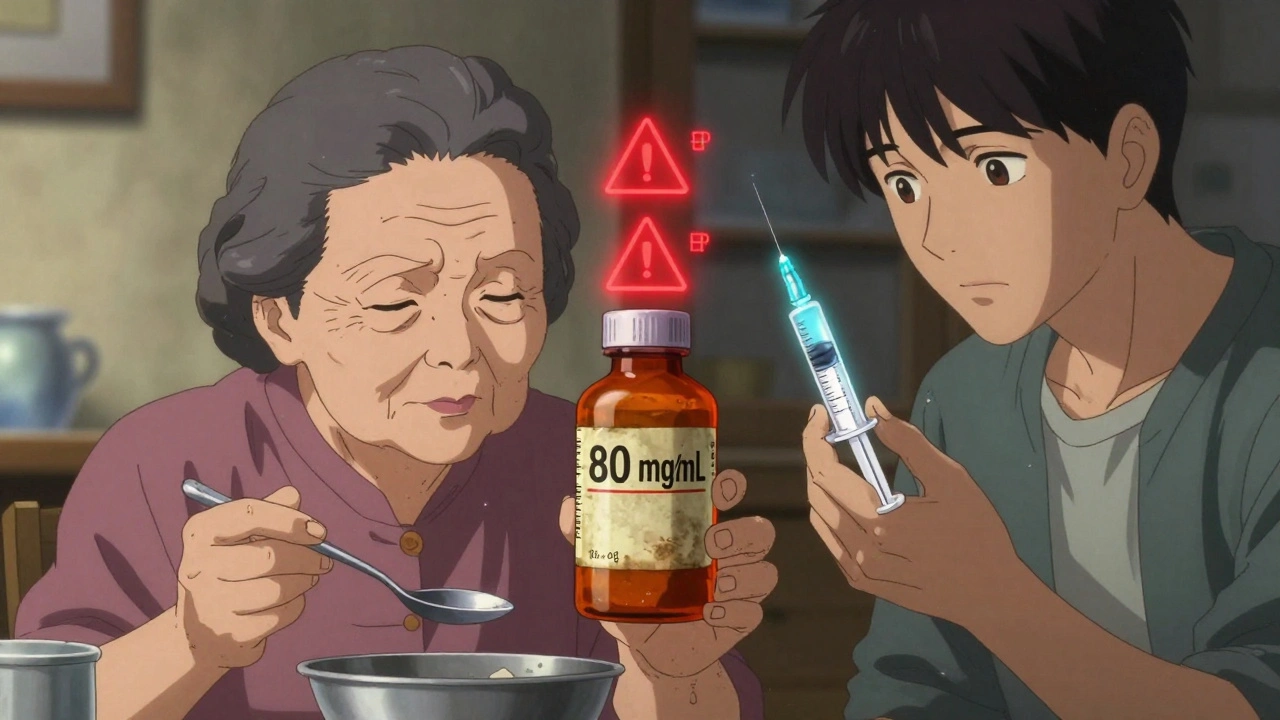
Dosing by Weight - Not Age
Age doesn’t determine the dose. Weight does. And most parents don’t know their baby’s weight in kilograms. Here’s the formula:- Acetaminophen: 10-15 mg per kg of body weight, every 4-6 hours (max 5 doses in 24 hours)
- Ibuprofen: 5-10 mg per kg, every 6-8 hours (max 4 doses in 24 hours)
Who’s Most at Risk? (Spoiler: It’s Not Just Parents)
Grandparents, babysitters, and even older siblings are often the ones giving the medicine. And they’re more likely to make mistakes. A 2023 study found caregivers over 65 made over three times more dosing errors than parents under 30. Why? Outdated knowledge, vision problems, and confusion over old labels. Many still remember the 80 mg/mL drops that were banned over a decade ago. If someone else is giving the medicine, sit down with them. Show them the syringe. Read the label together. Make sure they know the weight and the concentration. Also, be wary of multi-symptom products. Cold and cough medicines with acetaminophen, antihistamines, and decongestants? The FDA advises against them for kids under 6. Why? Because you’re not just giving one medicine - you’re giving three, and you might accidentally double up on acetaminophen. That’s how liver damage starts.The Five-Step Safety Check
The CDC and the American Academy of Pediatrics agree on one thing: if you follow this five-step process, you cut your risk of error by over 80%.- Confirm weight in kilograms - Use a baby scale or ask your pediatrician for the latest weight.
- Calculate the dose - Use 10-15 mg/kg for acetaminophen, 5-10 mg/kg for ibuprofen.
- Verify the concentration - Look at the bottle. Is it 160 mg/5 mL? If not, stop.
- Use only an oral syringe - No cups, no droppers, no spoons.
- Double-check with someone else - Even if you’re sure, get a second set of eyes.

What to Do If You Make a Mistake
If you gave too much - even a little - call Poison Control immediately. In the U.S., it’s 1-800-222-1222. In Australia, it’s 13 11 26. Don’t wait for symptoms. Don’t try to make your baby vomit. Just call. Poison Control centers handled over 14,000 infant medication queries in 2022. In 99% of cases, they prevented a trip to the ER by giving clear, real-time advice. If you’re unsure whether the dose was wrong, err on the side of caution. It’s better to call and be told you’re fine than to wait and regret it.The Future Is Here - And It’s Smarter
New tech is making this easier. In January 2023, the FDA approved the first connected oral syringe - the MediSafe SmartSyringe. It pairs with an app to verify the correct dose, alert you if you’re about to give too much, and even remind you when it’s time for the next dose. Clinical trials showed 98.7% accuracy. While these aren’t yet common in homes, the trend is clear: medicine is becoming smarter. But until then, your syringe, your label, and your double-check are your best tools.Final Reminder: When in Doubt, Don’t Guess
You don’t need to be a pharmacist to keep your baby safe. You just need to be careful. Always read the label. Always use a syringe. Always check the concentration. Always ask if you’re unsure. Medicines are powerful. For babies, they’re also fragile. One drop can make the difference between healing and harm. Don’t let confusion be the reason your baby pays the price.Can I use a kitchen teaspoon to measure infant medicine?
No. Kitchen teaspoons vary in size and are not accurate. A standard teaspoon holds between 4.5 and 6 mL, not the exact 5 mL needed. Using one can lead to overdoses of 20% or more. Always use an oral syringe with mL markings.
Is infant acetaminophen the same as children’s acetaminophen?
No. Infant acetaminophen is 160 mg per 5 mL. Children’s acetaminophen is 160 mg per 10 mL. Using children’s formula for an infant gives half the intended dose. Using infant formula for a child gives too much. Never swap them. Always check the concentration on the label.
What should I do if I give my baby the wrong dose?
Call Poison Control immediately - 1-800-222-1222 in the U.S. or 13 11 26 in Australia. Do not wait for symptoms. Do not try to induce vomiting. Poison Control can guide you on whether you need to go to the hospital. Most errors can be handled safely over the phone.
Why are oral syringes better than droppers?
Droppers vary in drop size - one manufacturer’s drop may be 0.05 mL, another’s 0.08 mL. This inconsistency leads to dosing errors. Oral syringes give exact milliliter measurements (0.1 mL or 0.2 mL increments), making them far more accurate. Studies show syringes reduce errors by 67% compared to droppers.
Can I use ibuprofen for a baby under 6 months?
Ibuprofen is not recommended for babies under 6 months unless directed by a doctor. Acetaminophen is the preferred option for infants under 6 months. Always consult your pediatrician before giving ibuprofen to a baby under 6 months old.
Are multi-symptom cold medicines safe for infants?
No. The FDA advises against using over-the-counter cold and cough medicines in children under 6 years. These products often contain multiple active ingredients, including acetaminophen, which can lead to accidental overdose. For infants, stick to single-ingredient medicines only - and only when necessary.


ashlie perry
December 5, 2025 at 20:12They say the FDA banned the 80mg/mL drops but did you know the same company that made those still sells the same formula under a different name? They just changed the label. I’ve seen the receipts. They’re laughing all the way to the bank while moms panic over droppers.
Juliet Morgan
December 6, 2025 at 20:59I used to use a spoon until my cousin’s baby ended up in the ER. Now I only use the syringe. It’s a pain but so worth it. I keep one in my diaper bag, my purse, and my nightstand. You never know when 3am meds happen.
Norene Fulwiler
December 8, 2025 at 14:31As a nurse in a pediatric ward, I’ve seen too many of these cases. The worst? Grandparents using the old 80mg/mL dropper because ‘that’s what they used for my kids.’ I’ve had to explain this 20 times this month alone. Please. Just. Read. The. Label.
Stephanie Fiero
December 9, 2025 at 01:10Oral syringes are the only way. I bought 5 of them last month because my sister kept ‘losing’ them. Then she used a teaspoon again. I swear to god if she gives my niece the wrong dose I’m taking her to court. No joke.
Ali Bradshaw
December 9, 2025 at 08:08My sister-in-law is a nurse. She taught me to write the concentration on a sticky note and stick it to the bottle. I did it last week. My husband looked at me like I was crazy. Then he saw the label and said ‘ohhhhh.’ We both laughed. Then we cried. Because this is how close we came to disaster.
Annie Grajewski
December 9, 2025 at 19:37Wow. So we’re supposed to be pharmacists now? Next they’ll make us memorize the pharmacokinetics of ibuprofen before we can change a diaper. I’m just glad I didn’t have kids in 2008 when the labels were different. I’d be in a mental institution by now.
Mark Ziegenbein
December 10, 2025 at 00:06Let’s be real - this entire system is a corporate-designed nightmare. The FDA didn’t ban the 80mg/mL because they care about babies. They did it because the pharmaceutical companies wanted to consolidate their market and charge more for the ‘new’ formula. And now they’re selling you $15 syringes because they know you’re scared. You’re not being educated - you’re being manipulated into dependency on branded tools. Wake up. The real danger isn’t the dropper. It’s the profit motive.
And don’t get me started on the MediSafe SmartSyringe. Of course it’s 98.7% accurate. It’s also $120 and requires an app subscription. That’s not innovation. That’s extortion dressed in tech glitter. Real parents don’t need gadgets. They need transparency. And they need to stop trusting the same companies that gave us opioids.
I’ve read the studies. I’ve seen the data. And I’ve seen the lobbyists. This isn’t about safety. It’s about control. They want you to feel so helpless that you’ll buy everything they sell. Don’t be fooled. Your brain is your best syringe. Use it.
Also, the ‘double-check with someone else’ rule? That’s not safety. That’s gaslighting. If you can’t trust yourself to read a label, maybe you shouldn’t be giving medicine at all. Stop outsourcing your responsibility to strangers on Reddit. Be the adult. Or don’t be the parent.
And for the love of all that’s holy - stop using emoticons when you’re talking about your child’s life. This isn’t a TikTok comment. This is survival.
Deborah Jacobs
December 11, 2025 at 17:28I used to think I was careful. Then I gave my 4-month-old the wrong dose because I mixed up the bottles. I didn’t even realize until 2 hours later. I called Poison Control on autopilot - they talked me through it like I was their own kid. They didn’t yell. Didn’t judge. Just said ‘you’re okay, but here’s what to do next.’ I still have the syringe they mailed me. It’s in my drawer with a note: ‘DO NOT IGNORE THIS.’
My baby’s fine. But I’m not the same. I check the label three times now. I write the weight on the bottle. I keep a printed chart taped to the fridge. I even made my mom sit with me and watch a YouTube video. She cried. I cried. We hugged. And now she knows.
This isn’t about being perfect. It’s about being prepared. And if you’re reading this and you’ve ever been scared you messed up - you’re not alone. We’ve all been there. Just don’t let fear paralyze you. Let it make you smarter.
Lucy Kavanagh
December 13, 2025 at 11:29Did you know the NHS in the UK uses a completely different system? They don’t even use mL for babies - they use teaspoons and half-teaspoons. And guess what? Their infant mortality rate is lower than ours. So maybe we’re the ones doing it wrong. Maybe the FDA is just scared of change.
Jennifer Patrician
December 13, 2025 at 17:41Oral syringes? Please. That’s just another way for Big Pharma to sell you overpriced plastic. My cousin’s baby got sick last year - she used a dropper, got the dose right, and the kid was fine. Meanwhile, her sister bought a $40 syringe and still gave the wrong dose because she misread the numbers. It’s not the tool. It’s the person. Stop blaming the dropper. Start blaming the people who can’t read.
Rupa DasGupta
December 14, 2025 at 19:06I just gave my baby ibuprofen for the first time and I cried so hard 😭 I didn’t even know she weighed 7.2kg 😭 I used the syringe but I still thought I was gonna kill her 😭 my mom said ‘you’re not a monster, you’re a mom’ 😭
ashlie perry
December 16, 2025 at 17:56They’re selling those ‘smart’ syringes for $120. But the old 80mg/mL bottles? Still floating around in basements and grandparents’ cabinets. Someone’s got a stash. And they’re not telling anyone.