
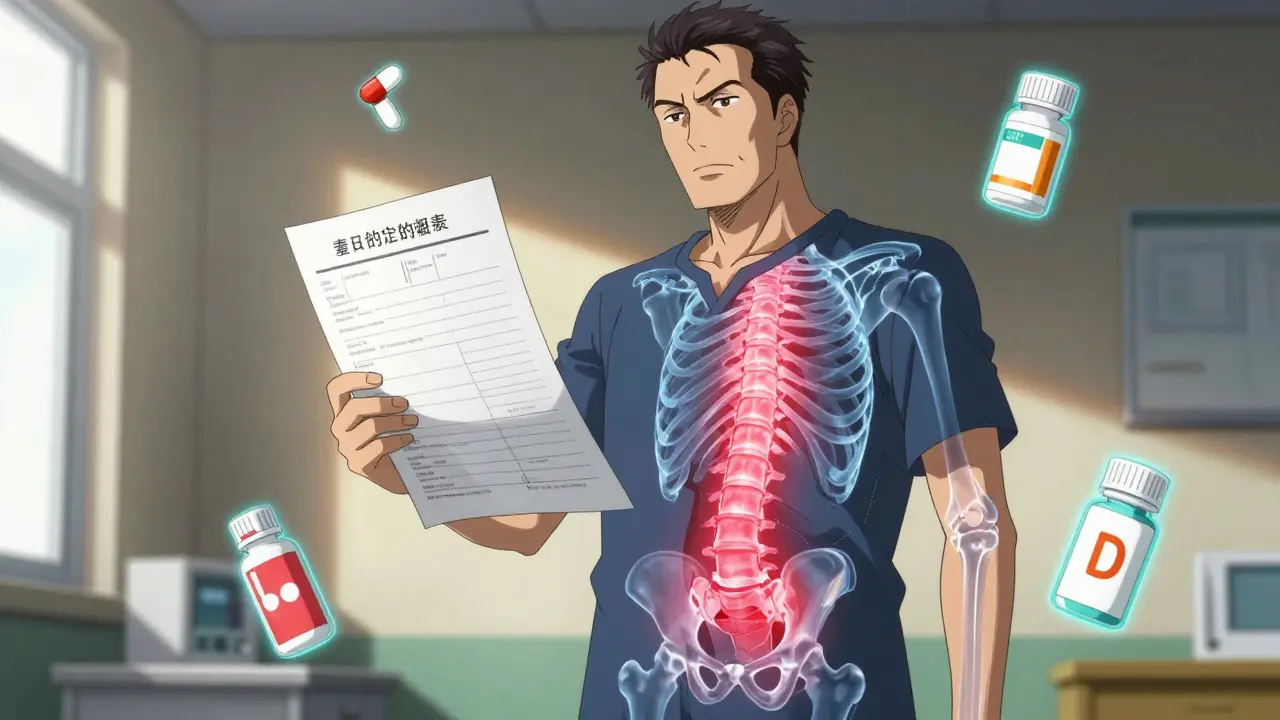
Corticosteroid Bone Loss Risk Calculator
Your Risk Assessment
Risk Results
Low Risk
10%
Estimated risk of fracture within next year
Recommended Actions
Start calcium and vitamin D supplementation
Take 1000-1200 mg calcium and 800-1000 IU vitamin D daily
Take 1000-1200 mg calcium and 800-1000 IU vitamin D daily
Begin weight-bearing exercise
30 minutes daily of walking, resistance training
30 minutes daily of walking, resistance training
When you're on long-term corticosteroids-like prednisone-for conditions like rheumatoid arthritis, lupus, or severe asthma, you’re not just fighting inflammation. You’re also quietly losing bone. Every day you take these drugs, your bones get weaker. And it happens fast. Within just three to six months, your fracture risk can jump by 70% to 100%. This isn’t a slow, inevitable decline. It’s a direct, measurable attack on your skeleton. And the worst part? Most people don’t even know it’s happening until they break a bone.
Why Corticosteroids Eat Away at Your Bones
Corticosteroids don’t just reduce swelling or calm your immune system. They mess with the very cells that build and maintain your bones. Osteoblasts, the cells that lay down new bone, get suppressed. They die off faster. At the same time, osteoclasts-the cells that break down bone-stay active longer. The result? Your body breaks down bone faster than it can rebuild it. This isn’t just theory. Studies show that people taking as little as 2.5 mg of prednisone daily for three months or more start losing bone density within weeks. The spine, hips, and wrists take the hardest hit because they’re made of trabecular bone-the spongy, inner type that turns over fastest. In the first year, bone mineral density (BMD) can drop by 5% to 15%. That’s like aging 10 to 15 years overnight. And it’s not just about bone structure. Corticosteroids also reduce how much calcium your gut absorbs-by about 30%. Your kidneys start dumping more calcium in your urine. Your muscles weaken. Your balance suffers. All of this stacks up. You’re not just losing bone. You’re becoming more likely to fall.The First Rule: Use the Least Amount Possible
The single most effective thing you can do to protect your bones is to take the lowest dose of corticosteroids for the shortest time possible. This isn’t a suggestion-it’s a medical imperative. If your doctor can cut your daily dose from 10 mg to 5 mg of prednisone, your fracture risk drops by 35% in just six months. That’s a huge win. But here’s the catch: many people stay on high doses longer than they need to because they’re afraid their condition will flare up. That fear is real. But so is the risk of breaking a hip or vertebra. Work with your doctor to find the smallest effective dose. Ask if there are steroid-sparing drugs-like methotrexate or biologics-that can help you reduce or stop corticosteroids over time.Calcium and Vitamin D: The Non-Negotiable Base
You can’t fix steroid-induced bone loss without calcium and vitamin D. No exceptions. The Cleveland Clinic and the American College of Rheumatology both say you need at least 1,000 to 1,200 mg of calcium daily. That’s not a supplement you take once a week. That’s about three servings of dairy, or fortified plant milk, or leafy greens like kale and bok choy-plus supplements to make up the difference. Vitamin D is just as critical. You need 600 to 800 IU daily, but many people need 800 to 1,000 IU to get their blood levels above 20 ng/mL-the minimum threshold for bone protection. If you live in Melbourne, where winter sunlight is weak, you’re even more likely to be deficient. Get your vitamin D level checked. If it’s below 30 ng/mL, your doctor should prescribe a higher dose temporarily to catch you up. A 2021 meta-analysis showed that people taking 1,000 mg calcium and 500 IU vitamin D daily lost 0.72% of spine BMD per year. Those on placebo lost 2% per year. That’s a 64% reduction in bone loss-just from two simple supplements.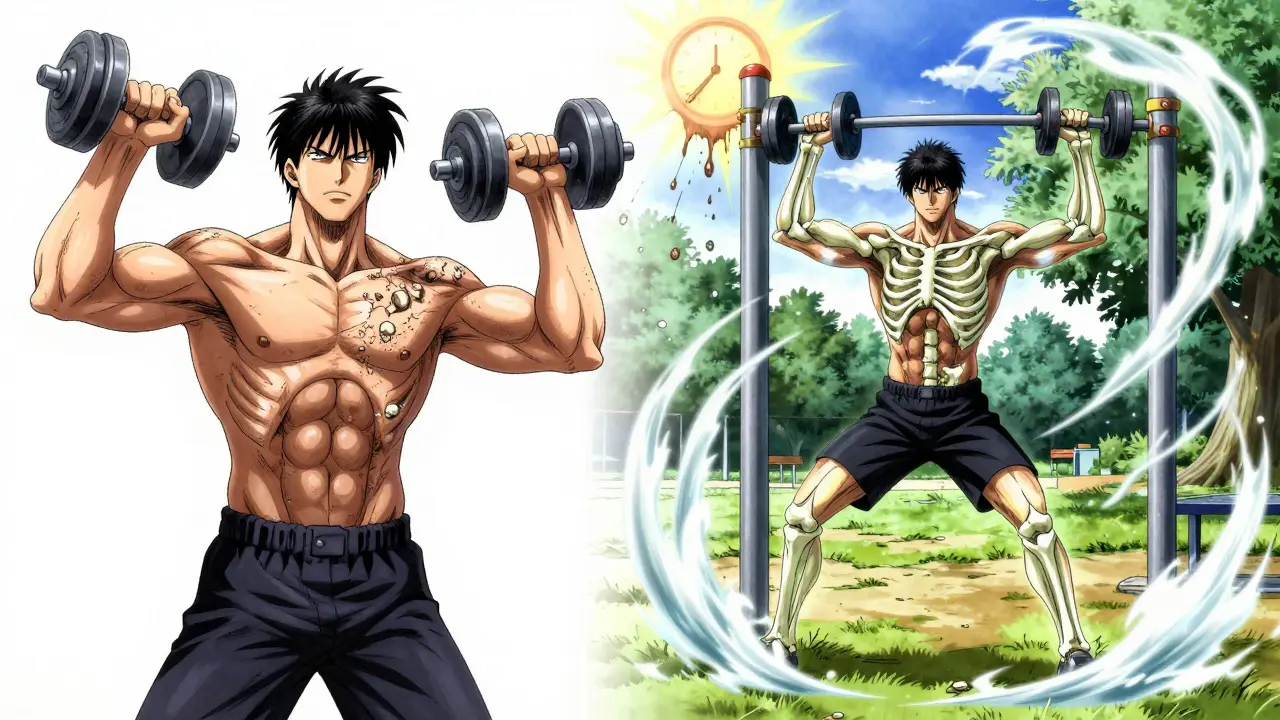
Movement Matters-But It’s Harder Than You Think
Weight-bearing exercise is supposed to strengthen bones. But corticosteroids blunt that effect. Studies show that even if you walk, lift weights, or do yoga, your bones respond only about 75% as well as they would if you weren’t on steroids. Still, you can’t skip it. The Royal Osteoporosis Society recommends at least 30 minutes of weight-bearing activity on most days. That means walking, stair climbing, dancing, or resistance training with bands or light dumbbells. Don’t think you need to run marathons. Just keep moving. And don’t skip balance exercises-like standing on one foot or heel-to-toe walking. Falls are the leading cause of fractures in steroid users.Smoking and Alcohol: Two More Things to Quit
If you smoke, you’re doubling your fracture risk. Smoking reduces blood flow to bones, slows healing, and lowers estrogen levels-critical for bone maintenance. Quitting smoking can reduce your fracture risk by 25% to 30% within a year. It’s one of the most powerful things you can do. Alcohol isn’t much better. More than three standard drinks a day increases bone loss and raises your chance of falling. Limit yourself to one drink a day, and avoid binge drinking. Even if you’re otherwise healthy, alcohol and steroids are a dangerous mix.When You Need More Than Supplements
For many people, calcium and vitamin D aren’t enough. If you’ve been on steroids for more than three months and you’re over 50-or if you’ve already had a fracture-you need stronger treatment. Bisphosphonates are the first-line option. Risedronate (5 mg daily or 35 mg weekly) cuts vertebral fracture risk by 70%. Alendronate works too. They’re cheap, oral, and effective. But they can upset your stomach. Take them on an empty stomach with a full glass of water, and stay upright for 30 minutes after. If you can’t tolerate them, ask about zoledronic acid-a once-a-year IV infusion that boosts spine BMD by 4.5% in 12 months. If your bones are already very weak (T-score below -2.5) or you’ve broken a bone on low-dose steroids, teriparatide might be your best bet. It’s a daily injection that actually builds new bone. Studies show it increases spine BMD by 9.1% in a year-nearly twice as much as bisphosphonates. It’s expensive and requires daily shots, but for high-risk patients, it’s life-changing. Denosumab is another option: a shot every six months that blocks bone breakdown. It’s great for people who can’t take bisphosphonates. But you can’t stop it suddenly-you have to switch to another drug, or you risk a rebound in bone loss.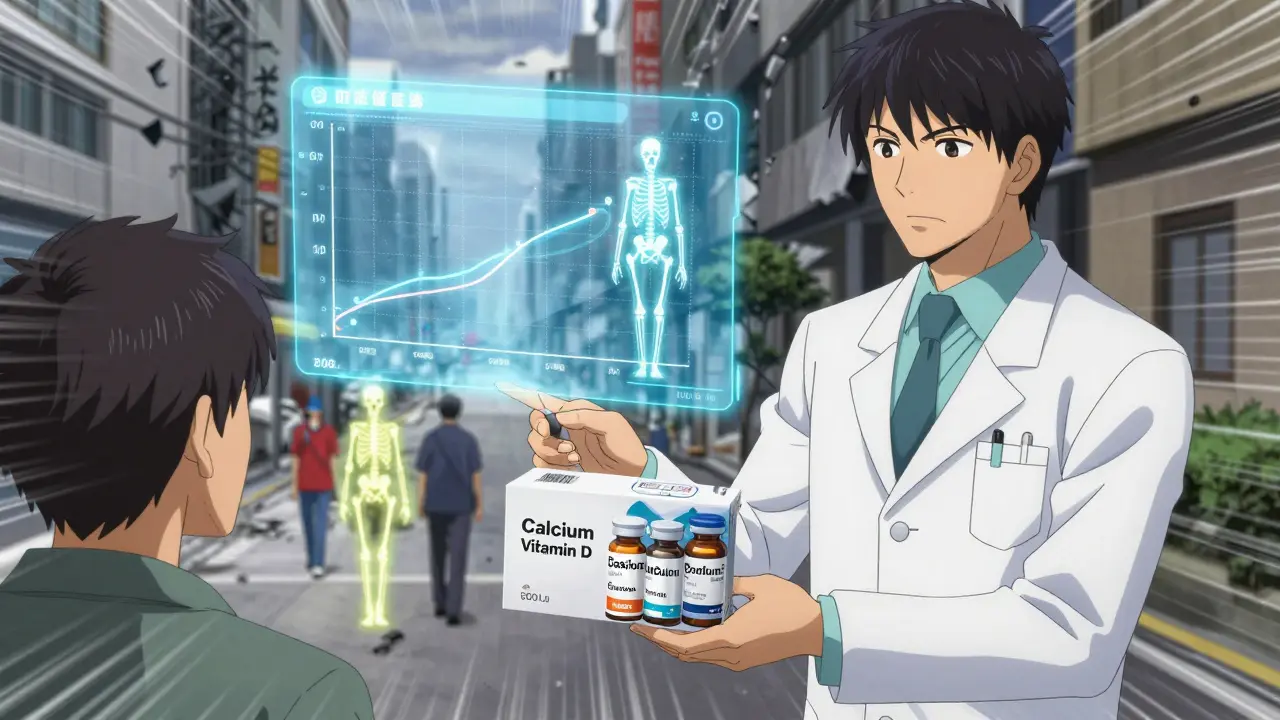
The Hidden Crisis: Most People Get No Help at All
Here’s the uncomfortable truth: only about 15% of people on long-term corticosteroids get the full package of care they need. A 2020 JAMA study found that just 62% received any kind of osteoporosis prevention-whether it was a bone scan, supplements, or a prescription. Men were far less likely to be screened than women. Only 31% had a bone density test. Only 40% had calcium documented in their records. Why? Because doctors are busy. Patients don’t know to ask. There’s no system in place. But you don’t have to be part of that statistic. Ask your doctor for a bone density scan (DXA) when you start long-term steroids-and every one to two years after. Ask if you’re a candidate for bisphosphonates or other drugs. If your doctor says, “We’ll monitor,” push back. Say, “I know this is a high-risk situation. I want to be proactive.”What Works in Real Life
Some clinics have cracked the code. In the U.S. Veterans Affairs system, they added automatic alerts to electronic health records. When a patient gets a steroid prescription over 2.5 mg/day for three months, the system pops up: “Order DXA scan. Prescribe calcium and vitamin D. Assess fracture risk.” Result? Prevention rates jumped from 40% to 92%. Pharmacist-led programs in Australia and the UK have done the same. Pharmacists call patients, check their supplements, explain how to take bisphosphonates correctly, and follow up. Adherence jumped from 45% to 85%. You don’t need a fancy system. But you do need to take charge. Keep a log: what dose of steroids you’re on, what supplements you take, whether you’ve had your bone scan. Bring it to every appointment.It’s Not Too Late-But Time Is Running Out
The first three to six months on corticosteroids are the most critical. That’s when bone loss is fastest. That’s when prevention has the biggest impact. If you’ve been on steroids for years and haven’t done anything yet, don’t wait. Start now. Get your BMD tested. Start calcium and vitamin D. Talk to your doctor about bisphosphonates. Quit smoking. Move every day. You don’t have to accept brittle bones as the price of staying alive. With the right steps, you can protect your skeleton-even while taking the drugs you need.
Andrew Gurung
December 26, 2025 at 15:11This is the most important post I've read all year. Like, I'm not even kidding - I cried reading this. 😭 I’ve been on 10mg prednisone for 2 years and thought I was ‘fine’ until I slipped on ice and fractured my wrist. No one warned me. NO ONE. My rheumatologist just said ‘take calcium’ like it’s a Starbucks order. I’m now on risedronate and doing yoga in my living room at 6am while my cat judges me. Bone loss is the silent villain we never talk about. 🙏
Paula Alencar
December 27, 2025 at 12:21It is with profound concern and deep empathy that I address the systemic failure in clinical practice regarding steroid-induced osteoporosis. The data presented here is not merely statistical-it is a moral indictment of a healthcare paradigm that prioritizes symptom suppression over structural preservation. The fact that fewer than 15% of patients receive comprehensive preventive care is not an oversight; it is a betrayal of the Hippocratic Oath. Every clinician who fails to order a DXA scan upon initiating long-term corticosteroid therapy is complicit in preventable suffering. We must institutionalize protocols-not rely on patient advocacy alone. The VA model is not an exception; it is the baseline standard. I urge every medical institution to adopt this as non-negotiable practice.
Will Neitzer
December 29, 2025 at 03:47Paula, you’re absolutely right. This isn’t just about individual responsibility-it’s about institutional accountability. I’ve worked in rheumatology for 18 years, and I’ve seen too many patients break hips because no one thought to check their vitamin D or order a baseline scan. The fact that men are even less likely to be screened than women is unconscionable. We treat osteoporosis like a ‘women’s issue,’ but steroid-induced bone loss affects everyone equally. I’ve started requiring DXA scans and calcium/vitamin D prescriptions on the same day I write a steroid script. It’s saved three patients from vertebral fractures already. This isn’t optional care. It’s standard of care. Period.
Janice Holmes
December 30, 2025 at 22:47Let’s be real: bisphosphonates are a scam. They’re just corporate pharma’s way of monetizing the side effects of their own drugs. And don’t get me started on teriparatide-$12,000 a year for a daily injection? Meanwhile, the real solution is simple: stop prescribing steroids like candy. Why not just use low-dose NSAIDs or acupuncture? Or better yet-why not address the root cause of inflammation instead of chemically suppressing it with a sledgehammer? I’ve been off prednisone for 18 months now after switching to a plant-based, anti-inflammatory diet. My bones are stronger than ever. No drugs. No scans. Just food. 🌱
Olivia Goolsby
January 1, 2026 at 15:56Okay, but have you considered that corticosteroids are a government-controlled mind-altering substance designed to make people dependent on Big Pharma? The bone loss? That’s just the first phase. The real agenda is to create a population of elderly, frail, wheelchair-bound citizens who can’t protest, can’t move, and can’t think clearly-because they’re on daily meds with side effects that make them docile. And don’t think the FDA doesn’t know. They approved this for decades. The vitamin D thing? A distraction. The real fix? Get off the grid. Live in the sun. Eat wild-caught fish. Stop trusting doctors who get paid by pharmaceutical reps. I’ve been off all meds for 5 years. My BMD is better than my 25-year-old nephew’s. They’re lying to you. All of them.
Elizabeth Ganak
January 2, 2026 at 03:33i just started prednisone last month for my lupus and i was so scared… but this post actually calmed me down? like, i didn’t know i could do anything about it. i’m already taking 1200mg calcium and 1000iu vit d, walking my dog every day, and i asked my doc for a dexa scan next week. it’s not perfect, but at least i’m not just sitting there waiting to break. thanks for writing this. 💙
Nicola George
January 3, 2026 at 21:30Wow. So let me get this straight: the entire medical system is broken, but the solution is to drink milk and walk your dog? Cute. Meanwhile, I’m in South Africa, where most people can’t afford calcium supplements, let alone a DXA scan. Your ‘life-changing’ teriparatide? Costs more than my annual salary. This post reads like a luxury pamphlet for rich Americans. Meanwhile, the rest of us are just trying not to die from lupus, and now we’re supposed to be bone experts too? Thanks, but no thanks. 🙃
Kishor Raibole
January 4, 2026 at 22:44While the empirical evidence presented is compelling, and the recommendations are methodologically sound, it is imperative to recognize the socio-economic disparities that render these interventions inaccessible to vast populations. The assertion that ‘you don’t need a fancy system’ ignores the structural inequities that preclude patients in low-resource settings from even accessing primary care, let alone bone density scans or bisphosphonates. The VA model, while laudable, is a product of a state-funded, centralized healthcare infrastructure-unattainable in nations with fragmented or privatized systems. To advocate for individual action without addressing systemic barriers is not empowerment; it is epistemic violence. The solution lies not in patient compliance, but in policy reform, universal access to diagnostics, and equitable drug pricing. Until then, this discourse remains a privileged echo chamber.