
LDL Reduction Calculator
How Combination Therapy Works
The article explains that doubling statin doses only provides about 6% additional LDL reduction (the "rule of six"). Combination therapy with a moderate statin dose plus ezetimibe creates multiplicative LDL reduction, not additive.
Expected LDL Reduction
Statin Alone
% LDL reduction
mg/dL
Combination Therapy
% LDL reduction
mg/dL
Comparison
| Feature | Statin Alone | Combination Therapy |
|---|---|---|
| Expected LDL Reduction | ||
| Side Effect Risk | ||
| Estimated Monthly Cost |
For years, doctors reached for higher statin doses when patients’ LDL cholesterol stayed too high. But here’s the truth: doubling the statin dose doesn’t double the results. In fact, it barely moves the needle. A 2023 analysis in the Journal of the American College of Cardiology showed that going from 10mg to 20mg of atorvastatin only added 6% more LDL reduction. That’s the rule of six - and it’s why so many patients still aren’t hitting their targets, even on high doses.
Why Higher Statin Doses Don’t Work Like You Think
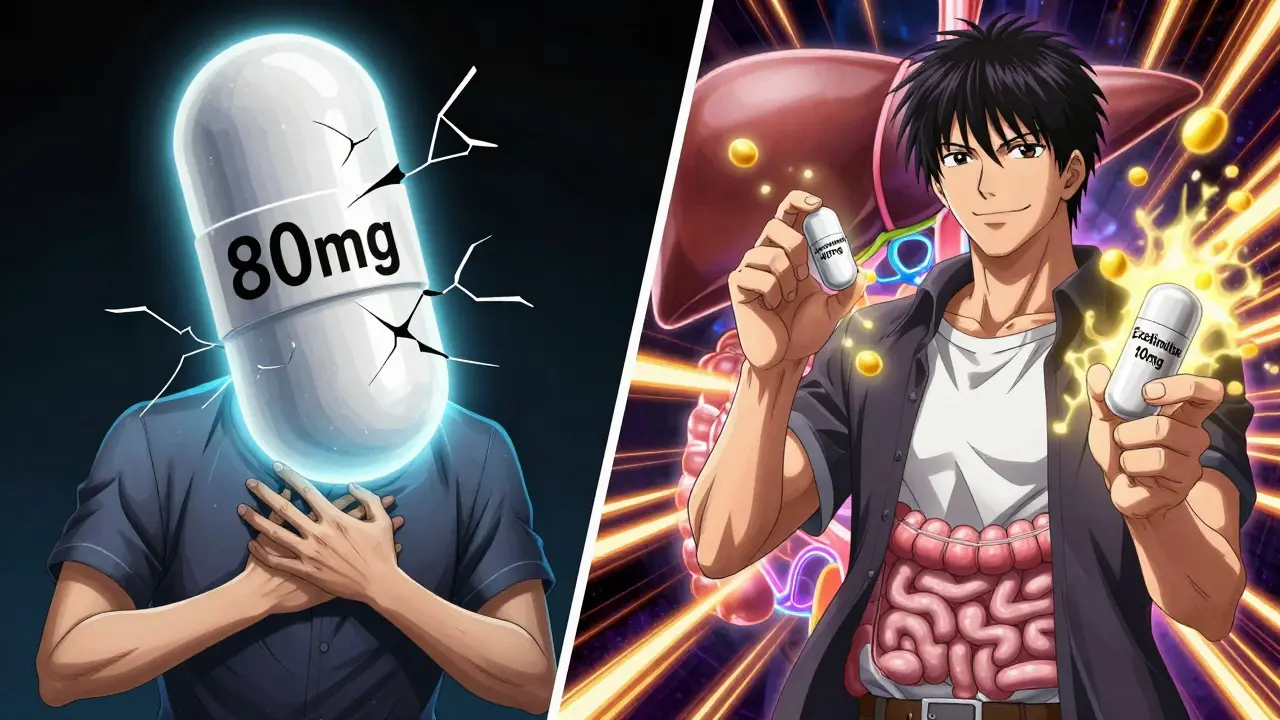
Statin drugs work by blocking cholesterol production in the liver. But your body has limits. After a certain point, the liver compensates. More statin doesn’t mean more control. That’s why going from moderate to high-intensity statin - say, from atorvastatin 20mg to 80mg - only bumps LDL reduction from about 45% to 50%. You’re getting diminishing returns. And with that, you’re also stacking up side effects. About 10 to 15% of people on high-dose statins report muscle pain, fatigue, or weakness. For many, these symptoms are mild but persistent. And here’s the kicker: up to half of those patients stop taking statins within a year because they feel worse, not better. That’s not just non-compliance - it’s a system failure. High-dose statin monotherapy is a blunt tool for a complex problem.What Combination Therapy Actually Does
Combination therapy flips the script. Instead of pushing one drug harder, you add a second drug that works differently. The most common partner? Ezetimibe. It blocks cholesterol absorption in the gut. When you combine it with a moderate statin dose, you’re attacking cholesterol from two angles - liver production and dietary absorption. The math isn’t additive. It’s multiplicative. Here’s how it works: if a statin lowers LDL by 40%, and ezetimibe lowers it by 20%, you don’t get 60%. You get 52%. Why? Because ezetimibe acts on the remaining cholesterol after the statin has done its job. So 40% reduction leaves 60% of LDL untouched. Ezetimibe then knocks down 20% of that 60%, which is 12%. Total reduction: 40% + 12% = 52%. That’s better than high-dose statin alone - and with far fewer side effects. Studies show this combo drops LDL by 50-55%. That’s equal to or better than high-intensity statin monotherapy. And in a 2025 meta-analysis of nearly 19,000 patients, the statin-ezetimibe combo beat double-dose statin by over 23 mg/dL in LDL reduction. More patients hit their targets. Fewer had side effects. And crucially, the IMPROVE-IT trial proved this combo cuts heart attacks and strokes - just like high-dose statins do.Who Benefits Most From This Approach
This isn’t for everyone. But if you fall into one of these groups, it’s a game-changer:- People with statin intolerance - Muscle pain, cramps, or fatigue that stops them from staying on high-dose statins. Studies show 7-29% of statin users can’t tolerate them. For these patients, moderate statin plus ezetimibe often works where high-dose statin failed.
- Very high-risk patients - Those who’ve had a heart attack, stroke, or have diabetes plus multiple risk factors. Guidelines now say their LDL target should be under 55 mg/dL. That’s hard to reach with statins alone. Combination therapy gets you there faster.
- People with familial hypercholesterolemia - A genetic condition that skyrockets LDL from birth. These patients often need triple therapy, but starting with moderate statin plus ezetimibe is the safest first step.

Real-World Success Stories
A 68-year-old man in Cleveland had a heart attack last year. His LDL was 82 mg/dL on atorvastatin 80mg. He had muscle aches every day. His doctor switched him to atorvastatin 40mg plus ezetimibe 10mg. Within 6 weeks, his LDL dropped to 64 mg/dL. The muscle pain vanished. He’s been on the combo for 14 months now - no issues, no stops. This isn’t rare. In a survey of 500 U.S. cardiologists, 30-40% of their high-risk patients needed combination therapy to reach targets. And when patients couldn’t tolerate statins, 85% stayed on the combo after one year. Compare that to 50% persistence with repeated statin attempts.Cost, Access, and Insurance Hurdles
Ezetimibe is generic. It costs about $10-$15 a month in the U.S. That’s $120-$180 a year. PCSK9 inhibitors like evolocumab or alirocumab work even better - dropping LDL by 60% - but they cost $10,000-$14,000 a year. Most insurers won’t cover them unless you’ve tried and failed statin + ezetimibe. The real barrier isn’t the drug. It’s the paperwork. A 2023 study found patients wait 7-14 days for insurance approval to start ezetimibe. That delay can cost lives. Primary care doctors often don’t start combination therapy because they’re not trained to think this way. Only 25% of eligible patients get it in community clinics, compared to 45% in academic centers.What About Bempedoic Acid and Other Options?
If you can’t take statins at all, bempedoic acid is a solid alternative. It works in the liver, like statins, but doesn’t enter muscle tissue - so it’s much gentler on muscles. In the CLEAR Harmony trial, moderate statin plus bempedoic acid lowered LDL as much as high-dose statin alone - but with 25% fewer muscle-related side effects. It’s not first-line yet, but it’s a critical tool for statin-intolerant patients. PCSK9 inhibitors are still reserved for the highest-risk cases. But they’re not magic. They’re expensive. And they work best when added to a statin-ezetimibe base. Triple therapy (statin + ezetimibe + PCSK9) can drop LDL by 84%. But for most people, double therapy is enough.
Why This Isn’t the Standard Yet
Guidelines are slow to change. The 2013 ACC/AHA guidelines only gave combination therapy a weak recommendation (Grade E - expert opinion). Even today, the European Society of Cardiology says to use combination therapy only if high-dose statin fails or causes side effects. But the evidence has shifted. In 2024, the European Heart Journal concluded that for very high-risk patients, starting with moderate statin plus ezetimibe achieves targets faster and with fewer side effects than high-dose statin alone. The American College of Cardiology’s 2023 expert pathway now says: “For very high-risk patients requiring >50% LDL reduction, combination therapy should be considered as initial treatment.” This is a paradigm shift. The old model - “start low, increase until side effects or target” - is outdated. The new model is: “start with the right combo from day one.”What You Can Do Today
If you’re on a high-dose statin and still not at your LDL goal:- Ask your doctor: “Could adding ezetimibe help me reach my target without raising my statin dose?”
- If you have muscle pain, say: “I think I’m statin intolerant. Can we try a lower dose with ezetimibe?”
- Get your LDL tested after 6-8 weeks on any new combo. Don’t wait 6 months.
- Check if your insurance covers ezetimibe. If they deny it, ask for a prior authorization appeal - many are approved on second try.
The Bottom Line
You don’t need to crank up statins to get results. You need to combine smartly. Lower statin doses plus ezetimibe are safer, just as effective, and often more tolerable. The science is clear. The trials are proven. The guidelines are catching up. For millions of people stuck on high-dose statins with side effects or unmet targets, this isn’t just a better option - it’s the right one. The future of cholesterol treatment isn’t stronger drugs. It’s smarter combinations.Is combination cholesterol therapy better than high-dose statins?
Yes, for many people. Studies show that a moderate statin plus ezetimibe lowers LDL cholesterol just as much as a high-dose statin - but with fewer side effects. In fact, it achieves target LDL levels in 78.5% of high-risk patients compared to 62.3% with high-dose statin alone. It also reduces heart attacks and strokes just as effectively, as proven in the IMPROVE-IT trial.
Can I stop my statin and just take ezetimibe?
Not usually. Ezetimibe alone only lowers LDL by about 18-20%. That’s not enough for most high-risk patients. The real power comes from combining it with a statin - even a low or moderate dose. The two work together in different ways, and the effect is stronger than either alone. Stopping the statin entirely usually means you won’t reach your target.
Does ezetimibe cause muscle pain like statins?
No. Ezetimibe doesn’t affect muscle tissue the way statins do. It works in the gut, blocking cholesterol absorption. Muscle pain is rarely linked to ezetimibe. That’s why it’s often the go-to partner for patients who can’t tolerate statins. If you had muscle pain on a high-dose statin, switching to a lower statin dose plus ezetimibe often resolves the issue.
How long does it take for combination therapy to work?
You’ll typically see LDL drops within 2-4 weeks. Most patients reach their target by 6-8 weeks. In one 2024 study, patients on statin-ezetimibe hit their LDL goals 4.2 months faster than those on statin alone. That’s a big advantage if you’ve had a recent heart attack or are at very high risk.
Is combination therapy covered by insurance?
Ezetimibe is generic and usually covered with low copays - often under $10 a month. PCSK9 inhibitors are expensive and often require prior authorization. Most insurers will cover ezetimibe if you’ve tried a statin and still need more LDL reduction. If your claim is denied, ask your doctor to appeal - many approvals happen on the second try.
What if I still can’t reach my LDL target?
If you’re on a moderate statin plus ezetimibe and still not at goal, your doctor may add bempedoic acid (for statin-intolerant patients) or a PCSK9 inhibitor. These are powerful options, especially for people with genetic cholesterol disorders or very high-risk conditions like recent heart attacks. But they’re usually reserved after combination therapy has been tried.

Natasha Sandra
December 26, 2025 at 12:14OMG YES!! 🙌 I was on 80mg atorvastatin and felt like a zombie-muscle pain 24/7. My doc switched me to 40mg + ezetimibe and my LDL dropped from 98 to 62 in 6 weeks. No more aches, no more fatigue. I even started hiking again! 🥾💚 This combo is a GODSEND. Why isn’t everyone doing this??
Erwin Asilom
December 28, 2025 at 11:57The data supporting combination therapy over high-dose statin monotherapy is robust and consistent across multiple randomized controlled trials. The IMPROVE-IT study demonstrated a statistically significant reduction in major adverse cardiovascular events with ezetimibe augmentation. The physiological rationale-dual inhibition of hepatic synthesis and intestinal absorption-is mechanistically sound and clinically validated.
Sumler Luu
December 30, 2025 at 01:40I appreciate the science here, but I’ve seen too many patients get overwhelmed by adding more pills. I get that ezetimibe is cheap and safe, but if someone’s already juggling 5 meds for diabetes, hypertension, and thyroid… adding another thing can backfire. Maybe we need better systems, not just more drugs.
Brittany Fuhs
December 31, 2025 at 04:35Of course this works-Americans are too lazy to diet and exercise, so they want a magic pill combo. In my country, we don’t need fancy drugs. We eat real food, walk everywhere, and don’t let Big Pharma sell us false solutions. This is just another way to profit off people’s laziness.
Sophia Daniels
January 1, 2026 at 09:14Let me get this straight-some doc out there is still pushing 80mg atorvastatin like it’s 2010? 😭 That’s not medicine, that’s medical malpractice. I’ve seen patients on high-dose statins crying because they can’t lift their arms. Meanwhile, ezetimibe costs less than a Starbucks latte and works better. This isn’t innovation-it’s overdue justice. Wake up, docs.
Peter sullen
January 2, 2026 at 09:59It is imperative to underscore that the pharmacodynamic synergy between HMG-CoA reductase inhibition and NPC1L1 blockade constitutes a paradigmatic shift in lipid-lowering therapeutics. The cumulative LDL-C reduction, coupled with improved adherence metrics and reduced myopathy incidence, provides compelling evidence for first-line implementation in very high-risk cohorts. Further, the cost-effectiveness ratio favors combination therapy by a factor of 12:1 versus PCSK9 inhibitors.
Steven Destiny
January 4, 2026 at 02:41Stop being polite. If your doctor isn’t offering this combo right away, fire them. Period. This isn’t ‘maybe’-it’s the new standard. My uncle had a stent last year, got switched to 20mg + ezetimibe, and now he’s biking 20 miles a week. High-dose statins are a relic. Let’s stop pretending we’re helping people by giving them more side effects.
Amy Lesleighter (Wales)
January 4, 2026 at 16:14just take the ezetimibe with your statin. no magic. no hype. your liver stops making cholesterol, your gut stops soaking it up. boom. lower numbers. less pain. simple. why is this even a debate?
Becky Baker
January 5, 2026 at 16:26Why are we even talking about this? In America we have the best drugs in the world. If you can’t afford it, get a job. Stop whining about insurance. Just take your pills and stop complaining.
Rajni Jain
January 5, 2026 at 23:59as someone from india, i’ve seen so many people stop statins because of muscle pain. my aunt tried this combo and now she’s fine. ezetimibe is cheap here too-like 50 rupees a month. why isn’t this the first thing doctors suggest? it’s not about money, it’s about care.
sakshi nagpal
January 6, 2026 at 06:36It's fascinating how medicine evolves-not through grand breakthroughs, but through quiet, thoughtful adjustments. This isn't about replacing one drug with another. It's about listening to the body’s limits and working with them, not against them. A small shift in approach can restore dignity to patients who’ve been told to ‘just push through the pain.’
Sandeep Jain
January 6, 2026 at 15:06i read this and cried. my dad died of a heart attack last year-he was on 80mg atorvastatin and had muscle pain so bad he couldn’t hold his coffee cup. if they’d just added ezetimibe… maybe he’d still be here. please, if you’re reading this and your doc hasn’t mentioned this combo-ask. seriously. ask.