
Buying medicine abroad sounds simple: cheaper prices, no wait times, maybe even a better deal than back home. But what if that pill you bought in a market in Thailand, or ordered from a website claiming to be Canadian, isn’t what it says it is? Every year, thousands of travelers and cost-conscious consumers end up with fake, contaminated, or completely empty medications-and many don’t realize it until it’s too late.
Why Foreign Medications Are Riskier Than You Think
The global market for fake or substandard medicines is worth over $30 billion, and nearly three-quarters of those sales happen online. The World Health Organization estimates that 1 in 10 medical products in low- and middle-income countries are counterfeit. But this isn’t just a problem overseas-it’s hitting North America and Europe hard too. In 2024, the U.S. Drug Enforcement Administration (DEA) shut down dozens of online pharmacies linked to India and the Dominican Republic that were selling fake weight loss drugs like semaglutide and liraglutide. One victim in Ohio died after taking a pill she thought was oxycodone. It was laced with fentanyl. That’s not an outlier. The DEA documented over 150 similar deaths linked to counterfeit painkillers in the last two years alone. Even when the packaging looks real, the contents aren’t. Counterfeiters copy logos, bottle designs, and even batch numbers. They use real-looking websites with fake licenses, fake customer reviews, and social media ads that look like they’re from a hospital or pharmacy. One Reddit user in March 2024 ordered Eliquis from a site claiming to be Canadian. The pills had no active ingredient. He suffered a stroke.How to Spot a Fake Online Pharmacy
Legitimate pharmacies don’t operate like street vendors. Here’s what to look for:- They require a valid prescription. If a site lets you buy prescription drugs without one, walk away. No legitimate pharmacy in the U.S., Canada, or EU sells controlled medications without a doctor’s order.
- They display a verifiable license. In the U.S., check for VIPPS certification (Verified Internet Pharmacy Practice Sites). As of October 2024, only 68 pharmacies held this certification. In Canada, look for the CIPA seal. In the EU, verify through your national medicines agency.
- They list a physical address and phone number. Fake sites often use PO boxes or vague addresses like “Suite 100, London, UK.” Call the number. If no one answers, or it’s a voicemail with no name, it’s a red flag.
- They don’t claim to be endorsed by health agencies. The FDA, EMA, and WHO never endorse specific online pharmacies. If a site says “Approved by the FDA,” it’s lying.
- The price is too good to be true. If you’re paying $10 for a 30-day supply of insulin that costs $300 at home, it’s not a deal-it’s a trap. Legitimate pharmacies don’t sell brand-name drugs at 90% off.
- The packaging looks off. Foreign language labels, mismatched fonts, broken seals, or pills that look different from what you’ve taken before are warning signs. Real medications have consistent color, shape, and imprint codes.
The National Association of Boards of Pharmacy (NABP) keeps a public list of 12,000 illegal online pharmacies. New ones pop up every month. Don’t trust Google ads or Instagram influencers selling “Canadian” meds-they’re often just redirecting you to fake sites.
“But It’s From Canada!”-The Myth of Safe Imports
Many people think buying from Canada is safe. It’s not. A 2024 report in the AMA Journal of Ethics found that 73% of medications sold as “from Canada” actually originate from India, Turkey, or Southeast Asia. Canadian pharmacies themselves don’t have the capacity to supply U.S. demand. So when you order from a “Canadian” site, you’re not getting medication from a Canadian pharmacy-you’re getting whatever the middleman sends. Canada’s own health agency has publicly said they can’t verify the safety of drugs shipped to the U.S. That means you’re trusting a chain of unknown suppliers with no oversight. And it’s not just pills. Fake insulin, antibiotics, and heart medications have been found in shipments labeled as Canadian.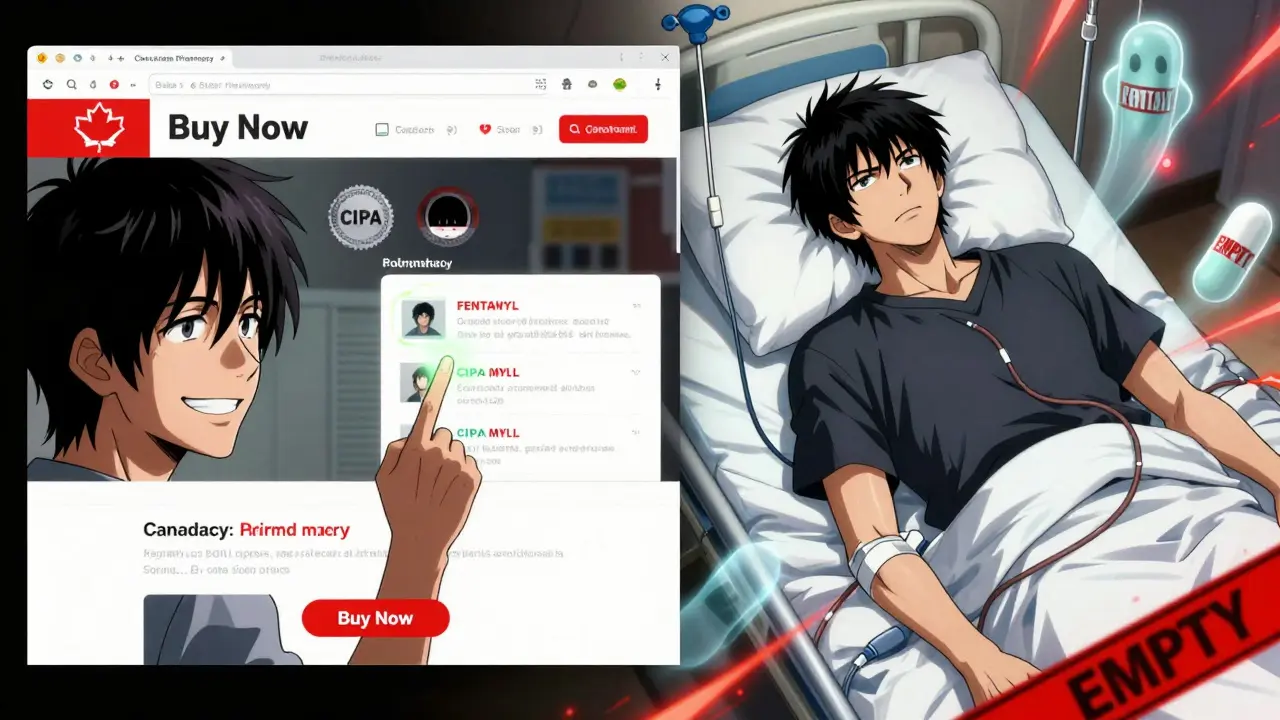
What Happens When You Take Fake Medicine?
It’s not just about getting sick. It’s about getting worse. - Empty pills: Some counterfeit drugs contain no active ingredient at all. If you’re taking blood thinners like warfarin or Eliquis and your pills are fake, you could have a stroke or internal bleeding. - Wrong ingredients: Fake Viagra has been found to contain rat poison, paint thinner, and even chalk. Fake antibiotics may have no antibiotic at all-letting infections spread unchecked. - Toxic additives: Fentanyl, methamphetamine, and heavy metals like lead have been found in counterfeit painkillers and weight loss drugs. A single pill can kill. - Drug resistance: Substandard antibiotics don’t kill bacteria-they train them to survive. This contributes to global superbugs. The WHO says counterfeit antimalarials in Africa are directly responsible for thousands of preventable deaths each year. - Cost to the system: In 2022, counterfeit drugs added $67 billion in extra costs to the U.S. healthcare system. Hospitals treated people poisoned by fake meds. Insurance companies paid for ER visits. Legitimate drug makers lost $34 billion in revenue.What to Do If You’ve Already Bought Medicine Online
If you’ve ordered pills from a site that doesn’t meet the safety criteria above:- Stop taking them. Even if you feel fine, the risk is still there.
- Don’t flush or throw them away. Keep the pills and packaging. Authorities need them for investigation.
- Report it. In the U.S., file a report with the FDA’s MedWatch program. In Canada, contact Health Canada. In the EU, report to your national medicines agency. In Australia, contact the TGA.
- See your doctor. Tell them what you took and where you got it. They may need to run tests for drug levels or organ damage.
- Check the NABP list. Search the website you bought from on the NABP’s “Not Recommended” list. If it’s there, warn others.
How to Get Medications Safely While Traveling
If you’re traveling and need medication:- Bring enough for your entire trip. Pack extra in case of delays. Keep them in original bottles with your name and prescription label.
- Carry a doctor’s note. Especially for controlled substances like opioids, benzodiazepines, or ADHD meds. Some countries treat these as illegal drugs-even if they’re legal at home.
- Don’t buy local unless absolutely necessary. If you must, go to a government-run hospital pharmacy or a major chain like Boots (UK), Watsons (Asia), or CVS (if available). Avoid street vendors, small clinics, or unmarked shops.
- Check your country’s travel health advisory. The U.S. State Department, Health Canada, and the Australian government all list warnings about medication risks in specific countries.
The Bigger Picture: Why This Problem Keeps Growing
People buy fake meds because they’re desperate. The cost of insulin in the U.S. is over $300 a vial. A month of Ozempic can cost $1,000. That’s why 68% of Americans say they’ve considered buying abroad. But the real solution isn’t more enforcement-it’s better access. Countries with universal healthcare report 83% fewer cases of illegal medication purchases. When people can afford safe drugs, they don’t risk their lives for a bargain. Until then, your best protection is knowledge. Don’t assume. Don’t guess. Don’t trust a website just because it looks professional. If it’s not on a government-approved list, it’s not safe.Final Checklist: Before You Click Buy
Ask yourself these five questions:- Do I have a valid prescription for this medication?
- Is this pharmacy listed on my country’s official approved list (VIPPS, CIPA, etc.)?
- Does the site show a real phone number and physical address I can verify?
- Are the prices in line with what I’d pay at home-or are they suspiciously low?
- Would I feel comfortable giving this pharmacy my credit card and medical history?
If you answer no to any of these, don’t buy. The risk isn’t worth it. Your health isn’t a gamble.
Can I get safe medication from a Canadian pharmacy online?
No. While Canada has strong drug regulations, most websites claiming to be Canadian pharmacies are not based in Canada. They’re often operated by middlemen who source drugs from India, Turkey, or Southeast Asia. Even if the packaging says "Canada," the pills inside may be counterfeit. Health Canada itself has warned that it cannot verify the safety of drugs shipped to the U.S. or Australia.
What should I do if I think I took a fake pill?
Stop taking the medication immediately. Keep the pills and packaging. Contact your doctor and report it to your country’s health authority-FDA in the U.S., Health Canada, TGA in Australia, or your national medicines agency. If you feel unwell, go to the ER. Fake pills can contain deadly substances like fentanyl or heavy metals, and symptoms may not show up right away.
Are online pharmacies that don’t require a prescription illegal?
Yes. In the U.S., Canada, the EU, Australia, and most developed countries, selling prescription medications without a valid prescription is illegal. Any website that lets you buy pills like oxycodone, insulin, or Eliquis without a doctor’s order is operating illegally and is almost certainly selling counterfeit or dangerous products.
How can I verify if an online pharmacy is legitimate?
In the U.S., use the VIPPS program from the National Association of Boards of Pharmacy. In Canada, check for the CIPA seal. In the EU, visit your national medicines agency’s website-they list approved online pharmacies. Never trust a site that claims to be "FDA approved"-the FDA doesn’t approve online pharmacies. Only sites that require prescriptions, show real contact info, and are listed on official government registers are safe.
Why are fake medications so common in travel destinations?
Many countries have weak drug regulations, poor oversight, and high demand for affordable medications. Criminal networks exploit this by producing fake versions of popular drugs and selling them in tourist areas or online. Even pharmacies in these regions may unknowingly stock counterfeit products because they’re sourced from unregulated suppliers. Tourists often don’t know how to spot the difference, making them easy targets.

dean du plessis
December 27, 2025 at 18:45Man, I bought some 'Canadian' insulin last year off a Reddit ad. Looked legit. Turns out it was just sugar pills. Took me three weeks to realize my blood sugar was skyrocketing. Didn't even feel sick until I collapsed at work. Now I carry my own meds everywhere. Don't be stupid.
Todd Scott
December 28, 2025 at 04:37It’s not just about fake meds-it’s about systemic failure. The fact that a diabetic in Ohio has to choose between rent and insulin isn’t a market failure, it’s a moral collapse. We’ve turned healthcare into a commodity and now people are gambling with their lives because the system won’t let them breathe. The DEA shutting down websites is like putting a bandaid on a hemorrhage. Until we fix pricing, access, and insurance loopholes, this problem will keep mutating. People aren’t stupid-they’re desperate. And desperation doesn’t care about VIPPS seals or CIPA logos. It just wants to survive. The real scandal isn’t the counterfeit pills-it’s that we let this happen in the first place.
Andrew Gurung
December 29, 2025 at 07:42OMG I can't even 😭 I just saw someone on Instagram selling 'Ozempic' from 'Pharmaca Canada' for $29.99. Like… are you serious? That’s not a deal, that’s a death sentence wrapped in a Shopify theme. I’m not even mad, I’m just… disappointed in humanity. Like, we’ve got AI that can write sonnets but we still can’t tell a fake pill from a real one? 🤦♂️
Paula Alencar
December 30, 2025 at 10:53It is with profound concern that I address this critical public health issue. The commodification of human well-being under the guise of economic efficiency has led to a global crisis of trust in pharmaceutical systems. When individuals are forced to navigate the labyrinthine, predatory landscape of unregulated online pharmacies, they are not merely purchasing medication-they are surrendering their autonomy to shadow networks that profit from their vulnerability. The fact that the World Health Organization estimates one in ten medical products in low- and middle-income countries are counterfeit speaks not only to regulatory failure, but to a collective moral abandonment. We must not treat this as a consumer issue-it is a human rights issue. The dignity of life should not be contingent upon one’s ability to pay for a prescription.
Nikki Thames
December 31, 2025 at 01:36It’s fascinating how people will risk their lives for a discount, yet won’t take five minutes to verify a pharmacy’s license. This isn’t about capitalism-it’s about the death of critical thinking. You’d check the VIN before buying a used car, but you’ll swallow a pill from a site with a .xyz domain because it says ‘FDA Approved’ in Comic Sans? The real tragedy isn’t the fentanyl-laced pills-it’s that we’ve become so numb to risk that we treat our bodies like disposable tech. You wouldn’t let a stranger inject you in a parking lot. Why is a website any different?
Chris Garcia
December 31, 2025 at 08:43In the African context, we know this pain all too well. In Lagos, I once saw a man buy fake malaria pills from a roadside vendor-his child died within 48 hours. The packaging had the same colors, same logo, same spelling. But inside? Dust and chalk. We call it ‘medicine of the poor’-but it’s not poverty that kills. It’s indifference. The West talks about counterfeit drugs like a foreign problem. But the same networks that sell fake insulin in Ohio sell fake antiretrovirals in Kigali. The criminals don’t care about borders. Only profit. Until we treat this as a global health emergency-not a consumer cautionary tale-we will keep burying people who just wanted to live a little longer.
James Bowers
January 2, 2026 at 01:33Any pharmacy that does not require a prescription is operating illegally under the Controlled Substances Act. The fact that this is even a question indicates a dangerous level of public ignorance. The DEA’s 150+ death statistics are not anecdotes-they are forensic facts. To suggest otherwise is to endanger public safety. This is not a matter of personal choice; it is a matter of criminal liability. If you purchase from an unverified source, you are not a consumer-you are a vector for public health catastrophe.
Alex Lopez
January 2, 2026 at 02:44Wow. So the solution to $300 insulin is… more bureaucracy? 🙃 Let me get this straight: we’re telling people to wait 3 weeks for a VIPPS-certified pharmacy while they’re literally dying? The system is broken. The meds are unaffordable. And now we’re gonna lecture people about ‘verifiable licenses’ like they’re choosing between Starbucks and Dunkin’? The real crime isn’t the fake pills-it’s that we made them necessary. 🤷♂️
Gerald Tardif
January 3, 2026 at 18:33Been there. Lost a cousin to fake oxycodone. Took her three days to realize the pills weren’t working. By then, her liver was fried. I don’t preach. I just tell people: if it feels too good to be true, it’s probably poison. I carry my meds in a little ziplock with the original label taped to it. No fancy apps. No Instagram pharmacies. Just my name, my doctor’s number, and a prayer. You don’t need to be a genius to stay alive. Just careful.
Elizabeth Ganak
January 5, 2026 at 06:01i bought some ‘canadian’ viagra once and it worked… but then i felt weird for a week. didn’t tell anyone. just stopped taking it. maybe i got lucky? idk. but i’m not doing it again.
Nicola George
January 5, 2026 at 20:14Oh sweetie, you thought the ‘Canadian’ pharmacy was legit? Honey. That’s like buying a Rolex from a guy on a bus. You don’t get the real thing-you get a guy who’s been sleeping in his car for three weeks and still thinks he’s a CEO. And now you’re gonna tell me you didn’t notice the site had ‘.info’ in the URL? 😂
Raushan Richardson
January 6, 2026 at 21:38I’m so glad someone finally laid this out. I used to think buying meds abroad was a smart hack-until my mom got sick from fake antibiotics. Now I’m the person who prints out the NABP list and sticks it on the fridge. If you’re gonna save money, save it on your health. Don’t gamble with your life. And if you’re thinking about it? Just talk to your doctor. They’ll help. Really.
Robyn Hays
January 8, 2026 at 01:23What’s wild is how many people don’t realize fake meds are contributing to antibiotic resistance. I read a paper last year that showed 40% of counterfeit antibiotics contain sub-therapeutic doses-meaning they don’t kill bacteria, they just teach them to fight back. That’s not just dangerous for you-it’s dangerous for everyone. We’re all in this together. Your ‘quick fix’ could be the reason the next person’s pneumonia turns fatal. It’s not just your body you’re risking.
Liz Tanner
January 9, 2026 at 07:02I’ve worked in a hospital ER for 12 years. I’ve seen the kids with fake ADHD meds. The elderly with fake heart pills. The young adults who thought they were getting weight-loss drugs and ended up in ICU from fentanyl. The packaging looks real. The website looks professional. The reviews are fake but convincing. The only thing that’s real is the damage. Please-don’t wait until it’s too late. If you’re unsure, call your pharmacy. Ask your doctor. Text a friend. Don’t click ‘buy now.’
Kylie Robson
January 9, 2026 at 21:39Per 21 CFR Part 1311, the dispensing of controlled substances via online pharmacy without a valid electronic prescription constitutes a Schedule II violation under the Controlled Substances Act. Furthermore, the lack of DEA registration and compliance with the Ryan Haight Online Pharmacy Consumer Protection Act renders such transactions per se illegal. The presence of counterfeit pharmaceuticals introduces a Class I recall scenario under FDA 21 CFR § 7.3, triggering potential public health emergency protocols. The absence of chain-of-custody documentation and GMP compliance renders these products adulterated under 21 U.S.C. § 352(f).