
When you pick up a pill, you’re probably thinking about the active ingredient-the medicine that’s supposed to help you. But what you don’t see? Up to 99% of that pill isn’t the drug at all. It’s made of excipients: fillers, binders, colors, preservatives, and more. These are called "inactive" ingredients because they’re not meant to treat your condition. But here’s the problem: they might not be as inactive as we thought.
What exactly are excipients?
Excipients are the non-active parts of a medication. They help the drug stay stable, make it easier to swallow, control how fast it dissolves, or even just make it look nice. Common ones include lactose, microcrystalline cellulose, polyvinylpyrrolidone, magnesium stearate, and propylene glycol. In a typical tablet, you might find five to fifteen of these ingredients. Together, they make up the bulk of the pill-sometimes more than 90% of its weight.For decades, regulators and manufacturers treated excipients like harmless scaffolding. The FDA’s Inactive Ingredient Database lists around 1,500 approved excipients across different routes of administration-oral, injectable, eye drops, and more. Each has a safe concentration limit. For example, polysorbate 80 is fine at 5% in pills but capped at 0.05% in IV solutions. That’s because how you get the drug into your body changes how your body reacts to everything in it.
Why "inactive" might be a misnomer
A groundbreaking 2020 study in Science turned the old assumption on its head. Researchers tested 314 excipients against 44 biological targets and found that 38 of them had measurable activity. That means they weren’t just sitting there-they were interacting with your cells.Aspartame, a sweetener used in some chewable tablets, blocked the glucagon receptor at concentrations you actually reach in your bloodstream after taking a pill. Sodium benzoate, a preservative, inhibited monoamine oxidase B-a target linked to Parkinson’s disease. Propylene glycol, common in liquid meds, affected monoamine oxidase A, which plays a role in mood regulation. These aren’t random lab findings. The study showed that for some excipients, the levels in your body after normal dosing overlap with the levels that caused biological effects in the lab.
Dr. Giovanni Traverso, lead author of the study, put it bluntly: "The blanket classification of excipients as 'inactive' is scientifically inaccurate for a meaningful subset of these compounds."
Regulatory differences: what’s allowed and why
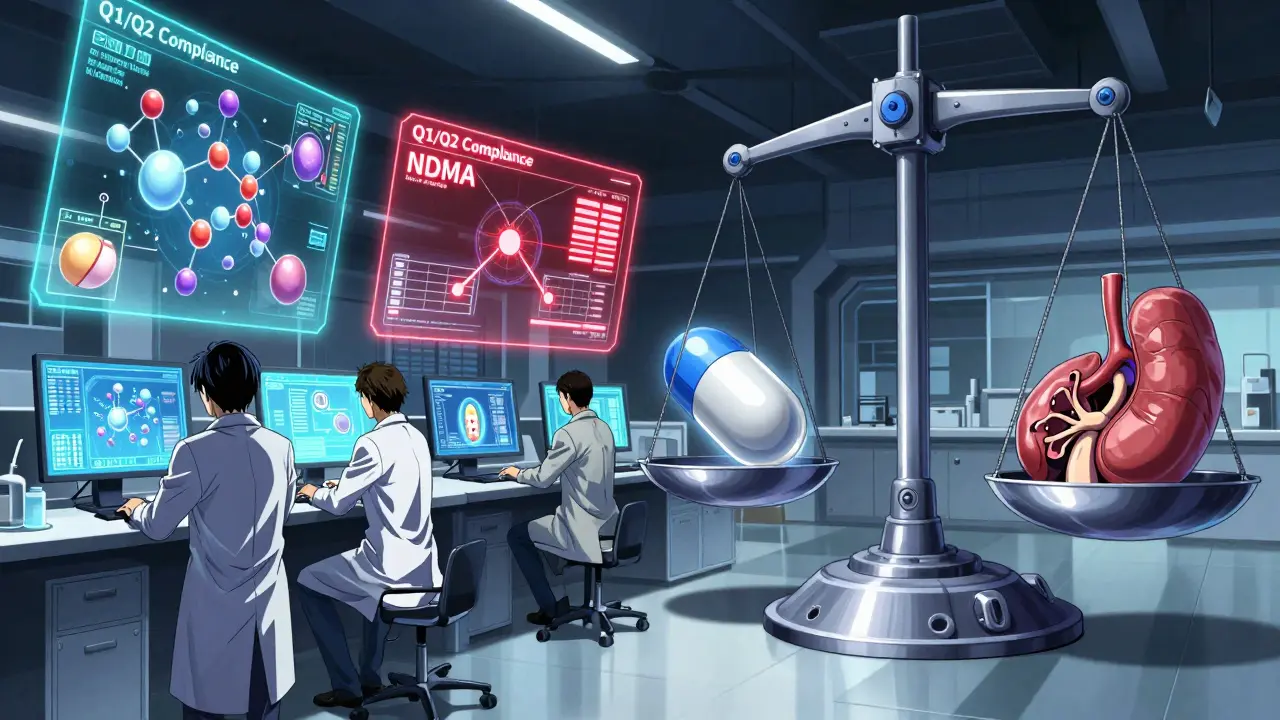
Not all medications are treated the same. If you’re making a generic version of an injectable, eye drop, or ear drop, you have to match the original drug’s excipients exactly-down to the last milligram. This is called Q1 (qualitative sameness) and Q2 (quantitative sameness). The FDA requires this because these routes deliver drugs directly into sensitive tissues. A tiny change can cause irritation, toxicity, or immune reactions.But for oral pills? You can swap out excipients. As long as you prove the new version works the same way, you’re good. That’s why generic manufacturers often change fillers or disintegrants. It’s cheaper and faster. But it’s also where things go wrong.
In 2020, Aurobindo tried to replace magnesium stearate with sodium stearyl fumarate in a generic version of Entresto. The FDA rejected it. In vitro tests showed a 15% difference in how fast the drug released at stomach pH. That’s enough to change absorption-and potentially reduce effectiveness or cause side effects.
On the flip side, Teva’s generic version of Jardiance succeeded by swapping one disintegrant for another. Bioequivalence studies showed nearly identical drug levels in the blood. The difference? They had the data to prove it.
When excipients cause real harm
The 2018 recall of 14 generic valsartan products wasn’t about the active ingredient. It was about a new solvent used in manufacturing. That solvent reacted with other chemicals to form NDMA-a known carcinogen. The excipient system, not the drug itself, created the danger.Even small changes can trigger reactions in sensitive people. The FDA’s 2023 pilot program started after reports of hypersensitivity to aspartame and saccharin in orally disintegrating tablets. The rate? Just 0.002% of users. But when you’re one of those people, that’s 100% of your problem.
People with rare conditions-like lactose intolerance, celiac disease, or allergies to dyes like tartrazine-can have real reactions to excipients. These aren’t "side effects" in the traditional sense. They’re unintended consequences of ingredients we’ve treated as invisible.
What’s changing in the industry
The pharmaceutical world is waking up. The global excipients market is growing fast-projected to hit $11.3 billion by 2028. Why? Because new drug delivery systems need new ingredients. Extended-release pills, patches, nasal sprays, and implantables all demand specialized excipients that behave differently than the old ones.The FDA is responding. In 2023, they proposed updating their Inactive Ingredient Database to include predicted tissue concentrations for each excipient. That’s a big deal. It means they’re finally acknowledging that where the excipient goes in your body matters as much as how much you take.
They’re also developing a computational model to predict which excipients might interact with biological targets-based on the 2020 Science study. And they’re considering a new rule: requiring all novel excipients to be screened against a panel of 50 high-risk biological targets. That could add $500,000 to $1 million to the cost of developing a new generic drug.
Meanwhile, the International Pharmaceutical Excipients Council is pushing for "presumed inert" thresholds-concentration levels below which an excipient is considered safe. But academics warn that people vary too much. What’s harmless to one person could trigger a reaction in another.
What this means for you
If you’re taking a standard pill for high blood pressure or cholesterol, the risk from excipients is extremely low. The system works well for most people, most of the time. The FDA’s Adverse Event Reporting System shows only 0.03% of side effects are definitively linked to excipients.But if you’ve had unexplained reactions-rashes, stomach upset, headaches, or fatigue-that started after switching to a generic version, it’s worth asking your pharmacist: "Did the inactive ingredients change?"
Patients with autoimmune conditions, chronic illnesses, or multiple sensitivities should be more cautious. Keep a list of excipients you’ve reacted to. Ask for formulations without certain additives. Some pharmacies can compound medications without problematic fillers.
And if you’re a patient who’s been told your reaction is "all in your head," know this: science is now confirming that some excipients aren’t inert. Your experience isn’t imaginary. It’s emerging evidence.
What’s next?
The old model-"if it’s not the drug, it doesn’t matter"-is fading. Regulatory agencies, researchers, and even manufacturers are starting to treat excipients like part of the medicine, not just packaging.By 2025, an estimated 30% of complex generic drug applications will need extra safety studies for excipients. That’s up from 18% in 2022. It’s not just about cost or speed anymore. It’s about safety.
For now, the best thing you can do is stay informed. Don’t assume all generics are identical. If you notice a change in how you feel after switching brands, speak up. Ask for the ingredient list. Your body might be telling you something the label doesn’t.
Are excipients really harmless?
Not always. While most excipients are safe at approved levels, research has shown that some-like aspartame, sodium benzoate, and propylene glycol-can interact with biological targets at concentrations reached during normal drug use. The term "inactive" is outdated for a subset of these ingredients.
Can excipients cause allergic reactions?
Yes. People with lactose intolerance, celiac disease, or allergies to dyes like tartrazine can react to excipients. Even rare substances like aspartame and saccharin have been linked to hypersensitivity in a tiny fraction of users. These reactions are real and documented.
Why do generic drugs have different excipients?
Generic manufacturers often change excipients to cut costs, use more available materials, or avoid patent issues. As long as they prove the drug works the same way, regulators allow it. But this flexibility can sometimes lead to differences in how the drug is absorbed-especially if the new excipient alters dissolution rates.
How do I know if my medication’s excipients changed?
Check the package insert or ask your pharmacist for the ingredient list. Generic manufacturers are required to list all excipients. If you notice a change in how you feel after switching brands, ask if the excipients were altered. Some pharmacies can provide the same formulation if you have a reaction.
Are there safer excipients I should look for?
There’s no universal "safe" list, but if you have known sensitivities, avoid specific excipients. For example, if you’re lactose intolerant, look for formulations using microcrystalline cellulose instead of lactose. If you’re sensitive to dyes, choose uncolored versions. Always consult your doctor or pharmacist before switching medications.

Beth Beltway
January 31, 2026 at 21:11The idea that excipients are 'inactive' is pure pseudoscience masquerading as regulatory policy. That 2020 Science paper didn't just 'suggest' something-it proved that common additives like aspartame and sodium benzoate are pharmacologically active at therapeutic doses. The FDA's database is a joke. They approve these substances based on historical use, not mechanistic biology. If you're taking a generic version of anything, you're essentially playing Russian roulette with your neurochemistry. This isn't about 'sensitivities'-it's about unregulated drug interactions disguised as filler.
Shawn Peck
February 1, 2026 at 13:32Bro, I switched to a different generic for my blood pressure med and my headaches stopped. I didn't even know what excipients were until this post. Now I check the label like it's a food ingredient list. Who knew your pill had more junk than a fast food burger?
Kelly Weinhold
February 3, 2026 at 01:16This is actually so fascinating and I'm so glad someone finally broke this down in plain terms. I used to think people who said they reacted to generics were just being dramatic, but now I get it-our bodies aren't one-size-fits-all machines. Some of us are just more sensitive to the little things, and that doesn't make us weird, it makes us human. The fact that the FDA is finally starting to take this seriously gives me hope. Maybe one day we'll stop treating medicine like a commodity and start treating it like something that actually lives inside us.
Sheila Garfield
February 3, 2026 at 15:24Interesting stuff. I’ve been on the same generic for years and never thought twice about it. But now I’m wondering if that slight nausea I get after taking it on an empty stomach is actually the magnesium stearate. I’ll ask my pharmacist next time I refill. No need to panic, but maybe a little more curiosity won’t hurt.
Sarah Blevins
February 5, 2026 at 10:55While the Science study is compelling, it is imperative to contextualize the clinical relevance of in vitro findings. The plasma concentrations of excipients following oral administration rarely approach the EC50 values observed in cell-based assays. Furthermore, pharmacokinetic variability across populations introduces significant noise. To extrapolate these results into a broad public health concern is premature without longitudinal cohort data.
Jason Xin
February 6, 2026 at 15:58So let me get this straight-we’ve been giving people pills full of mystery chemicals for decades, calling them 'inactive,' and now we’re surprised some of them actually do stuff? Wow. Groundbreaking. Next you’ll tell me water can be wet.
Kathleen Riley
February 8, 2026 at 07:41The ontological fallacy inherent in the term 'inactive ingredient' reveals a deeper epistemological crisis within pharmacological epistemology. To designate a substance as inert is to impose a Cartesian dualism upon molecular biology-an artificial separation between 'active' and 'non-active' that ignores the emergent properties of polypharmacological systems. The body does not distinguish between 'drug' and 'filler'; it responds to molecular structure, irrespective of intent. Thus, the very lexicon of pharmaceutical regulation is obsolete.
Donna Fleetwood
February 8, 2026 at 10:21I used to think my migraines were stress-related until I switched from one generic to another and they vanished. Now I always check the excipient list. Turns out, I’m sensitive to tartrazine. No one ever told me that. I’m just glad this info is getting out there. If you’ve ever felt off after a med switch-don’t ignore it. Your body’s not crazy. The system is.
Melissa Cogswell
February 9, 2026 at 08:35If you have celiac or lactose intolerance, always ask for a lactose-free version. Microcrystalline cellulose is a safe alternative. I work in pharmacy and see this happen way more than people realize. Most pharmacists will help you find a match-it just takes asking. No need to suffer silently.
Kimberly Reker
February 10, 2026 at 02:09Just read this whole thing and honestly? My mind is blown. I thought excipients were like the plastic wrap around a candy bar-just there to hold it together. Turns out they’re more like the seasoning in your soup: you don’t notice it, but if it’s off, everything tastes wrong. I’m going to start reading my pill labels like a recipe. And if I ever feel weird after switching brands? I’m not gonna blame myself anymore. I’m gonna ask: 'What changed in the filler?'