
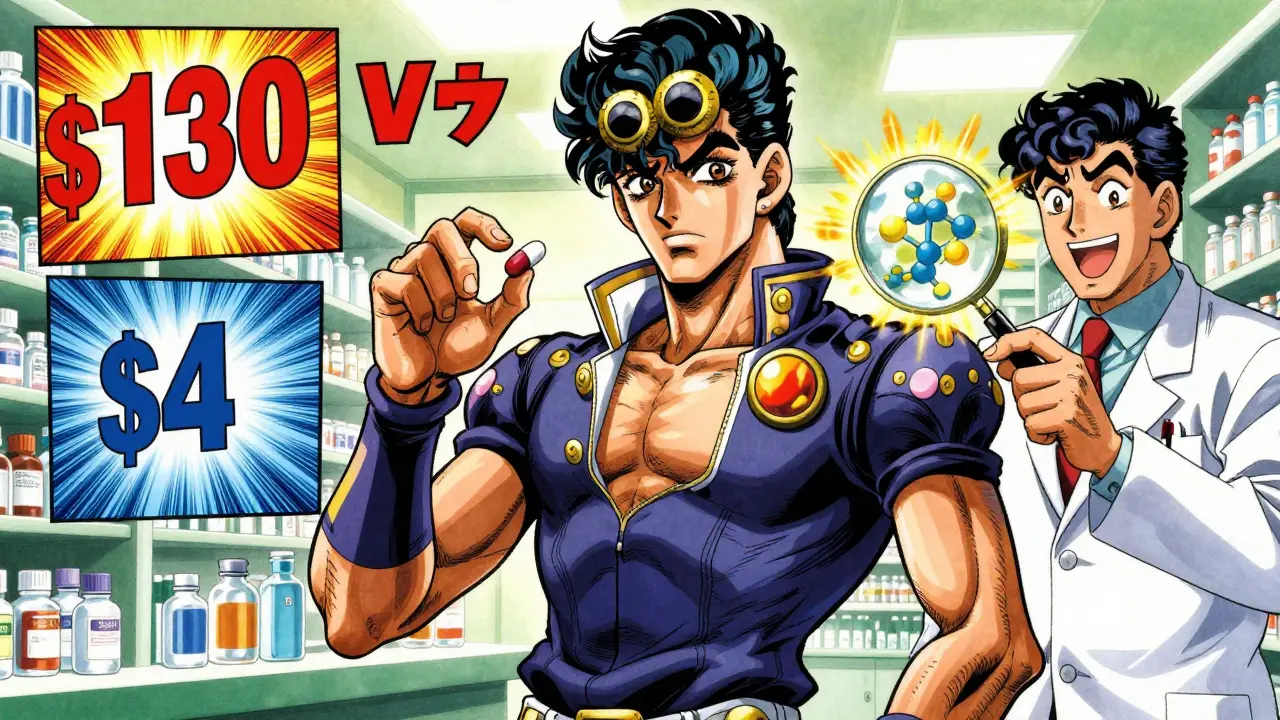
Let’s say you’re filling a prescription for blood pressure medicine. The pharmacist hands you a small bottle. You look at the label - same active ingredient, same dose, same instructions. But the price? It’s a fraction of what you paid last time. That’s the power of switching to generic medications.
Most people assume brand-name drugs are better. That’s not true. The science is clear: generics work just as well. And they save you, your insurance, and the whole healthcare system a ton of money.
They’re the exact same medicine - just cheaper
Generic medications aren’t knockoffs. They’re not imitation products. They’re legally required to contain the exact same active ingredient, in the exact same strength, and deliver it to your body in the exact same way as the brand-name version. The U.S. Food and Drug Administration (FDA) doesn’t allow anything less.
Before a generic drug hits the shelf, it must pass a strict test called bioequivalence. That means it has to get into your bloodstream at the same rate and to the same level as the brand-name drug. The FDA requires the difference to be within 80% to 125% of the original - a range so tight, it’s practically identical.
Think of it like two different brands of running shoes. Same sole, same cushioning, same support. One costs $150. The other costs $40. You’re not getting a worse shoe. You’re just not paying for the marketing, the fancy packaging, or the years of research that went into the original.
They save you serious money - often 85% less
The biggest reason to switch? Cost. Plain and simple.
Generic drugs cost, on average, 80% to 85% less than their brand-name counterparts. That’s not a guess. That’s data from the FDA’s 2023 report. For example:
- Lipitor (atorvastatin): Brand-name cost $130/month. Generic? As low as $4.
- Coumadin (warfarin): Brand-name runs over $300 for a 30-day supply. Generic? Around $4.
- Allegra (fexofenadine): Brand-name is $30. Generic? About $10.
And it’s not just out-of-pocket. Insurance plans love generics. Most have tiered copays: $1-$10 for generics, $25-$75 for brand-name. Some plans don’t cover brand-name drugs at all unless you prove there’s no generic alternative.
In 2023 alone, generic drugs saved the U.S. healthcare system over $1.6 trillion in just 10 years. That’s not a typo. That’s trillions. And it’s not just about big drugs - even common prescriptions like metformin for diabetes cost $4 a month as a generic versus $300 for Glucophage. For many, that’s the difference between taking your medicine and skipping doses.
They’re just as safe - maybe safer
Some people worry: “If it’s cheaper, is it less safe?” The answer is no. In fact, generics are held to the same manufacturing standards as brand-name drugs. The FDA inspects every facility - whether it’s in the U.S., India, or elsewhere - that makes generic drugs. In 2023 alone, they did over 1,200 inspections.
And here’s something surprising: adverse event reports for generics are proportional to how often they’re used. Since generics make up about 90% of all prescriptions, they show up in those reports 90% of the time. That doesn’t mean they’re dangerous - it means they’re widely used. If generics were riskier, we’d see a spike in reports. We don’t.
A 2022 study in the Journal of the American Heart Association looked at 186,000 patients taking heart medications. Half took brand-name, half took generic. The results? Identical outcomes. No difference in heart attacks, hospitalizations, or deaths.
What about those weird-looking pills?
One common complaint? “My pill changed color.”
Yes, generics can look different. Shape. Size. Color. Even the imprint on the pill. That’s because inactive ingredients - like dyes, fillers, or binders - aren’t required to match the brand-name version. These don’t affect how the drug works. They just change what it looks like.
But changing the pill’s appearance can cause anxiety. A patient might think, “This isn’t the same.” That’s understandable. But it’s not a safety issue. It’s a perception issue.
Pharmacists are trained to explain this. Ask them. Show them the label. You’ll see the active ingredient is identical. If you’re still unsure, ask your doctor to write “Dispense as written” on the prescription. That means no substitution.
Are there exceptions?
For most drugs - over 90% - the answer is no. But there are rare cases where small differences matter.
These are called narrow therapeutic index (NTI) drugs. A tiny change in blood level can mean the difference between no effect and a toxic reaction. Examples include warfarin (blood thinner), levothyroxine (thyroid hormone), and some anti-seizure drugs.
Even here, the FDA says approved generics meet strict standards. But some doctors - especially neurologists or cardiologists - may prefer to stick with one brand for patients on these drugs, not because generics are unsafe, but because consistency matters.
That said, a 2023 study in Research in Social and Administrative Pharmacy found that switching patients from brand-name to generic NTI drugs didn’t increase adverse events. So while caution is understandable, fear isn’t supported by data.
Why do generics cost so much less?
Brand-name companies spend billions on research, clinical trials, and marketing. That cost gets baked into the price. Once the patent expires, other companies can make the same drug without repeating those steps. They only need to prove bioequivalence - a fraction of the cost.
And competition drives prices down. One generic? Price drops 30%. Five generics? Price drops nearly 85%. That’s why you’ll see four different companies selling the same generic pill at the same pharmacy - and why prices keep falling.
What do experts say?
The American Medical Association recommends prescribing generics whenever possible. The FDA’s former director, Dr. Janet Woodcock, said: “Generic drugs undergo rigorous review to ensure they are as safe and effective as brand-name drugs.”
Harvard Medical School’s Dr. Aaron Kesselheim reviewed over 50 studies on generic heart medications. His conclusion? “Our research confirms that generic cardiovascular drugs perform as well as their brand-name counterparts.”
Even Medicare data shows the difference: beneficiaries pay an average of $1.85 per generic prescription versus $33.67 for brand-name. That’s not a typo. That’s over 94% less.

What about biosimilars?
There’s a newer category called biosimilars - generic versions of complex biologic drugs like insulin, rheumatoid arthritis treatments, and cancer therapies. These are harder to copy than pills, but they’re coming fast. As of December 2023, the FDA had approved 37 biosimilars. They’re expected to save the U.S. system over $300 billion in the next decade.
They’re not traditional generics, but they follow the same logic: same effect, lower cost.
How to switch
Switching is easy. When your prescription is due for renewal, ask your pharmacist: “Is there a generic available?”
If your doctor hasn’t written “dispense as written,” the pharmacy can legally substitute a generic. No extra steps. No paperwork. Just ask.
Check your insurance formulary. Most have a list of preferred generics. If your drug isn’t on it, ask your insurer why - and if they’ll cover the generic.
Use tools like the FDA’s Orange Book - a public database that lists approved generics and their therapeutic equivalence ratings. You don’t need to be a doctor to use it.
Real stories
On Reddit, a user named PharmTech87 wrote: “Switching my blood pressure meds to generic saved me $280 a month. No side effects. Just cheaper.”
A diabetes patient on PatientsLikeMe said: “Metformin generics cost me $4 a month. Glucophage was $300. This keeps me alive.”
Kaiser Permanente’s 2023 survey showed 87% of patients were satisfied with generics - and 92% said cost was the main reason they switched.
The numbers don’t lie. People who switch to generics are 68% less likely to skip doses because they can’t afford them.
Bottom line
Generic medications are not second-rate. They’re the same medicine, tested just as rigorously, made in the same factories, and held to the same standards. The only real difference? Price.
Switching can save you hundreds - even thousands - a year. It doesn’t mean you’re compromising. It means you’re being smart.
Ask your pharmacist. Ask your doctor. Ask your insurance. And don’t let the color of the pill fool you. What matters is what’s inside - and that hasn’t changed.

MALYN RICABLANCA
March 18, 2026 at 09:58Let me just say this-GENERIC DRUGS AREN’T JUST CHEAP, THEY’RE A REVOLUTION!!!
Imagine your blood pressure med going from $280 to $4?! That’s not savings-that’s liberation!!!
I used to cry in the pharmacy aisle, clutching my prescription like it was my last breath-now? I laugh. I actually laugh. I buy generics like they’re on sale at Target (because they are!!!).
And the pills? Color-changing? Shape-shifting? WHO CARES?! It’s the same active ingredient-same science, same FDA stamp, same life-saving power!!!
People who say ‘I need the brand’ are just emotionally attached to the packaging. Like buying a Rolex because the logo feels better on your wrist. It’s not the watch-it’s the brand.
I had a neighbor who skipped her diabetes meds because Glucophage cost $300. She got hospitalized. Switched to metformin? $4. Alive. Happy. No drama.
The FDA doesn’t lie. The studies don’t lie. The 186,000-patient heart study? Identical outcomes. Identical. Not ‘close.’ Not ‘probably.’ IDENTICAL.
And biosimilars? Ohhhhh, honey. You ain’t ready. Insulin biosimilars are coming in at 70% less. We’re about to see healthcare collapse under its own greed… and rise again on generics.
Stop being scared of a differently colored pill. Start being grateful you can afford to live.
And if you’re still skeptical? Go check the Orange Book. It’s free. It’s public. It’s the truth. And it’s not pretty… but it’s real.
PS: I’ve saved $14,000 in 3 years. I bought a dog. Her name is Generic. She’s the best thing I’ve ever bought.
gemeika hernandez
March 19, 2026 at 06:51My grandma took generics for 15 years. Never had a problem. Just cheaper pills that work.
Nicole Blain
March 19, 2026 at 08:15So… generics are just as good? 😍
And cheaper? 😍
And the FDA says so? 😍
Then why are we still overpaying? 🤔
Also… I just bought my first generic pill and it was BLUE. I was weirded out. Now I think it’s kinda cool. 🌈💊
Prathamesh Ghodke
March 20, 2026 at 13:24Hey, I'm from India-we make a lot of these generics. I've seen the factories. Clean. Regulated. Inspected.
People act like generics are made in a basement somewhere. Nah. They're made in the same plants as the brand names. Just without the ad budget.
And yeah, I've seen people freak out because their pill changed from pink to white. I get it. But it's like switching from Coke to Pepsi. Same sugar. Same fizz. Different label.
Also-$4 for metformin? That's what we pay here. It's not magic. It's capitalism.
Sanjana Rajan
March 20, 2026 at 20:20Oh please. You think generics are safe? Please. I know someone whose cousin’s neighbor took a generic and ended up in the ER.
It’s not about science. It’s about trust. And who trusts a pill that costs less than a latte?
Also, why is the FDA even allowed to approve these? They’re too busy checking TikTok trends to inspect labs.
And don’t even get me started on biosimilars. That’s just Big Pharma trying to sneak in cheaper poison.
Wake up, people. You’re being played.
Kyle Young
March 21, 2026 at 12:40The underlying assumption here is that cost reduction equates to societal benefit.
But is that always true? What if the savings are absorbed by insurers, not patients? What if pharmacists are incentivized to substitute, regardless of patient preference?
And while the data is compelling, the emotional experience of medication adherence is not captured in clinical trials.
Perception matters. Trust matters. Consistency matters.
Perhaps the answer isn’t just ‘switch to generic’ but ‘reform the system that makes patients fear their own medicine.’
Aileen Nasywa Shabira
March 22, 2026 at 17:57Oh wow. A whole article about generics like they’re some kind of miracle.
Let me guess-the FDA is flawless? The manufacturers aren’t cutting corners? The 80%-125% bioequivalence range isn’t a loophole?
And you didn’t mention that many generics are made in China and India, where regulatory oversight is… flexible?
Also, why do you think brand-name drugs still exist? Because people are stupid? Or because sometimes, the extra $100 matters?
Oh, and the ‘color-changing pill’ thing? That’s not perception-it’s a psychological trigger. Your brain knows something changed. It’s not irrational. It’s biological.
So yeah. Save money. But don’t pretend this is a moral victory.
Ryan Voeltner
March 24, 2026 at 04:10Generics represent one of the most profound examples of efficiency in modern healthcare.
The fact that identical therapeutic outcomes can be achieved at a fraction of the cost is not merely an economic advantage-it is a moral imperative.
When millions of people choose between food and medication, the answer should not be a matter of branding.
Systems that prioritize profit over access undermine the very purpose of medicine.
Let us not celebrate the generic pill. Let us mourn the system that made it necessary.
Kathy Underhill
March 24, 2026 at 06:38I’ve been on generic levothyroxine for seven years.
My TSH levels are stable.
I’ve never had an issue.
I pay $3 a month.
My doctor switched me without asking.
I didn’t panic.
I didn’t need to.
It worked.
That’s all that matters.
Don’t overthink it.
Linda Olsson
March 24, 2026 at 08:57My cousin works at a generic drug lab.
She says they use ‘fillers’ from questionable sources.
She won’t take them herself.
She says the FDA inspections are a joke.
She says the real test is what happens after 10 years.
She says they don’t test long-term side effects.
She says the brand-name drug is safer.
She says she’d rather pay more.
She says she’s not paranoid.
She says she’s just careful.