
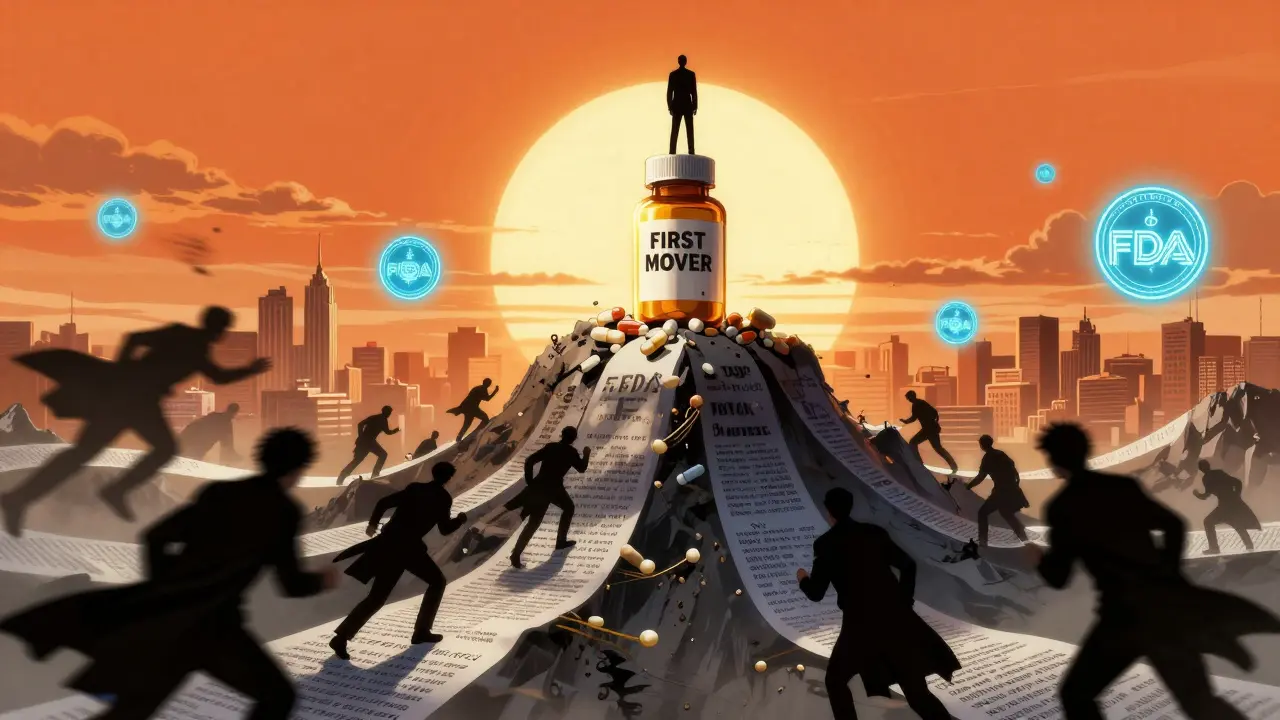
When a brand-name drug loses its patent, the race is on. Not just to make a copy - but to be the first to make it. The company that hits the market first with a generic version doesn’t just get a head start. They lock in a market share that can last for years. This isn’t luck. It’s a structured, legally backed advantage built into U.S. drug policy since 1984. And for generic manufacturers, it’s the difference between a modest profit and a multi-million-dollar windfall.
Why Being First Matters More Than You Think
The U.S. system doesn’t just allow the first generic company to enter - it gives them a 180-day exclusivity window under the Hatch-Waxman Act. During that time, no other generic can legally sell the same drug. But here’s the real secret: the advantage doesn’t end after those six months. In fact, the biggest wins happen long after the clock runs out.
Pharmacies don’t stock five versions of the same pill. They pick one. Usually, the first one they got. Why? Because inventory costs money. Training staff, updating systems, handling returns - it’s easier to stick with what’s already there. Once a pharmacist starts ordering from Company A, they rarely switch to Company B, even if B’s pill is 10% cheaper. That’s called stocking inertia. And it’s a silent, powerful force.
Doctors follow suit. If a patient is doing fine on a generic from Company A, most prescribers won’t bother switching to another. Especially for chronic conditions like high blood pressure or diabetes. Patients don’t notice the difference. Why change? The result? The first generic captures 70-80% of the market during its exclusivity period. Even after five competitors enter, it still holds 30-40%. The second entrant? Maybe 15%. The rest? Fight over scraps.
The Money Behind the Market Share
That early dominance isn’t just about volume - it’s about pricing. In those first few months, the first generic can charge close to the brand-name price. Why? Because pharmacies and insurers have no other option. That premium pricing window lasts longer than most people realize. By the time the second generic arrives, prices have already started dropping. The first mover got the best of both worlds: high margins early, then steady volume later.
McKinsey’s 2023 analysis shows that first-mover generic manufacturers average a 6-13 percentage point market share advantage over later entrants. In injectable drugs? That gap jumps to 8-10 points. In specialty therapies with fewer prescribers? It’s even wider. For example, the first generic for a rare autoimmune drug might hold 85% of the market two years later. Meanwhile, the second and third entrants are still fighting to get 10% each.
And here’s the kicker: the biggest winners aren’t always the smallest players. Large generic manufacturers with established supply chains, regulatory teams, and therapeutic expertise gain more than 10 market-share points over smaller rivals. Why? Because they’re better at navigating the system. They know how to file the right patent challenges. They have relationships with API suppliers that give them 12-15% lower costs. They’ve done this before.
What Can Kill Your Advantage
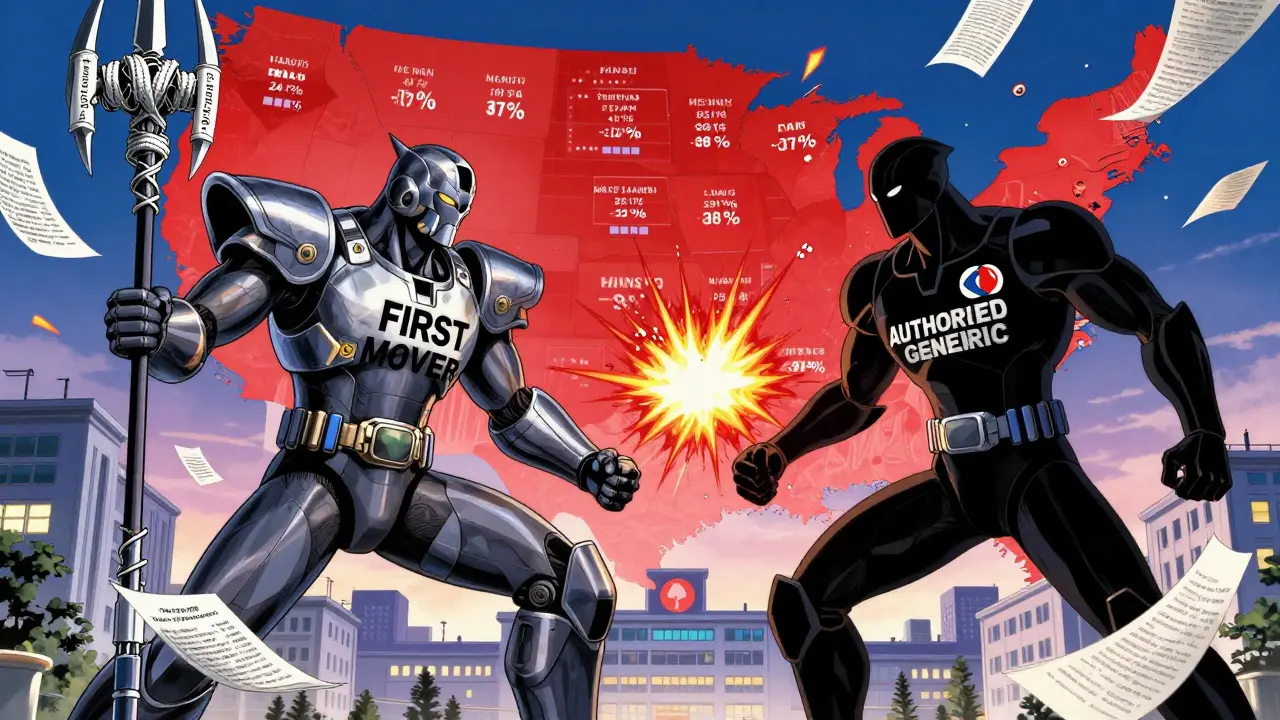
It’s not all smooth sailing. The biggest threat? Authorized Generics (AGs). That’s when the original brand company launches its own generic version - under a different label - during your 180-day exclusivity. Suddenly, instead of a two-player race (you vs. the brand), you’re in a three-way fight. And the brand still has its name recognition, its sales reps, and its existing relationships with pharmacies.
The FTC found that AGs cut first-filer revenue by 4-8% at retail and 7-14% at wholesale. That’s millions in lost revenue. Smart generic companies now plan for this. They build backup supply chains. They lock in long-term deals with API makers. They don’t rely on one source. Because if the brand slips in an AG, you need to be able to keep producing - and pricing aggressively - to hold your ground.
Another risk? Timing. If the second generic enters just six months after you, your advantage shrinks. If it’s two years later? You’re basically untouchable. That’s why some companies delay their own filings - waiting for the right patent challenge window - to stretch out the gap. A three-year lead can mean holding 50% of the market five years later. A one-year lead? You’re lucky to hold 25%.
Where the Advantage Is Strongest
Not all drugs are created equal. The first-mover advantage is strongest in areas where switching is hard:
- Injectables - harder to produce, fewer competitors, higher margins.
- Specialty drugs - used by fewer doctors, who get comfortable with one brand.
- Chronic condition meds - patients stay on them for decades. No reason to switch.
- Domestic manufacturers - U.S.-based companies get 22% higher market saturation than overseas ones. Why? Faster supply, fewer regulatory delays, better FDA communication.
On the flip side, in crowded markets - say, a common oral drug with five or more generics - the advantage fades fast. After 18-24 months, market share equalizes. But even then, the first mover still ends up with more than double what the last entrant gets.
What It Takes to Win
Getting there isn’t about luck. It’s about precision.
- Patent strategy - You need to file a Paragraph IV challenge at the exact right time. Too early? You get rejected. Too late? Someone else gets there first.
- Manufacturing readiness - You can’t wait until approval to start production. You need to have your facility, your raw materials, your QA processes ready to go on day one.
- Therapeutic expertise - Companies that have previously launched generics in the same drug class are twice as likely to succeed. Experience matters. Knowing how patients react, how doctors prescribe, how insurers cover - that’s not something you learn on the fly.
- Regulatory agility - The FDA’s GDUFA III rules in 2022 made submissions more complex. Smaller companies struggle. Big ones have teams of former FDA reviewers on staff. That’s not an accident - it’s a competitive edge.
And don’t forget: the first generic doesn’t just beat competitors. It kills the brand’s revenue. Within a year, the original drug’s sales drop 70-90%. That’s why brand companies fight so hard - through lawsuits, pay-for-delay deals, and AGs. But since the FTC started cracking down on pay-for-delay in 2023, those tactics are riskier. More first generics are hitting the market faster than ever.
The Future Isn’t Diminishing - It’s Evolving
Some say the first-mover advantage is fading. That’s not true. It’s changing. Complex generics - inhalers, topical creams, injectables - are growing fast. These are harder to copy. Fewer companies can make them. So the first one in? They get a 15-20 point advantage. That’s bigger than ever.
And while FDA guidance is becoming more standardized, the human side hasn’t changed. Doctors still prescribe what they know. Pharmacies still stock what’s already on the shelf. Patients still take what’s in their bottle. Those habits don’t shift easily.
The next decade will belong to companies that treat the first-mover advantage like a chess game - not a sprint. Plan years ahead. Build relationships. Master the regulatory maze. And never assume your lead is safe.
Because in generics, being first isn’t just about speed. It’s about locking in a market that won’t let go.


phyllis bourassa
March 8, 2026 at 09:42This is why I hate how pharma works. First one in gets a golden ticket while everyone else scrambles for crumbs. It’s not capitalism-it’s a rigged game where the rules were written by lawyers with trust funds. And don’t even get me started on how pharmacies just stick with the first one like it’s a loyalty program. 😒
Amina Aminkhuslen
March 9, 2026 at 15:51The first generic doesn’t just win-it owns the shelf. Pharmacies don’t switch because switching costs more than the savings. It’s not inertia, it’s economic self-defense. And yeah, that 180-day exclusivity? That’s the Trojan horse. The real win is the 3-year head start no one talks about.
amber carrillo
March 9, 2026 at 16:22The structural advantage built into Hatch-Waxman is both brilliant and deeply flawed. It incentivizes innovation in manufacturing and regulatory strategy, but it also creates monopolistic pockets in markets that should be competitive. A system designed to lower prices ends up entrenching one player. Irony is thick here.
Tim Hnatko
March 11, 2026 at 12:59I’ve seen this play out in my work. A client’s company was the first to market a generic insulin analog. They didn’t just capture market share-they became the default. Even when cheaper options came in, no one switched. The real lesson? Habit beats price. Always.
Aaron Pace
March 11, 2026 at 19:45Bro, imagine being the first to drop a generic and watching your bank account explode 🤑💸. Then the brand slaps you with an authorized generic and you’re like ‘not again 😭’ but you’ve got 3 backup suppliers so you just drop prices 20% and keep rolling. This is the real Game of Thrones.
Joey Pearson
March 13, 2026 at 06:14You don’t win by being first. You win by being ready. The companies that crush this game don’t just file paperwork-they build supply chains, train teams, and prep for AGs before they even get approval. This isn’t luck. It’s strategy.
Roland Silber
March 13, 2026 at 08:43What’s fascinating is how much of this is psychological. Doctors prescribe what’s familiar. Pharmacists stock what’s already there. Patients take what’s in the bottle. The drug doesn’t change. The perception does. And perception is everything. The first mover doesn’t just have a product-they have a brand identity.
Patrick Jackson
March 13, 2026 at 20:31It’s wild to think about how something as simple as a pill can become a monument to timing, luck, and bureaucratic foresight. The first generic isn’t just a drug-it’s a legacy. A quiet, unassuming empire built on paperwork, supply chains, and the stubbornness of human habit. We think medicine is science. But sometimes? It’s just inertia. And the first one in? They’re the ones who got to write the rules. 🌌💊