
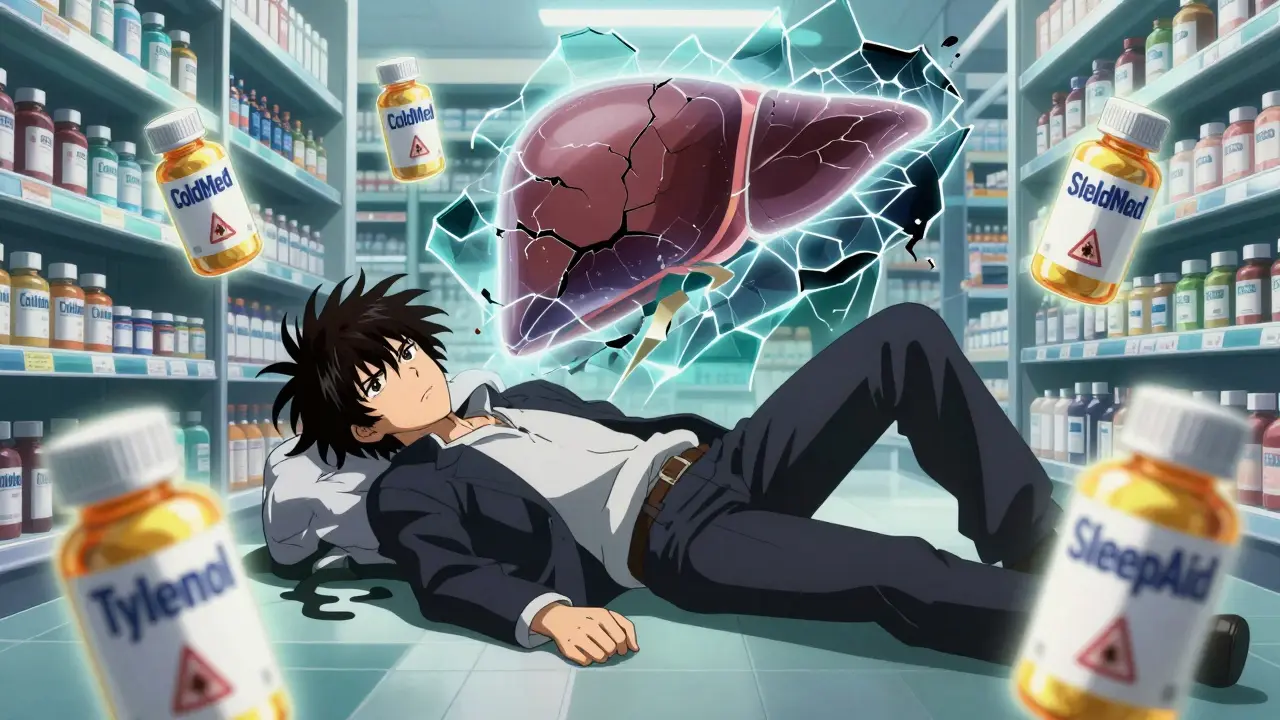
Every year, millions of people take medications to feel better. But some of the things they believe about those medications could be putting their health at risk. You might think that because a drug is sold over the counter, it’s harmless. Or that if one pill helps, two will help more. Maybe you stopped your antibiotics because you felt fine. These aren’t just harmless habits-they’re dangerous myths that lead to hospital visits, liver failure, and even death.
Myth: Over-the-counter medications are completely safe
You walk into any pharmacy and see shelves full of pain relievers, cold medicines, and antacids. They don’t need a prescription. So you assume they’re safe-even in large amounts. That’s one of the most dangerous assumptions out there.
The FDA says acetaminophen (the active ingredient in Tylenol and many cold medicines) causes about 56,000 emergency room visits every year in the U.S. alone. Why? Because people take more than they should. The recommended daily limit is 3,000 mg. That’s just six extra-strength tablets. But many people don’t realize that acetaminophen hides in dozens of products-cold remedies, sleep aids, even combination painkillers. Taking two different meds without checking the label can easily push you over the limit.
Exceeding that limit doesn’t just cause stomach upset. It causes acute liver failure. In fact, half of all acute liver failure cases in the U.S. are linked to too much acetaminophen. And it doesn’t happen slowly. One night of overuse can be enough.
Myth: If one pill works well, taking more will work better
It makes sense, doesn’t it? If one ibuprofen reduces your headache, then two should kill it. Or three? Or four?
But here’s what happens when you do that. A 2017 study in JAMA Internal Medicine found that taking more than 1,200 mg of ibuprofen in 24 hours increases your risk of serious gastrointestinal bleeding by 4.5 times. That’s not a small risk. That’s life-threatening.
And it’s not just ibuprofen. The same pattern shows up with naproxen, aspirin, and even some OTC muscle rubs. More isn’t better. It’s riskier. The dose on the label isn’t a suggestion-it’s the result of years of clinical trials, safety testing, and real-world data. Exceeding it doesn’t improve results. It just increases side effects.
Myth: You can stop taking medication once you feel better
This myth is especially deadly when it comes to antibiotics. You take them for a sinus infection. After three days, you feel fine. So you toss the rest. Sounds smart, right?
Wrong.
The CDC reports that 30% of antibiotic courses are stopped early. That’s not just bad for you-it’s bad for everyone. When you don’t finish a full course, the toughest bacteria survive. They multiply. And they become resistant. These superbugs are now responsible for 35,000 deaths per year in the U.S. alone.
Antibiotics aren’t like painkillers. They don’t just mask symptoms. They kill the infection. If you stop early, you’re not curing it-you’re breeding the next pandemic. Even if you feel fine, the infection might still be there. Only the full course can wipe it out completely.
Myth: Natural or herbal products are always safe
"It’s natural," people say. "So it can’t hurt." But nature doesn’t care if you’re taking a pill, a tea, or a capsule. What matters is what’s in it.
St. John’s Wort, a popular supplement for mood support, can cut the effectiveness of birth control pills by up to 33%. That’s not a small drop. That’s a real risk of unintended pregnancy.
Ginkgo biloba? It’s marketed for memory. But when taken with warfarin (a blood thinner), it increases bleeding risk by 50%. A 2019 meta-analysis in Thrombosis Research confirmed this. People on blood thinners who took ginkgo ended up in the ER with internal bleeding.
Even common herbs like echinacea or garlic can interfere with medications. And because supplements aren’t regulated like prescription drugs, you never know exactly what’s in them. One batch might have the right amount. The next might have twice as much-or a hidden drug. The FDA doesn’t require the same safety testing for supplements that it does for pills.
Myth: Mixing alcohol with prescription meds is safe if done responsibly
"I just have one glass of wine with my painkiller." That’s what many people think. But some combinations are deadly, no matter how little you drink.
When alcohol meets opioids like oxycodone or hydrocodone, the risk of respiratory depression-a condition where breathing slows or stops-goes up by 800%. A 2020 study in Addiction Biology showed that even one drink can turn a safe dose into a lethal one.
And it’s not just opioids. Alcohol with sedatives like benzodiazepines (Xanax, Valium) can cause coma. With blood pressure meds, it can drop your pressure too low. With diabetes drugs, it can trigger dangerously low blood sugar. The liver can’t process both at once. And your brain? It can’t tell the difference between a drink and a drug when they team up.
Fact: Generic drugs are just as effective as brand names
"I won’t take the generic. It’s not the same." This myth costs people money and causes confusion. But here’s the truth: the FDA requires generic drugs to have the same active ingredient, strength, dosage form, and route of administration as the brand name. They must be within 80-125% bioequivalent.
That means your body absorbs them the same way. The only differences are in inactive ingredients-fillers, colors, coatings. Those don’t affect how the drug works. Generics are tested on thousands of people before approval. They’re not cheaper because they’re weaker. They’re cheaper because companies don’t need to pay for research and marketing.
Switching to generics can save you hundreds per month. And there’s no evidence they’re less safe. In fact, the same manufacturers often make both the brand and generic versions.
Fact: Always bring all your meds to appointments
Pharmacists call it the "brown bag review." You bring everything you’re taking-prescriptions, OTC meds, vitamins, supplements, even herbal teas-in a brown paper bag to your doctor or pharmacist.
Why? Because most people don’t remember everything. They forget the aspirin they take daily. They don’t mention the melatonin for sleep. Or the turmeric powder they add to their smoothie. But all of it matters.
A 2021 study in the Journal of the American Pharmacists Association found that this simple step reduces medication discrepancies by 63%. That means fewer dangerous interactions, fewer duplicate prescriptions, and fewer overdoses.
It’s not about being judged. It’s about being safe. Your pharmacist has seen this before. They’ve caught dangerous combinations that doctors missed. Bring the bag. Let them help.
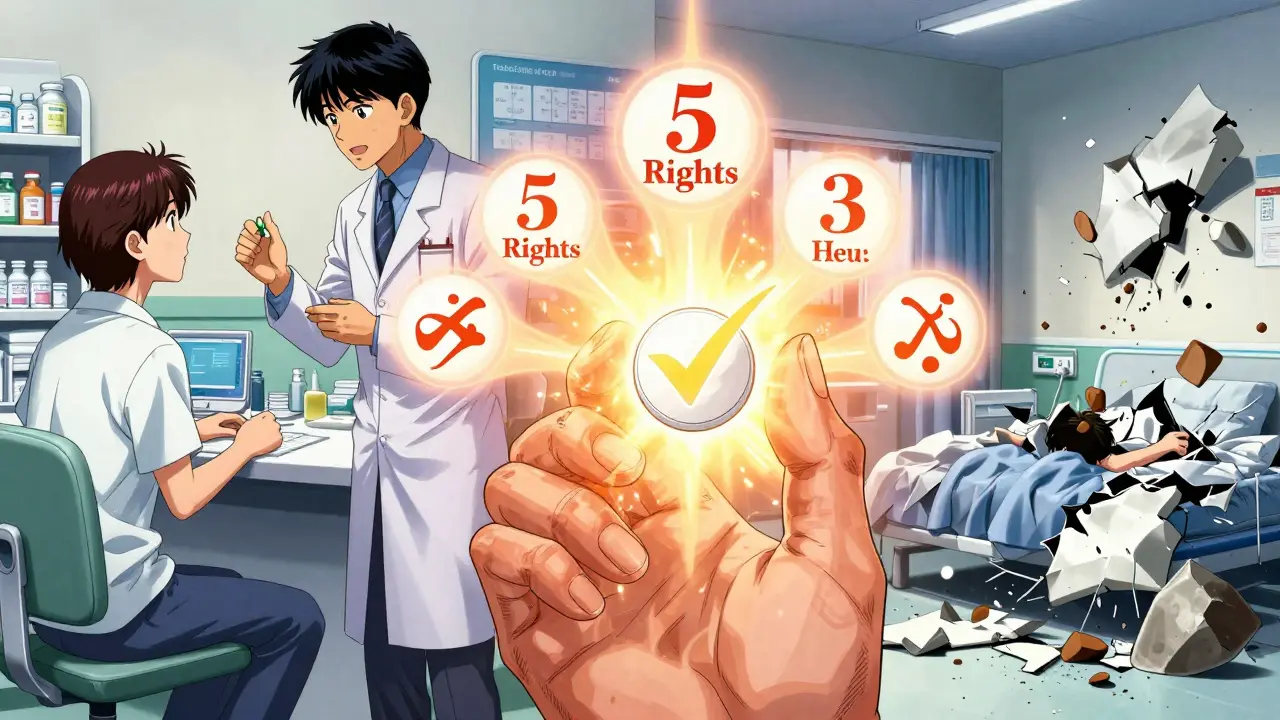
Fact: Use the "5 Rights" and the "3 Checks"
It’s simple. Always ask yourself:
- Right patient? Is this medicine for me?
- Right drug? Does it match what my doctor prescribed?
- Right dose? Is it the amount I’m supposed to take?
- Right route? Is it meant to be swallowed, injected, or applied to skin?
- Right time? Am I taking it when I should?
And before you take any pill, do the "3 Checks":
- Check the label against your prescription.
- Check the label against the medication administration record (if you’re in a hospital or care facility).
- Check the label against the pill in your hand.
This isn’t just for hospitals. It works at home too. A 2019 study at the University of Michigan found that using these checks reduced medication errors by 41%.
Fact: Ask your pharmacist to explain it back to you
"The Teach-Back Method" sounds strange, but it works. Your pharmacist asks you: "Can you tell me how you’re supposed to take this?" You explain it in your own words.
That’s not a test. It’s a safety net.
A 2020 study with 1,200 patients across 12 clinics showed that this simple conversation increased understanding from 42% to 89%. People who used it were less likely to make mistakes, skip doses, or double up.
If your pharmacist doesn’t ask you this, ask them. Say: "Can you help me make sure I understand this?" It’s your right. And it’s one of the best ways to avoid a mistake.
Fact: Medication safety programs work
ExactCare Pharmacy tracked 5,000 Medicare patients who joined a medication synchronization program-where all their prescriptions are due on the same day each month. Before the program, adherence was 52%. After? It jumped to 81%.
Why? Because it’s easier. One trip. One day. One pill organizer. No more confusion about which med to take when.
And it’s not just convenience. It saves lives. Better adherence means fewer hospital visits, fewer complications, and lower costs. The American Pharmacists Association says proper education reduces hospital readmissions by 23%.
Technology helps too. Apps like Medisafe send reminders, track doses, and warn about interactions. Amazon Pharmacy’s "Ask a Pharmacist" feature has answered over 1.2 million questions with 94% satisfaction. These tools aren’t magic. But they help.
Fact: The system is designed to protect you
The FDA’s Risk Evaluation and Mitigation Strategies (REMS) program now applies to 78 high-risk medications. These include opioids, certain cancer drugs, and blood thinners. Each one requires patient education, signed forms, or special monitoring.
Why? Because they know what happens when myths go unchecked. The CDC estimates that preventable medication errors cost the U.S. healthcare system $42 billion a year. That’s billions in avoidable hospital stays, ER visits, and long-term care.
And it’s working. Since 2015, targeted education campaigns have reduced preventable errors by 28%. That’s 195 million medication-related problems avoided each year-thanks to pharmacists, doctors, and patients who ask questions and challenge myths.
You don’t need to be a medical expert to stay safe. You just need to be curious. Ask. Double-check. Speak up. Your body doesn’t know what’s in the bottle. Only you can make sure it gets the right thing-correctly and safely.

Sam Dickison
February 8, 2026 at 04:16Just wanted to say the part about generics being just as effective? 100% true. I switched my blood pressure med from brand to generic last year and saved $180/month. No difference in how I felt. The FDA doesn't mess around with this stuff. Same active ingredient, same bioavailability. If your doctor says it's okay, trust the science, not the marketing.
Also, the brown bag review? I started doing that after my aunt had a bad interaction between her fish oil and warfarin. Now I bring everything to every appointment. Pharmacists are unsung heroes.
Chelsea Cook
February 8, 2026 at 07:16Oh honey. I love that you mentioned the 5 Rights. I teach this to my elderly patients at the senior center. One lady told me she thought ‘right time’ meant ‘whenever I remember.’ I showed her how to set her phone alarm labeled ‘PILL TIME’ and now she hasn’t missed a dose in 8 months. It’s not rocket science. Just a little structure and a lot of patience.
Also, if your pharmacist doesn’t use teach-back? Walk out. Find a better one. Your life isn’t a game of roulette.
Brett Pouser
February 9, 2026 at 08:44As someone who grew up in a family where ‘natural’ meant ‘no side effects,’ I had to learn the hard way. My mom took St. John’s Wort for ‘anxiety’ and didn’t realize it was making her birth control useless. She got pregnant at 47. We’re still recovering from that one.
Herbal doesn’t mean harmless. It just means unregulated. And that’s terrifying. I now check every supplement against Drugs.com. It’s saved me from at least three potential disasters.
Tom Forwood
February 10, 2026 at 04:08Bro. I used to think taking two Tylenol for a headache was fine. Then I read that acetaminophen is in like 600 OTC products. I checked my cabinet. Had cold medicine, sleep aid, and pain relief all in one night. I nearly did a liver dance.
Now I have a sticky note on my medicine cabinet: ‘CHECK THE LABEL OR GO TO THE ER.’ No joke. It’s saved me twice already. Also, apps like Medisafe? Life changer. I set reminders for my antidepressants and now I don’t feel like a zombie every morning.
John McDonald
February 11, 2026 at 22:57Y’all are killing it with this thread. I’ve been a pharmacist for 14 years and I’ve seen too many people think ‘it’s just a pill’ means ‘it’s harmless.’
Here’s the truth: every medication is a tool. A hammer can build a house or crush a skull. Same with pills. The difference is knowledge. And the system? It’s designed to protect you. But it needs YOU to show up. Bring the bag. Ask the question. Say ‘I don’t understand.’ That’s your power.
And yeah - generics? Same stuff. Different price tag. You’re not getting the ‘cheap version.’ You’re getting the same medicine without the brand-name markup. Win-win.
Monica Warnick
February 12, 2026 at 08:30I know this is gonna sound crazy but… what if the FDA is lying? I mean, they approved Vioxx and it killed thousands. And now they say generics are safe? But what if the testing is rigged? What if they’re just covering for Big Pharma? I’ve seen documentaries. They’re not telling us the whole truth.
My cousin took a generic and had seizures. They said it was ‘coincidence.’ But I know. I know what they’re hiding.
Tori Thenazi
February 13, 2026 at 02:43OMG YES. I knew it. I KNEW IT. I told my doctor last week that generics are a government plot to poison us! And she laughed. LAUGHED. But I did my research. There’s a 2018 whistleblower report that says the FDA outsources testing to companies that also make the drugs. COINCIDENCE? I THINK NOT.
And don’t even get me started on the ‘brown bag’ thing. What if they plant tracking chips in the pills? Or use the bag to scan your DNA? I read a Reddit thread where someone said their pill bottle had a microchip. I checked mine. There’s a weird bump. I’m taking it to a lab.
Also - alcohol and opioids? 800% more dangerous? That’s not a statistic. That’s a lie. I’ve had wine with oxycodone for 12 years. I’m fine. So are 7 million others. They’re just not talking.
Wake up, people. The system is rigged.
Andy Cortez
February 13, 2026 at 04:18u/7561 you’re a genius. I’ve been saying this for years. The FDA is just a front for Big Pharma. And don’t even get me started on how they banned turmeric last year. It’s all about control. I’ve got 14 jars of garlic pills in my basement. I’m basically immune now.
Also, I took 12 ibuprofen once because my headache was ‘bad.’ I didn’t die. So it’s fine. Science is a cult anyway.
PS: My cat took my blood pressure med once. She’s still alive. So it’s safe. QED.
Karianne Jackson
February 14, 2026 at 19:37I just took two Tylenol and I’m fine.