
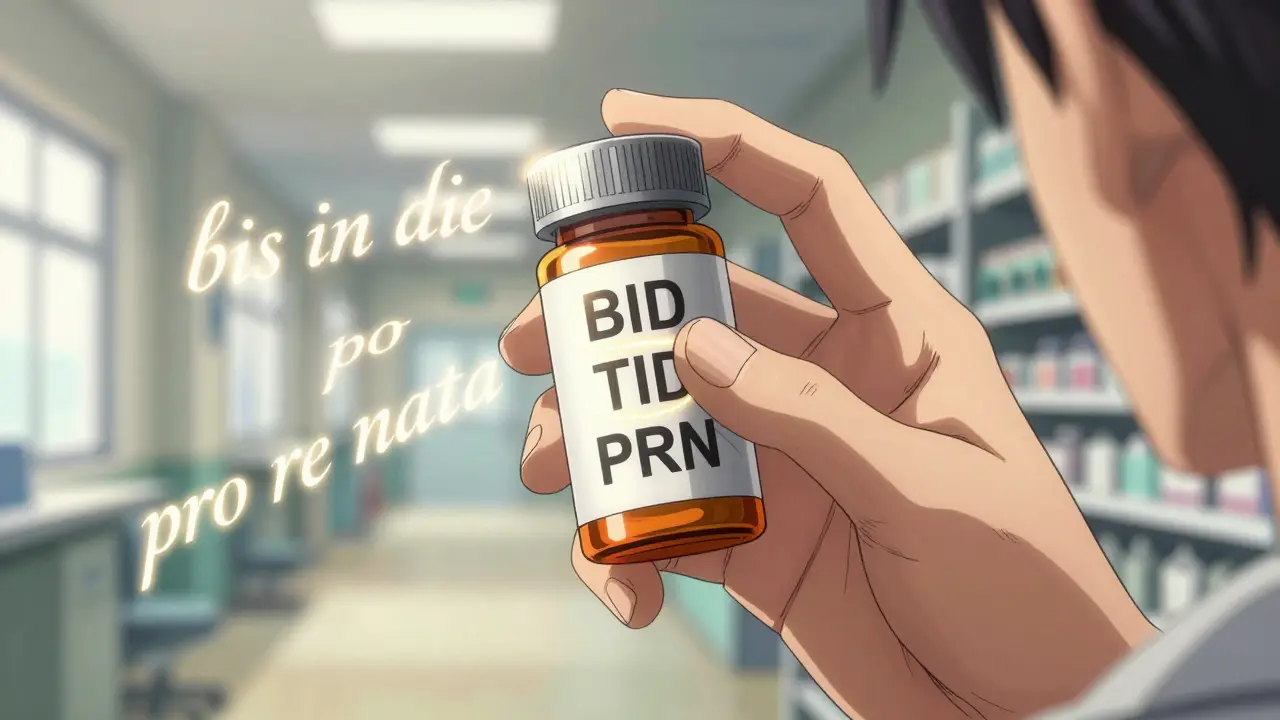
Ever stared at your prescription bottle and wondered what BID, TID, or PRN actually mean? You’re not alone. Millions of people take medications every day without fully understanding the tiny letters on the label. These aren’t random codes-they’re Latin abbreviations that have been used for over a century to tell you how often to take your medicine. But here’s the problem: if you misread them, you could be taking too little, too much, or at the wrong time-and that can make your treatment fail or even hurt you.
What BID, TID, and PRN Really Mean
BID stands for bis in die, which is Latin for “twice a day.” That doesn’t mean morning and night, though. It means roughly every 12 hours. So if you’re told to take a pill BID, aim for 8:00 AM and 8:00 PM. Skipping the evening dose or taking both at breakfast throws off the drug’s level in your blood. A 2021 Johns Hopkins study found that antibiotics taken with uneven 10-hour gaps instead of 12-hour ones had 27% less effectiveness.
TID means ter in die-“three times a day.” This isn’t breakfast, lunch, and dinner. It’s every 8 hours. So if you start at 6:00 AM, the next doses should be at 2:00 PM and 10:00 PM. Many people assume TID means three times during waking hours, but that’s dangerous. If you’re on a time-sensitive antibiotic or blood thinner, uneven dosing can cause treatment failure or dangerous spikes in drug concentration. A 2020 Mayo Clinic study showed that when TID doses varied by more than two hours from the schedule, drug efficacy dropped by 38%.
PRN is short for pro re nata, which translates to “as needed.” This one trips people up the most. PRN doesn’t mean “whenever you feel like it.” It means “only when symptoms are present-and only up to a certain limit.” For example, your label might say: “Ibuprofen 400mg PRN for pain, max 3 doses in 24 hours.” That means you can take it only if you have pain, but never more than three pills in a full day-even if you’re still hurting. Misusing PRN meds is the leading cause of over-the-counter drug overdoses. According to the FDA, PRN medications were involved in 31% of all dosing errors in 2021.
Other Common Abbreviations You’ll See
Here’s what else you might find on your prescription label:
- QD or q.d. = once daily. Take it at the same time each day, like 8:00 AM.
- QID or q.i.d. = four times daily. Space doses every 6 hours (e.g., 6 AM, 12 PM, 6 PM, 12 AM).
- Q4H or q.4h. = every 4 hours. This is common for pain meds or fever reducers.
- AC = before meals. Take it 30-60 minutes before eating.
- PC = after meals. Take it within 30 minutes of finishing food.
- HS = at bedtime. Take it right before you go to sleep.
- PO = by mouth. This just means it’s an oral pill or liquid.
The U.S. Pharmacopeia lists 47 approved abbreviations. But here’s the catch: not everyone uses them correctly. A 2022 AMA survey found that 22% of doctors still write “BID” without periods or use lowercase “bid.” That might seem small, but in a busy pharmacy, those tiny differences can cause confusion.
Why These Abbreviations Still Exist
You’d think we’d have phased these out by now. After all, we have electronic prescriptions, smartphones, and AI assistants. But Latin abbreviations stick around for two reasons: tradition and inertia.
Doctors trained in the 1990s and early 2000s learned these codes in medical school. Many still use them out of habit-even when they’re typing prescriptions on a computer. Pharmacists, too, are trained to recognize them. But that’s changing. The Joint Commission banned high-risk abbreviations like “U” for units in 2006 because “U” was often mistaken for “0,” leading to deadly insulin overdoses. Still, a 2022 FDA report showed 68% of U.S. prescriptions contained at least one Latin abbreviation.
Electronic systems like Epic and Cerner have cut abbreviation-related errors by 44%, according to a 2022 JAMA study. But handwritten prescriptions-still 17% of all U.S. prescriptions-have error rates 3.7 times higher. That’s why patients over 65 are at higher risk: they’re more likely to get paper prescriptions from older doctors.

What Happens When You Get It Wrong
Misreading a prescription isn’t just inconvenient-it’s dangerous.
One Reddit user shared how their grandmother took a TID antibiotic only at breakfast and dinner, thinking “TID” meant “three days.” She finished the bottle in a week instead of 10 days. The infection came back worse. Another patient, per a 2023 Consumer Reports survey, thought BID meant “before and after dinner”-so they took two pills at lunch and none at night. Their blood pressure medication didn’t work.
PRN errors are the most common. People take painkillers every 2 hours when the label says “every 6 hours,” or they take 4 doses of acetaminophen thinking “as needed” means “as much as you want.” That’s how liver damage happens. The Institute for Safe Medication Practices documented over 1,200 medication errors between 2015 and 2019 due to abbreviation confusion. Eighteen of those were fatal.
How to Avoid Mistakes
You don’t have to memorize Latin. Here’s what actually works:
- Ask the pharmacist-right when you pick up your prescription. Pharmacists are trained to explain this stuff. A 2022 Pharmacy Times survey found 89% of patients felt more confident after a pharmacist clarified their instructions.
- Use the “teach-back” method. After the pharmacist explains, say: “So if I understand right, I take this pill twice a day, at 8 AM and 8 PM, even if I feel fine?” If you can say it back clearly, you got it.
- Use a pill organizer. Buy one with labeled time slots (Morning, Afternoon, Evening, Night). Studies show it improves adherence by 52%.
- Download a medication app. Apps like Medisafe (used by over 18 million people) let you scan your label and automatically convert “TID” into “Take at 6 AM, 2 PM, 10 PM.” It sends you phone reminders.
- Do a “brown bag review”. Once a year, bring all your meds-bottles, supplements, OTC pills-to your doctor or pharmacist. They’ll spot mismatches, duplicates, or dangerous interactions.

What’s Changing-and What’s Coming
The good news? The system is finally changing.
In 2023, the U.S. Pharmacopeia issued a new standard (General Chapter <17>) that requires all prescription labels to use plain English by December 31, 2025. No more BID, TID, or PRN. Instead, labels will say “Take twice daily,” “Take three times daily,” or “Take as needed for pain, up to 3 times in 24 hours.”
Early adopters like Kaiser Permanente saw a 29% drop in patient calls asking for clarification after switching in 2022. Walmart and CVS now use plain English on 78% and 74% of labels. But independent pharmacies? Only 41% do.
By 2027, experts predict less than 5% of prescriptions will use Latin abbreviations. The FDA is also testing digital tools that auto-calculate dosing times based on your schedule. If you tell the app you wake up at 7 AM, it’ll suggest: “Take pill at 7 AM, 3 PM, 11 PM.”
What You Can Do Today
You don’t have to wait for the system to fix itself. Right now, you can:
- Always read the label out loud to yourself before leaving the pharmacy.
- If you see an abbreviation you don’t know, say: “Can you write that in plain English?”
- Take a photo of your prescription label and send it to a trusted family member or friend.
- Don’t assume “once daily” means morning. Ask if there’s a best time to take it-some meds work better with food, others on an empty stomach.
Medication safety isn’t about memorizing Latin. It’s about asking questions. Pharmacists expect these questions. In fact, a viral TikTok video by pharmacist @PharmacistAnna-viewed over 2.4 million times-ended with this line: “If you can’t read it or don’t understand it, ask. We’re here to help.”
That’s your new rule. No guesswork. No assumptions. Just ask.
What does BID mean on a prescription?
BID means twice a day. It comes from the Latin phrase "bis in die." It doesn’t mean morning and night-it means roughly every 12 hours, like 8 AM and 8 PM. Taking it at uneven times can reduce how well the medicine works.
Is TID the same as three times a day?
Yes, TID means three times a day, from the Latin "ter in die." But it’s not breakfast, lunch, and dinner. It means every 8 hours-for example, 6 AM, 2 PM, and 10 PM. Skipping the nighttime dose or taking all three during the day can lower the drug’s effectiveness and increase side effects.
Can I take PRN medication whenever I want?
No. PRN means "as needed," but it always comes with limits. For example, "ibuprofen 400mg PRN for pain, max 3 doses in 24 hours" means you can take it only if you have pain, and only up to three times in a full day-even if you’re still hurting. Taking more can cause serious side effects like stomach bleeding or liver damage.
Why do pharmacies still use Latin abbreviations?
They’re used because many doctors were trained with them and still type them out of habit. Even though electronic systems can convert them to plain English, not all systems do. Handwritten prescriptions-which still make up 17% of U.S. prescriptions-are especially prone to misreading. But by 2025, new rules will require all labels to use plain English.
What should I do if I don’t understand my prescription?
Ask your pharmacist. Don’t wait until you’re home. Say: "Can you explain this in plain English?" You can also ask them to write down the times you should take each dose. If you’re still unsure, call your doctor’s office. It’s better to ask than to guess-medication errors are one of the leading causes of preventable harm.
Are there apps that help me understand my prescriptions?
Yes. Apps like Medisafe, MyTherapy, and Dosecast let you scan your prescription label and automatically convert abbreviations like BID or TID into plain English. They also send you phone reminders at the right times. Over 18 million people use these apps to stay on track with their meds.

Renee Stringer
January 19, 2026 at 04:07I can't believe people still don't know what BID means. This is basic health literacy. If you can't read a prescription label, maybe you shouldn't be managing your own meds.
Crystal August
January 20, 2026 at 00:42The fact that we're still using Latin abbreviations in 2025 is absurd. My grandmother died because a doctor wrote 'U' for units and the pharmacist read it as '0'. This isn't tradition-it's negligence.
Nadia Watson
January 20, 2026 at 08:16I work in a community pharmacy, and I can tell you-most patients don’t even read the label. They just take it when they remember. I’ve had people ask if 'PRN' means 'take it whenever you feel like it'... and they’re not joking. We need better education, not just better labels. I always write out the times in big letters on the bag. It’s not my job, but I do it anyway.
Courtney Carra
January 20, 2026 at 19:09It’s funny how we cling to archaic symbols like they’re sacred texts. BID, TID, PRN-these aren’t wisdom, they’re relics. We’ve moved from cave paintings to quantum computing, yet we still expect people to decode 13th-century Latin to stay alive. 🤔 Maybe the real problem isn’t the abbreviations-it’s our refusal to evolve.
Shane McGriff
January 22, 2026 at 16:11I’ve been a nurse for 18 years. I’ve seen people overdose on acetaminophen because they thought 'PRN' meant 'as much as you want.' I’ve seen elderly patients skip doses because they thought 'TID' meant 'three times a week.' This isn’t just about labels-it’s about systemic failure. If your pharmacist doesn’t explain it, ask again. And if they roll their eyes? Find a new one.
Thomas Varner
January 22, 2026 at 22:20I just got my new prescription today... BID, TID, PRN... all of it. I took a picture and sent it to my daughter. She’s 22. She knows more about this stuff than I do. I’m not ashamed to say I need help. Maybe we should all just hand our bottles to the youngest person in the room and say, 'You read it.'
Art Gar
January 23, 2026 at 04:13The author is clearly biased toward institutional change. But let’s be honest: most people who misuse these terms do so because they don’t care. They don’t read the leaflet. They don’t ask questions. They assume. The system isn’t broken-it’s being abused by apathy. Fixing the label won’t fix the behavior.
Edith Brederode
January 24, 2026 at 17:39I love that apps like Medisafe exist. My mom uses one and it sends her notifications with emojis 📅💊. She’s 74 and she says it’s the only thing that keeps her from forgetting. We should make these tools free and mandatory in every pharmacy. It’s not a luxury-it’s a safety net.
Arlene Mathison
January 25, 2026 at 01:09If you’re taking meds and you don’t know what BID means, stop. Right now. Go to the pharmacy. Ask. Don’t wait until you feel worse. Your life isn’t a guessing game. You deserve to know what’s in your body. This isn’t complicated. It’s just scary to admit you don’t know. So do it anyway.
Emily Leigh
January 26, 2026 at 10:12Lmao so we're gonna replace latin with english... next they'll tell us to write 'you are required to consume this substance' instead of 'take one pill'. 🙄
Carolyn Rose Meszaros
January 27, 2026 at 19:39I always take a pic of my prescription and send it to my sister. She’s a med student. She translates it for me. I feel so much better knowing I’m doing it right. 🙏
Greg Robertson
January 29, 2026 at 05:11I never thought about how uneven dosing affects drug levels. That Johns Hopkins stat about antibiotics being 27% less effective with 10-hour gaps? That’s wild. I’m gonna start setting alarms now. Thanks for the reminder.
thomas wall
January 29, 2026 at 05:26It is profoundly disconcerting that a society capable of launching satellites still permits its citizens to ingest life-altering pharmaceuticals without comprehending the most rudimentary instructions. The persistence of Latin nomenclature is not merely archaic-it is a moral failing of the healthcare apparatus.
Jacob Cathro
January 31, 2026 at 05:25BID? TID? PRN? Bro, it's 2025. I just scan my pill bottle with my phone and it tells me when to take it. Why are we still talking about this? Like, the whole thing is obsolete. My Fitbit knows more about my meds than my doctor does.
Paul Barnes
February 1, 2026 at 12:56The article correctly identifies that 'TID' means every 8 hours, not three times during waking hours. However, it fails to clarify that 'QID' is often misinterpreted as 'four times a day' when it literally means 'four times daily,' which can include nighttime doses. This distinction matters for circadian-sensitive medications like corticosteroids.